Crusoe Edvan de Queiroz, Higashi Fabiana, Padilha Maria Paula Nalesso Camargo, Miranda Eliana Cristina Martins, Quero Adriana Alvares, Almeida Manuella de Souza Sampaio, Peres Ana Lucia M, Cury Priscilla, Chiattone Carlos, Barros Jose Carlos, Hungria Vania Tietsche de Moraes
Faculdade de Ciências Médicas da Santa Casa de São Paulo (FCMSCSP), São Paulo, SP, Brazil.
Universidade Estadual de Campinas (UNICAMP), Campinas, SP, Brazil.
Rev Bras Hematol Hemoter. 2014;36(1):19-24. doi: 10.5581/1516-8484.20140008.
Induction therapy followed by high-dose chemotherapy and autologous transplantation is the standard treatment for suitable patients with multiple myeloma.
The aim of this study was to assess whether induction therapy with thalidomidecontaining regimens was associated with improved results compared to vincristine, doxorubicin, and dexamethasone, and whether cyclophosphamide, thalidomide, and dexamethasone were associated with better results than thalidomide and dexamethasone.
The records of 152 patients who underwent autologous transplantation at this institution from August of 2004 to January of 2012 were reviewed, selecting those with at least partial response to a maximum of eight cycles of induction therapy and sufficient follow-up information for analysis.
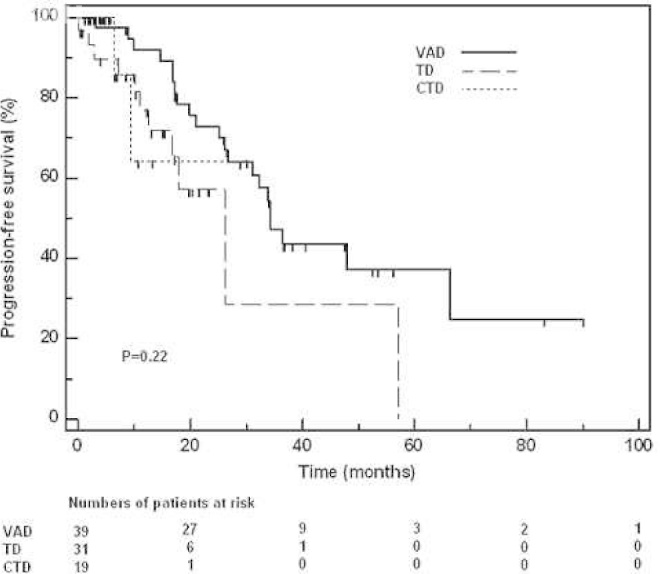
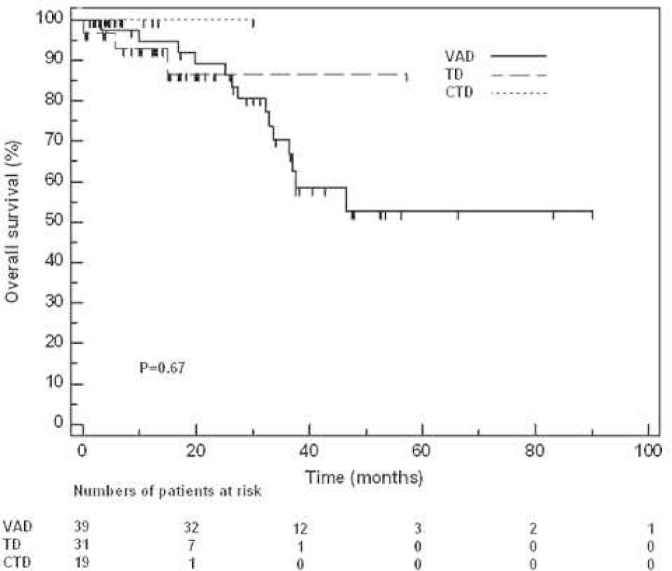
This study included 89 patients; 44 were female, with a mean age of 55 years (there was a significant trend for increasing age over the years of the study).The median number of induction therapy cycles was four, again with a trend of increase over the years.At least a very good partial response to induction therapy was achieved more often in the cyclophosphamide, thalidomide, and dexamethasone group (61.1%) and in the thalidomide and dexamethasone group (59.2%) than in the vincristine, doxorubicin, and dexamethasone group (16.2%). The overall median progression-free survival was 34 months, with no statistically significant difference between the three groups. The overall median survival was not reached, and there was no significant difference between the three groups; the estimated five-year overall survival was 55%.
Although the quality of responses appeared to be better with thalidomidecontaining regimens, these improvements did not translate into improved long-term outcomes. Given its track record, cyclophosphamide, thalidomide, and dexamethasone is currently considered the preferred regimen for first-line induction therapy in the Brazilian public health system.
诱导治疗后进行大剂量化疗和自体移植是适合的多发性骨髓瘤患者的标准治疗方法。
本研究的目的是评估与长春新碱、阿霉素和地塞米松相比,含沙利度胺方案的诱导治疗是否能带来更好的结果,以及环磷酰胺、沙利度胺和地塞米松是否比沙利度胺和地塞米松有更好的结果。
回顾了2004年8月至2012年1月在本机构接受自体移植的152例患者的记录,选择那些对最多8个周期诱导治疗至少有部分反应且有足够随访信息进行分析的患者。
本研究纳入89例患者;44例为女性,平均年龄55岁(在研究的几年中年龄有显著增加趋势)。诱导治疗周期的中位数为4个,同样在这些年中有增加趋势。环磷酰胺、沙利度胺和地塞米松组(61.1%)和沙利度胺和地塞米松组(59.2%)中至少达到非常好的部分反应的比例高于长春新碱、阿霉素和地塞米松组(16.2%)。总体无进展生存期的中位数为34个月,三组之间无统计学显著差异。总体生存期的中位数未达到,三组之间无显著差异;估计的五年总生存率为55%。
尽管含沙利度胺方案的反应质量似乎更好,但这些改善并未转化为更好的长期结果。鉴于其记录,环磷酰胺、沙利度胺和地塞米松目前被认为是巴西公共卫生系统一线诱导治疗的首选方案。