Cunniff Brian, Snider Gregg W, Fredette Nicholas, Stumpff Jason, Hondal Robert J, Heintz Nicholas H
Department of Pathology, University of Vermont College of Medicine, 149 Beaumont Avenue, Burlington, VT 05405, USA ; Vermont Cancer Center, University of Vermont College of Medicine, Burlington, VT 05405, USA.
Department of Biochemistry, University of Vermont College of Medicine, Burlington, VT 05405, USA.
Redox Biol. 2014 Feb 19;2:475-84. doi: 10.1016/j.redox.2014.01.021. eCollection 2014.
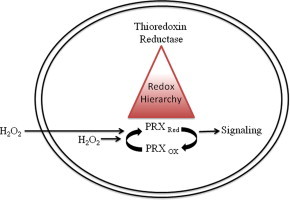
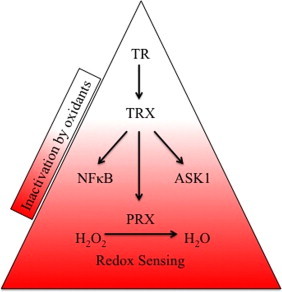
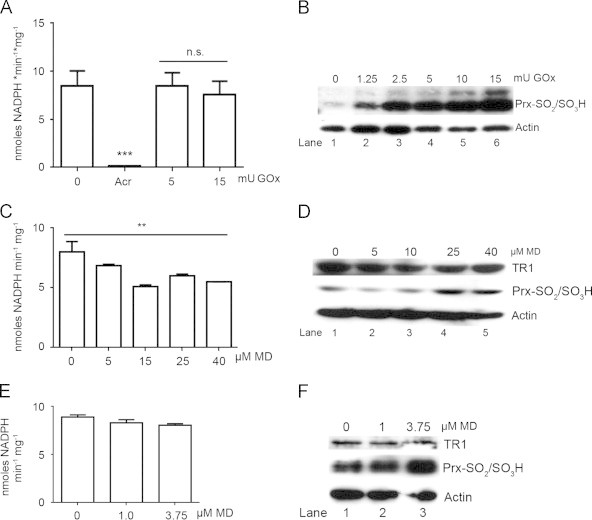
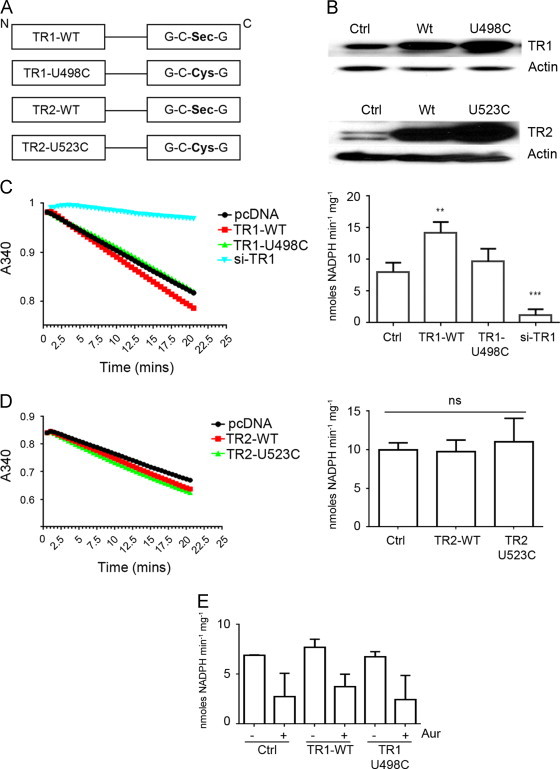
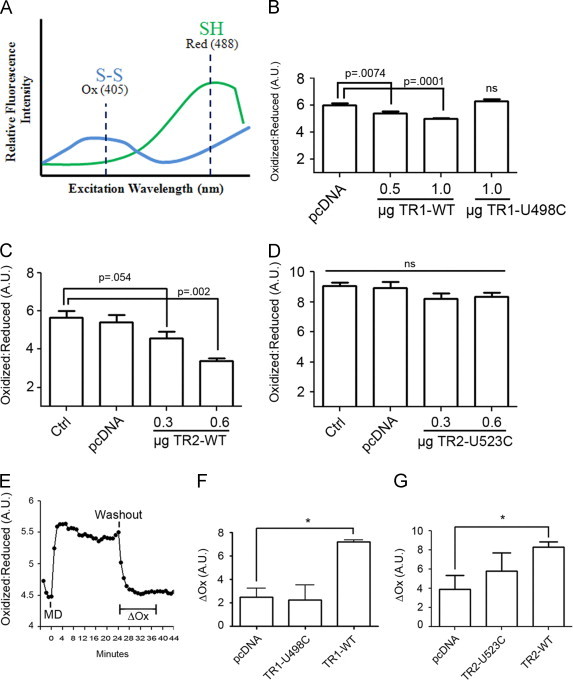
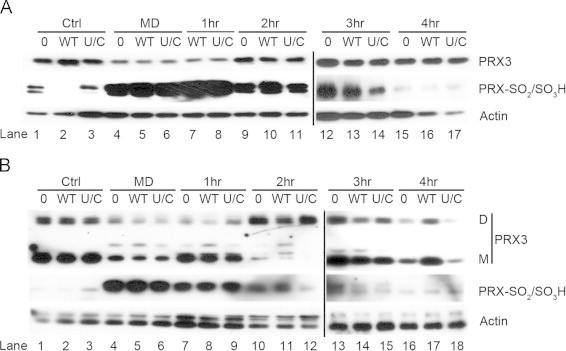
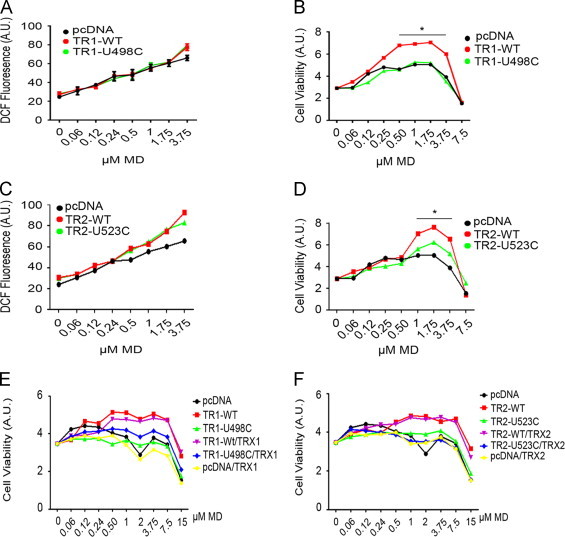
Thioredoxin reductase (TR) catalyzes the reduction of thioredoxin (TRX), which in turn reduces mammalian typical 2-Cys peroxiredoxins (PRXs 1-4), thiol peroxidases implicated in redox homeostasis and cell signaling. Typical 2-Cys PRXs are inactivated by hyperoxidation of the peroxidatic cysteine to cysteine-sulfinic acid, and regenerated in a two-step process involving retro-reduction by sulfiredoxin (SRX) and reduction by TRX. Here transient exposure to menadione and glucose oxidase was used to examine the dynamics of oxidative inactivation and reactivation of PRXs in mouse C10 cells expressing various isoforms of TR, including wild type cytoplasmic TR1 (Sec-TR1) and mitochondrial TR2 (Sec-TR2) that encode selenocysteine, as well as mutants of TR1 and TR2 in which the selenocysteine codon was changed to encode cysteine (Cys-TR1 or Cys-TR2). In C10 cells endogenous TR activity was insensitive to levels of hydrogen peroxide that hyperoxidize PRXs. Expression of Sec-TR1 increased TR activity, reduced the basal cytoplasmic redox state, and increased the rate of reduction of a redox-responsive cytoplasmic GFP probe (roGFP), but did not influence either the rate of inactivation or the rate of retro-reduction of PRXs. In comparison to roGFP, which was reduced within minutes once oxidants were removed reduction of 2-Cys PRXs occurred over many hours. Expression of wild type Sec-TR1 or Sec-TR2, but not Cys-TR1 or TR2, increased the rate of reduction of PRXs and improved cell survival after menadione exposure. These results indicate that expression levels of TR do not reduce the severity of initial oxidative insults, but rather govern the rate of reduction of cellular factors required for cell viability. Because Sec-TR is completely insensitive to cytotoxic levels of hydrogen peroxide, we suggest TR functions at the top of a redox pyramid that governs the oxidation state of peroxiredoxins and other protein factors, thereby dictating a hierarchy of phenotypic responses to oxidative insults.
硫氧还蛋白还原酶(TR)催化硫氧还蛋白(TRX)的还原,而硫氧还蛋白又能还原哺乳动物典型的2-半胱氨酸过氧化物酶(PRXs 1-4),这些硫醇过氧化物酶与氧化还原稳态和细胞信号传导有关。典型的2-半胱氨酸PRXs会因过氧化半胱氨酸过度氧化为半胱氨酸亚磺酸而失活,并通过一个两步过程再生,该过程包括硫氧还蛋白还原酶(SRX)的逆向还原和TRX的还原。在这里,短暂暴露于甲萘醌和葡萄糖氧化酶被用于检测在表达各种TR异构体的小鼠C10细胞中PRXs氧化失活和再激活的动力学,这些异构体包括编码硒代半胱氨酸的野生型细胞质TR1(Sec-TR1)和线粒体TR2(Sec-TR2),以及其中硒代半胱氨酸密码子被改变以编码半胱氨酸的TR1和TR2突变体(Cys-TR1或Cys-TR2)。在C10细胞中,内源性TR活性对使PRXs过度氧化的过氧化氢水平不敏感。Sec-TR1的表达增加了TR活性,降低了基础细胞质氧化还原状态,并提高了氧化还原反应性细胞质绿色荧光蛋白探针(roGFP)的还原速率,但不影响PRXs的失活速率或逆向还原速率。与一旦去除氧化剂在几分钟内就被还原的roGFP相比,2-半胱氨酸PRXs的还原发生在数小时内。野生型Sec-TR1或Sec-TR2的表达,但不是Cys-TR1或TR2的表达,增加了PRXs的还原速率并提高了甲萘醌暴露后细胞的存活率。这些结果表明,TR的表达水平不会降低初始氧化损伤的严重程度,而是控制细胞活力所需细胞因子的还原速率。由于Sec-TR对细胞毒性水平的过氧化氢完全不敏感,我们认为TR在一个氧化还原金字塔的顶端发挥作用,该金字塔控制过氧化物酶和其他蛋白质因子的氧化状态,从而决定对氧化损伤的表型反应层次。