Yoshida Kohta, Makino Takashi, Yamaguchi Katsushi, Shigenobu Shuji, Hasebe Mitsuyasu, Kawata Masakado, Kume Manabu, Mori Seiichi, Peichel Catherine L, Toyoda Atsushi, Fujiyama Asao, Kitano Jun
Ecological Genetics Laboratory, National Institute of Genetics, Shizuoka, Japan.
Division of Ecology and Evolutionary Biology, Graduate School of Life Sciences, Tohoku University, Miyagi, Japan.
PLoS Genet. 2014 Mar 13;10(3):e1004223. doi: 10.1371/journal.pgen.1004223. eCollection 2014 Mar.
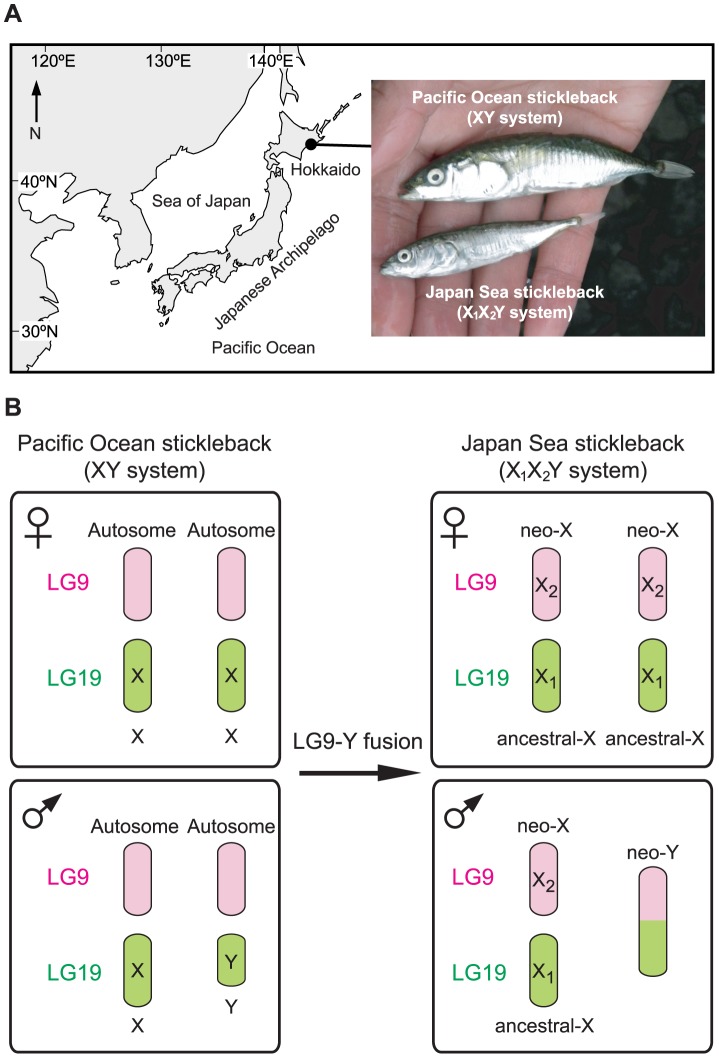
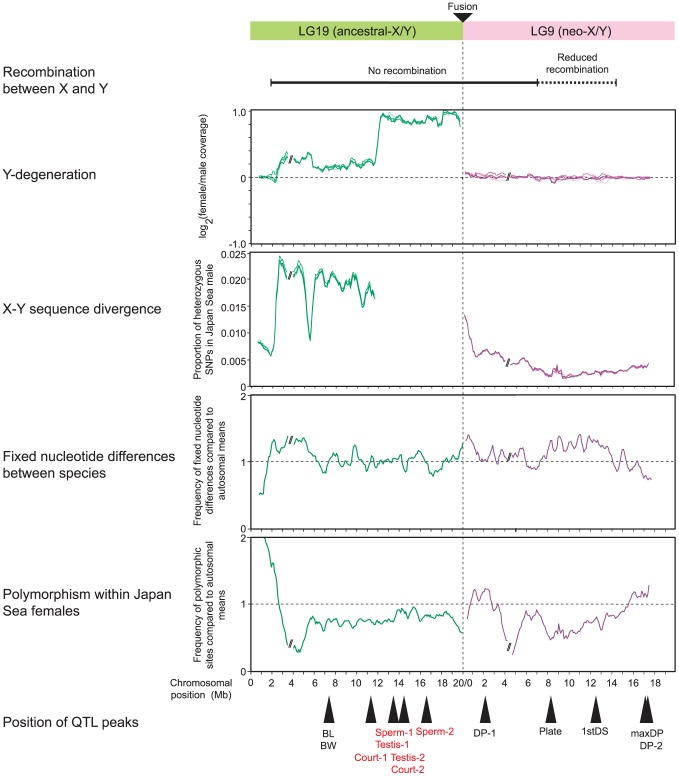
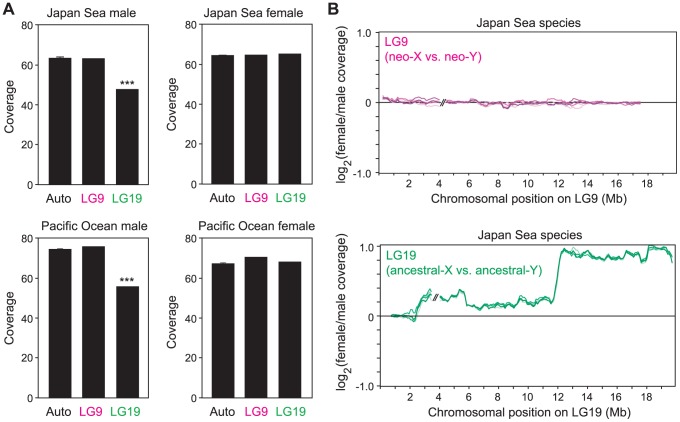
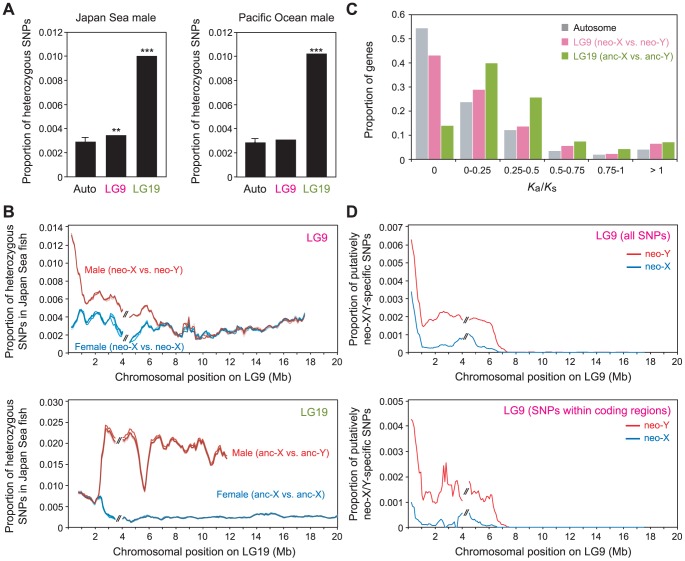
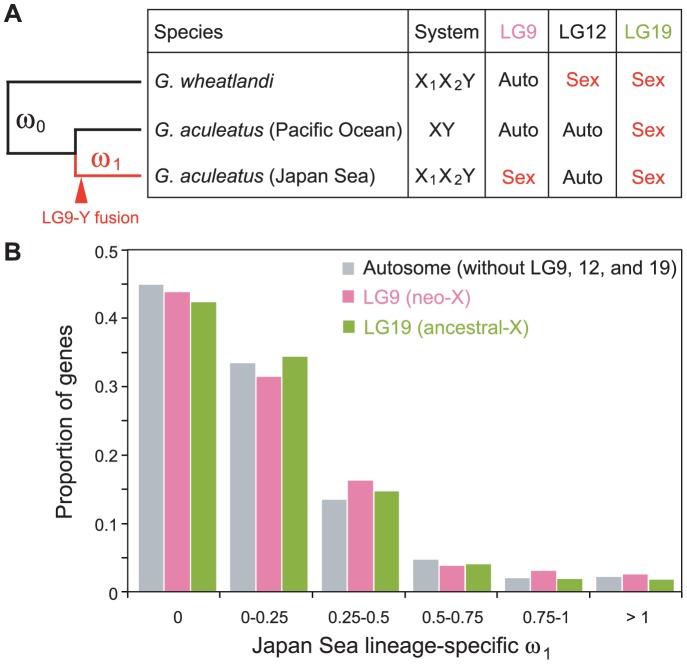
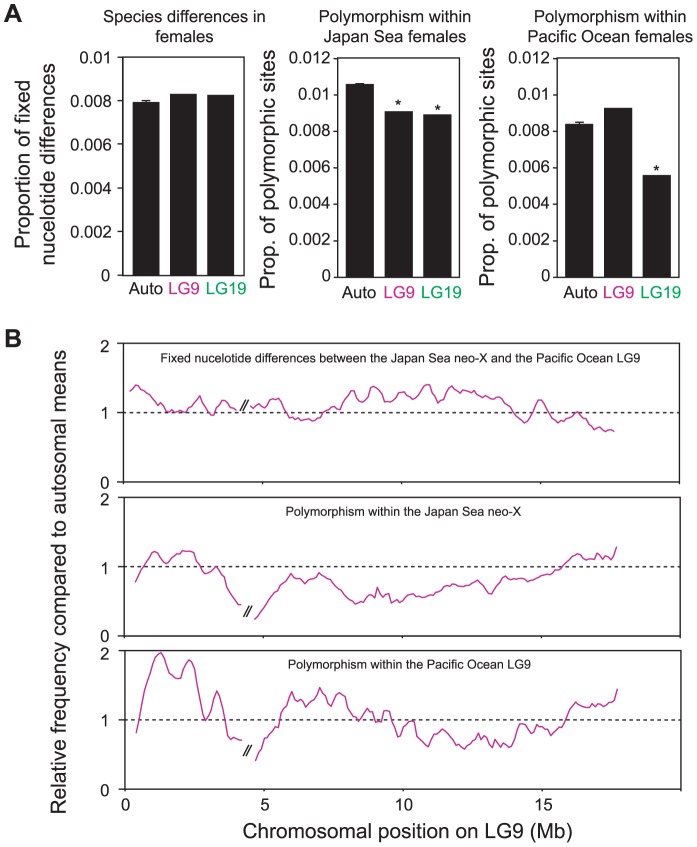
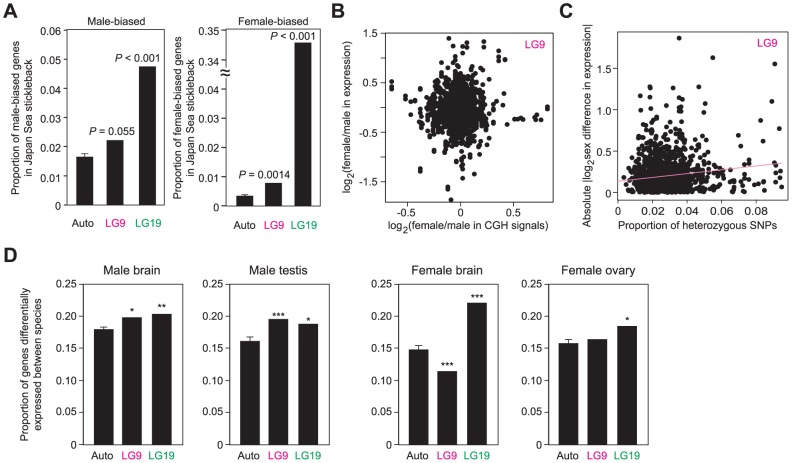
Sex chromosomes turn over rapidly in some taxonomic groups, where closely related species have different sex chromosomes. Although there are many examples of sex chromosome turnover, we know little about the functional roles of sex chromosome turnover in phenotypic diversification and genomic evolution. The sympatric pair of Japanese threespine stickleback (Gasterosteus aculeatus) provides an excellent system to address these questions: the Japan Sea species has a neo-sex chromosome system resulting from a fusion between an ancestral Y chromosome and an autosome, while the sympatric Pacific Ocean species has a simple XY sex chromosome system. Furthermore, previous quantitative trait locus (QTL) mapping demonstrated that the Japan Sea neo-X chromosome contributes to phenotypic divergence and reproductive isolation between these sympatric species. To investigate the genomic basis for the accumulation of genes important for speciation on the neo-X chromosome, we conducted whole genome sequencing of males and females of both the Japan Sea and the Pacific Ocean species. No substantial degeneration has yet occurred on the neo-Y chromosome, but the nucleotide sequence of the neo-X and the neo-Y has started to diverge, particularly at regions near the fusion. The neo-sex chromosomes also harbor an excess of genes with sex-biased expression. Furthermore, genes on the neo-X chromosome showed higher non-synonymous substitution rates than autosomal genes in the Japan Sea lineage. Genomic regions of higher sequence divergence between species, genes with divergent expression between species, and QTL for inter-species phenotypic differences were found not only at the regions near the fusion site, but also at other regions along the neo-X chromosome. Neo-sex chromosomes can therefore accumulate substitutions causing species differences even in the absence of substantial neo-Y degeneration.
在一些分类群中,性染色体更替迅速,亲缘关系相近的物种具有不同的性染色体。尽管有许多性染色体更替的例子,但我们对性染色体更替在表型多样化和基因组进化中的功能作用知之甚少。日本三刺鱼(Gasterosteus aculeatus)的同域种群提供了一个绝佳的系统来解决这些问题:日本海种群拥有一个由祖先Y染色体与一条常染色体融合形成的新性染色体系统,而同域的太平洋种群则拥有简单的XY性染色体系统。此外,先前的数量性状基因座(QTL)定位表明,日本海新X染色体促成了这些同域物种之间的表型分化和生殖隔离。为了研究新X染色体上对物种形成重要的基因积累的基因组基础,我们对日本海和太平洋种群的雄性和雌性个体进行了全基因组测序。新Y染色体尚未发生实质性退化,但新X和新Y的核苷酸序列已开始分化,尤其是在融合区域附近。新性染色体还含有过量的具有性别偏向表达的基因。此外,在日本海谱系中,新X染色体上的基因显示出比常染色体基因更高的非同义替换率。物种间序列差异较大的基因组区域、物种间表达有差异的基因以及物种间表型差异的QTL不仅在融合位点附近的区域被发现,在新X染色体的其他区域也有发现。因此,即使在新Y染色体没有实质性退化的情况下,新性染色体也能积累导致物种差异的替换。