Richards Vincent P, Palmer Sara R, Pavinski Bitar Paulina D, Qin Xiang, Weinstock George M, Highlander Sarah K, Town Christopher D, Burne Robert A, Stanhope Michael J
Department of Population Medicine and Diagnostic Sciences, College of Veterinary Medicine, Cornell University.
Genome Biol Evol. 2014 Apr;6(4):741-53. doi: 10.1093/gbe/evu048.
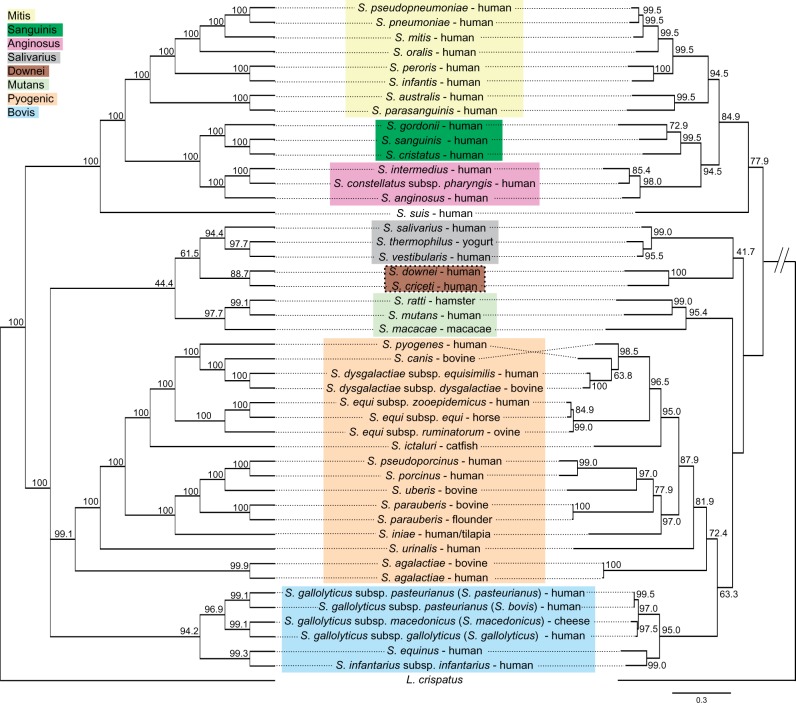
The genus Streptococcus comprises important pathogens that have a severe impact on human health and are responsible for substantial economic losses to agriculture. Here, we utilize 46 Streptococcus genome sequences (44 species), including eight species sequenced here, to provide the first genomic level insight into the evolutionary history and genetic basis underlying the functional diversity of all major groups of this genus. Gene gain/loss analysis revealed a dynamic pattern of genome evolution characterized by an initial period of gene gain followed by a period of loss, as the major groups within the genus diversified. This was followed by a period of genome expansion associated with the origins of the present extant species. The pattern is concordant with an emerging view that genomes evolve through a dynamic process of expansion and streamlining. A large proportion of the pan-genome has experienced lateral gene transfer (LGT) with causative factors, such as relatedness and shared environment, operating over different evolutionary scales. Multiple gene ontology terms were significantly enriched for each group, and mapping terms onto the phylogeny showed that those corresponding to genes born on branches leading to the major groups represented approximately one-fifth of those enriched. Furthermore, despite the extensive LGT, several biochemical characteristics have been retained since group formation, suggesting genomic cohesiveness through time, and that these characteristics may be fundamental to each group. For example, proteolysis: mitis group; urea metabolism: salivarius group; carbohydrate metabolism: pyogenic group; and transcription regulation: bovis group.
链球菌属包含对人类健康有严重影响且给农业造成重大经济损失的重要病原体。在此,我们利用46个链球菌基因组序列(44个物种),包括本文测序的8个物种,来首次从基因组层面深入了解该属所有主要类群的进化历史及功能多样性背后的遗传基础。基因获得/丢失分析揭示了基因组进化的动态模式,其特征是在该属内主要类群分化时,先是一个基因获得期,随后是一个丢失期。接着是与现存物种起源相关的基因组扩张期。这种模式与一种新出现的观点一致,即基因组通过扩张和精简的动态过程进化。泛基因组的很大一部分经历了横向基因转移(LGT),其致病因素,如亲缘关系和共享环境,在不同进化尺度上起作用。每个类群的多个基因本体术语显著富集,将这些术语映射到系统发育树上表明,对应于在导致主要类群的分支上产生的基因的那些术语约占富集术语的五分之一。此外,尽管存在广泛的LGT,但自类群形成以来,一些生化特征得以保留,这表明随着时间推移基因组具有凝聚性,且这些特征可能对每个类群至关重要。例如,蛋白水解:轻链菌组;尿素代谢:唾液链球菌组;碳水化合物代谢:化脓性链球菌组;以及转录调控:牛链球菌组。