Department of Theoretical Biology and Bioinformatics, Utrecht University, Utrecht, The Netherlands.
Genome Biol Evol. 2012;4(3):212-29. doi: 10.1093/gbe/evr141. Epub 2012 Jan 10.
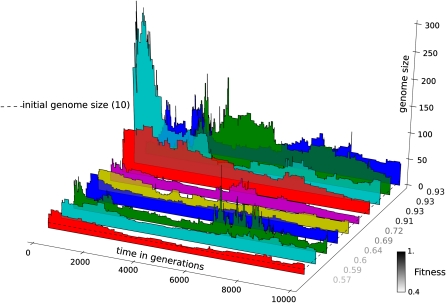
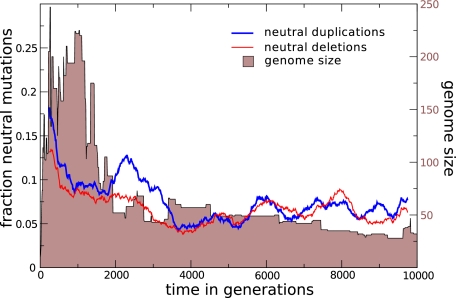
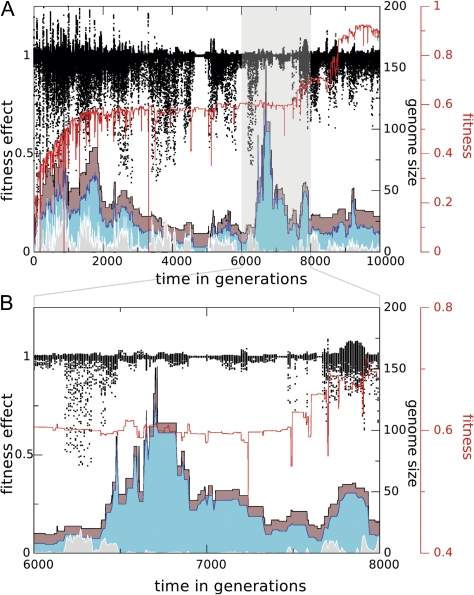
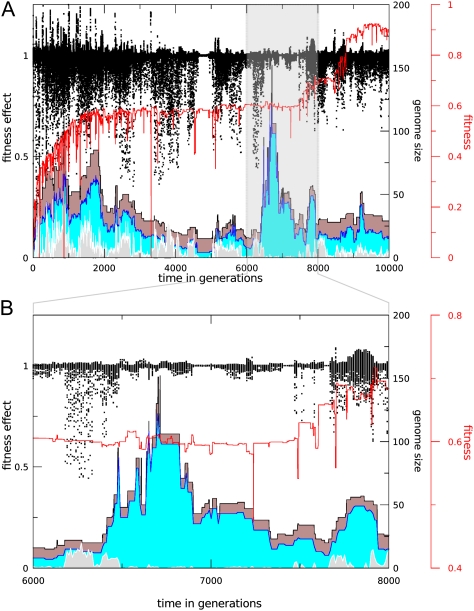
The picture that emerges from phylogenetic gene content reconstructions is that genomes evolve in a dynamic pattern of rapid expansion and gradual streamlining. Ancestral organisms have been estimated to possess remarkably rich gene complements, although gene loss is a driving force in subsequent lineage adaptation and diversification. Here, we study genome dynamics in a model of virtual cells evolving to maintain homeostasis. We observe a pattern of an initial rapid expansion of the genome and a prolonged phase of mutational load reduction. Generally, load reduction is achieved by the deletion of redundant genes, generating a streamlining pattern. Load reduction can also occur as a result of the generation of highly neutral genomic regions. These regions can expand and contract in a neutral fashion. Our study suggests that genome expansion and streamlining are generic patterns of evolving systems. We propose that the complex genotype to phenotype mapping in virtual cells as well as in their biological counterparts drives genome size dynamics, due to an emerging interplay between adaptation, neutrality, and evolvability.
从系统发生基因内容重建中可以看出,基因组的进化呈现出快速扩张和逐渐简化的动态模式。尽管基因丢失是后续谱系适应和多样化的驱动力,但据估计,祖先生物拥有非常丰富的基因组成。在这里,我们研究了在维持体内平衡的虚拟细胞进化模型中的基因组动力学。我们观察到基因组最初快速扩张和长时间突变负荷减少的模式。通常,通过删除冗余基因来减少负荷,从而产生简化模式。负荷减少也可能是由于产生高度中性的基因组区域。这些区域可以以中性的方式扩展和收缩。我们的研究表明,基因组扩张和简化是进化系统的通用模式。我们提出,虚拟细胞及其生物对应物中的复杂基因型到表型映射由于适应、中性和可进化性之间的新相互作用,导致了基因组大小的动态变化。