Robino Antonietta, Mezzavilla Massimo, Pirastu Nicola, Dognini Maddalena, Tepper Beverly J, Gasparini Paolo
Institute for Maternal and Child Health - IRCCS "Burlo Garofolo", Trieste, Italy; University of Trieste, Trieste, Italy.
Condotta Slow Food, Trieste, Italy.
PLoS One. 2014 Mar 13;9(3):e91716. doi: 10.1371/journal.pone.0091716. eCollection 2014.
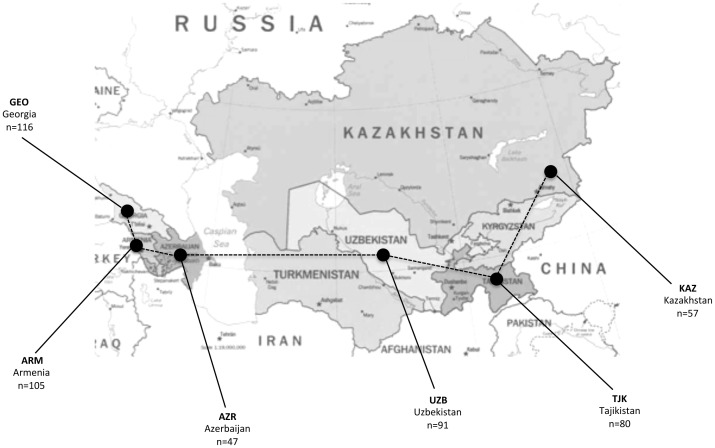
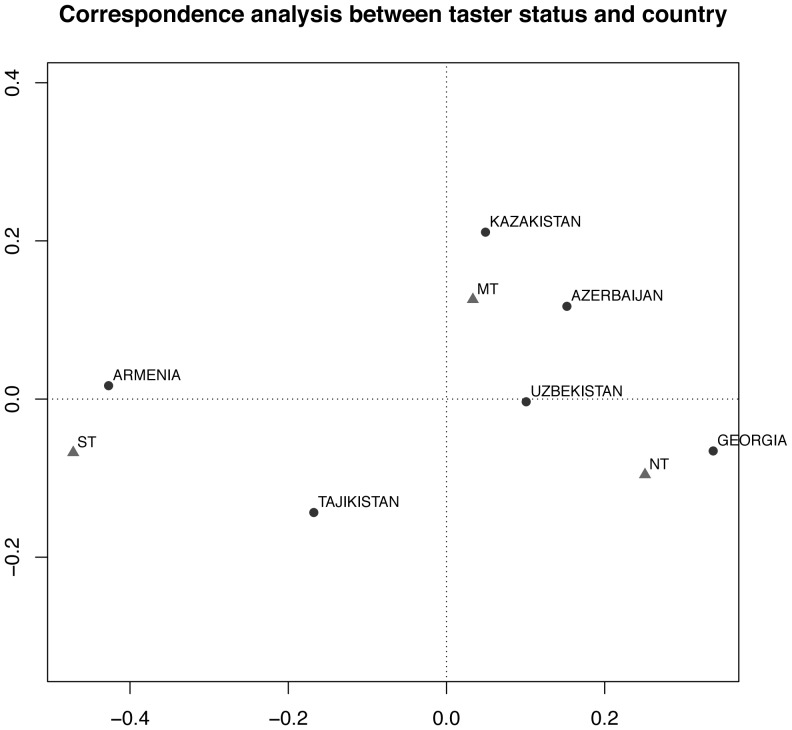
Taste is one of the main factors determining food choices. Differences in PROP bitter taste perception have been implicated in individual differences in food preferences and selection. The present study examined associations between, PROP phenotypes, self-reported food liking and TAS2R38 polymorphisms, the major gene implicated in PROP bitterness, in six different populations of the Caucasus and Central Asia, located along the ancient Silk Road. Differences in the distribution of PROP phenotypes across populations were detected, with a higher frequency of super tasters in Tajikistan (31.3%) and Armenia (39.0%) and a higher frequency of non tasters in Georgia (50.9%). While no relationships were observed between PROP phenotypes and food liking using standard statistical tests, we used an approach based on comparison of distance matrices derived from these data. The first matrix compared the food liking ratings of each population to all others pairwise using the Kruskal-Wallis test (at p<0.00063), and the second one compared the distribution of PROP phenotypes across all populations in a similar manner calculating the chi-square statistic as a distance measure. A strong correlation between the two matrices was found (Mantel test: r = 0.67, p-value = 0.03), suggesting that the pattern of food liking across populations was closely related to the distribution of PROP phenotypes. This same relationship was not observed when TAS2R38 genotypes were substituted for PROP phenotypes in this analysis. Our data suggest that a population-based approach utilizing distance matrices is a useful technique for detecting PROP-related differences in food liking and can be applied to other taste phenotypes.
味觉是决定食物选择的主要因素之一。对6 - 丙基硫氧嘧啶(PROP)苦味感知的差异与食物偏好和选择的个体差异有关。本研究调查了位于古丝绸之路沿线的高加索和中亚六个不同人群中,PROP表型、自我报告的食物喜好与TAS2R38多态性(与PROP苦味相关的主要基因)之间的关联。检测到不同人群中PROP表型分布存在差异,塔吉克斯坦(31.3%)和亚美尼亚(39.0%)的超级味觉者频率较高,而格鲁吉亚(50.9%)的非味觉者频率较高。虽然使用标准统计测试未观察到PROP表型与食物喜好之间的关系,但我们采用了一种基于比较这些数据得出的距离矩阵的方法。第一个矩阵使用Kruskal - Wallis检验(p<0.00063)将每个人群的食物喜好评分与所有其他人群进行两两比较,第二个矩阵以类似方式比较所有人群中PROP表型的分布,计算卡方统计量作为距离度量。发现两个矩阵之间存在强相关性(Mantel检验:r = 0.67,p值 = 0.03),表明不同人群的食物喜好模式与PROP表型分布密切相关。在该分析中,当用TAS2R38基因型替代PROP表型时,未观察到这种相同的关系。我们的数据表明,利用距离矩阵的基于人群的方法是检测与PROP相关的食物喜好差异的有用技术,并且可应用于其他味觉表型。