• 文献检索
  • 文档翻译
  • 深度研究
  • 学术资讯
  • Suppr Zotero 插件Zotero 插件
  • 邀请有礼
  • 套餐&价格
  • 历史记录
应用&插件
Suppr Zotero 插件Zotero 插件浏览器插件Mac 客户端Windows 客户端微信小程序
定价
高级版会员购买积分包购买API积分包
服务
文献检索文档翻译深度研究API 文档MCP 服务
关于我们
关于 Suppr公司介绍联系我们用户协议隐私条款
关注我们

Suppr 超能文献

核心技术专利:CN118964589B侵权必究
粤ICP备2023148730 号-1Suppr @ 2026

文献检索

告别复杂PubMed语法,用中文像聊天一样搜索,搜遍4000万医学文献。AI智能推荐,让科研检索更轻松。

立即免费搜索

文件翻译

保留排版,准确专业,支持PDF/Word/PPT等文件格式,支持 12+语言互译。

免费翻译文档

深度研究

AI帮你快速写综述,25分钟生成高质量综述,智能提取关键信息,辅助科研写作。

立即免费体验

COVID-19 作为全球选择性事件与苦味受体多态性:一项生态关联研究。

COVID-19 as a worldwide selective event and bitter taste receptor polymorphisms: An ecological correlational study.

机构信息

Student Research Committee, Jahrom University of Medical Sciences, Jahrom, Iran.

Department of Pediatrics, Jahrom University of Medical Science, Jahrom, Iran.

出版信息

Int J Biol Macromol. 2021 Apr 30;177:204-210. doi: 10.1016/j.ijbiomac.2021.02.070. Epub 2021 Feb 11.

DOI:10.1016/j.ijbiomac.2021.02.070
PMID:33582215
原文链接:https://pmc.ncbi.nlm.nih.gov/articles/PMC8043766/
Abstract

BACKGROUND

Given the observed olfactory and gustatory dysfunctions in patients with COVID-19 and recent findings on taste receptors possible important activities in the immune system, we elected to estimate the correlation between COVID-19 mortality and polymorphism of a particular type of bitter taste receptor gene called TAS2R38, in a worldwide epidemiological point of view.

METHODS

Pooled rate of each of the rs713598, rs1726866, rs10246939, and PAV/AVI polymorphisms of the TAS2R38 gene was obtained in different countries using a systematic review methodology and its relationship with the mortality of COVID-19. Data were analyzed by the comprehensive meta-analysis software and SPSS.

RESULTS

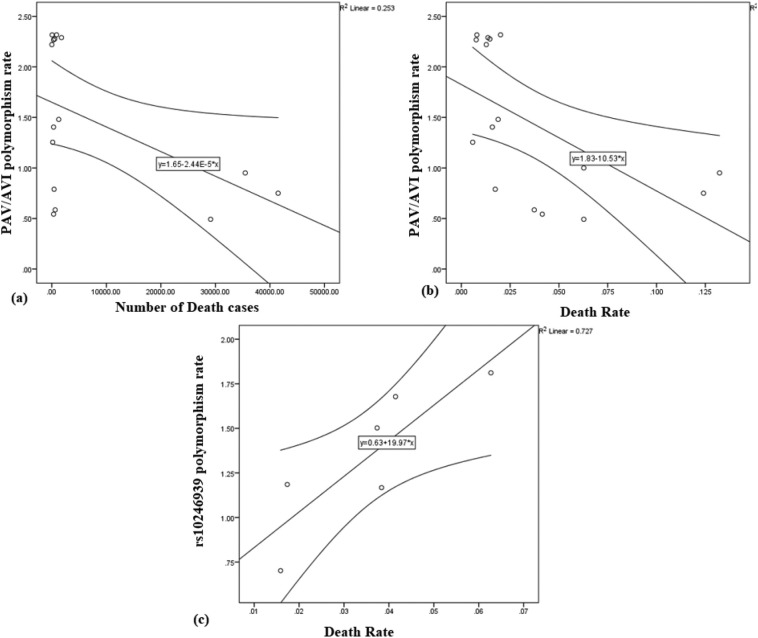
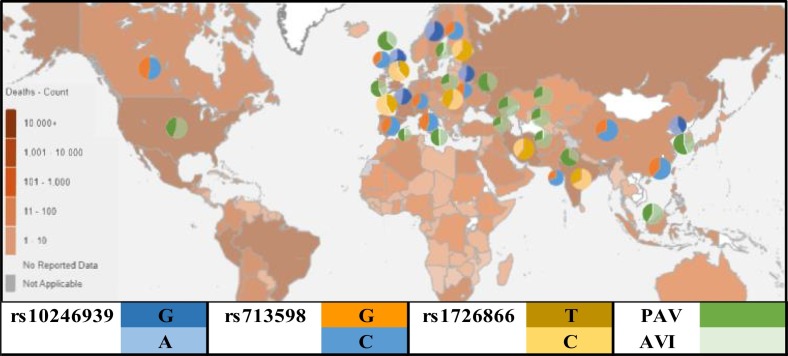
There was only a significant reverse Pearson correlation in death counts and PAV/AVI ratio, p = 0.047, r = -0.503. Also, a significant reverse correlation of PAV/AVI ratio and death rate was seen, r = -0.572 p = 0.021. rs10246939 ratio had a significant positive correlation with death rate, r = 0.851 p = 0.031. Further analysis was not significant. Our results showed that the higher presence of PAV allele than AVI, and a higher rate of G allele than A in rs10246939 polymorphism in a country, could be associated with lower COVID-19 mortality. While assessing all three polymorphisms showed a huge diversity worldwide.

CONCLUSION

Due to extraoral activities of bitter taste receptor genes, especially in mucosal immunity, this gene seems to be a good candidate for future studies on COVID-19 pathophysiology. Also, the high worldwide diversity of TAS2R38 genes polymorphism and its possible assassination with mortality raises concerns about the efficiency of vaccine projects in different ethnicities.

摘要

背景

鉴于 COVID-19 患者嗅觉和味觉功能障碍的观察结果,以及最近关于味觉受体的可能在免疫系统中具有重要活性的发现,我们选择从全球流行病学角度来估计 COVID-19 死亡率与特定类型苦味受体基因 TAS2R38 多态性之间的相关性。

方法

采用系统评价方法,在不同国家获得 TAS2R38 基因的 rs713598、rs1726866、rs10246939 和 PAV/AVI 多态性的每个等位基因的汇总率,并分析其与 COVID-19 死亡率的关系。使用综合荟萃分析软件和 SPSS 进行数据分析。

结果

仅在死亡人数和 PAV/AVI 比值上存在显著的负皮尔逊相关性,p=0.047,r=-0.503。此外,还观察到 PAV/AVI 比值与死亡率之间存在显著的负相关,r=-0.572,p=0.021。rs10246939 比值与死亡率呈显著正相关,r=0.851,p=0.031。进一步分析没有显著结果。我们的结果表明,在一个国家中,PAV 等位基因的存在率高于 AVI,并且 rs10246939 多态性中 G 等位基因的频率高于 A,这可能与 COVID-19 死亡率降低有关。而评估所有三种多态性显示出全球范围内的巨大多样性。

结论

由于苦味受体基因的口腔外活动,特别是在黏膜免疫中,该基因似乎是 COVID-19 病理生理学未来研究的良好候选基因。此外,TAS2R38 基因多态性在全球范围内的高度多样性及其与死亡率的可能关联引起了对不同种族疫苗项目效率的关注。
https://cdn.ncbi.nlm.nih.gov/pmc/blobs/599a/8043766/584cd849188f/gr2_lrg.jpg
https://cdn.ncbi.nlm.nih.gov/pmc/blobs/599a/8043766/27221e622656/gr1_lrg.jpg
https://cdn.ncbi.nlm.nih.gov/pmc/blobs/599a/8043766/584cd849188f/gr2_lrg.jpg
https://cdn.ncbi.nlm.nih.gov/pmc/blobs/599a/8043766/27221e622656/gr1_lrg.jpg
https://cdn.ncbi.nlm.nih.gov/pmc/blobs/599a/8043766/584cd849188f/gr2_lrg.jpg

相似文献

1
COVID-19 as a worldwide selective event and bitter taste receptor polymorphisms: An ecological correlational study.COVID-19 作为全球选择性事件与苦味受体多态性:一项生态关联研究。
Int J Biol Macromol. 2021 Apr 30;177:204-210. doi: 10.1016/j.ijbiomac.2021.02.070. Epub 2021 Feb 11.
2
Primary Ciliary Dyskinesia: The Impact of Taste Receptor (TAS2R38) Gene Polymorphisms on Disease Outcome and Severity.原发性纤毛运动障碍:味觉受体(TAS2R38)基因多态性对疾病结局和严重程度的影响。
Int Arch Allergy Immunol. 2020;181(9):727-731. doi: 10.1159/000508938. Epub 2020 Jul 13.
3
Distribution of TAS2R38 bitter taste receptor phenotype and haplotypes among COVID-19 patients.TAS2R38 苦味受体表型和单倍型在 COVID-19 患者中的分布。
Sci Rep. 2022 May 5;12(1):7381. doi: 10.1038/s41598-022-10747-2.
4
Analysis of Genetic Polymorphism of Bitter Taste Receptor TAS2R38 and TAS2R46, and Its Relationship with Eating and Drinking Habits in Japanese ToMMo Subjects.日本ToMMo人群中苦味受体TAS2R38和TAS2R46的基因多态性分析及其与饮食习惯的关系。
J Nutr Sci Vitaminol (Tokyo). 2023;69(5):347-356. doi: 10.3177/jnsv.69.347.
5
TAS2R38 and CA6 genetic polymorphisms, frequency of bitter food intake, and blood biomarkers among elderly woman.老年女性中TAS2R38和CA6基因多态性、苦味食物摄入频率及血液生物标志物
Appetite. 2017 Sep 1;116:57-64. doi: 10.1016/j.appet.2017.04.029. Epub 2017 Apr 25.
6
The Associations Between Bitter and Fat Taste Sensitivity, and Dietary Fat Intake: Are They Impacted by Genetic Predisposition?苦味和脂肪味敏感性与脂肪摄入量之间的关联:它们是否受到遗传易感性的影响?
Chem Senses. 2021 Jan 1;46. doi: 10.1093/chemse/bjab029.
7
Association between Genetic Variation in the Bitter Taste Receptor and Propylthiouracil Bitter Taste Thresholds among Adults Living in Japan Using the Modified 2AFC Procedure with the Quest Method.日本成年人中苦味受体基因变异与丙硫氧嘧啶苦味阈值的关联:改良 2AFC 程序结合 Quest 方法的研究
Nutrients. 2023 May 22;15(10):2415. doi: 10.3390/nu15102415.
8
Genotyping Analysis of Bitter-Taste Receptor Genes TAS2R38 and TAS2R46 in Japanese Patients with Gastrointestinal Cancers.日本胃肠道癌症患者苦味受体基因TAS2R38和TAS2R46的基因分型分析
J Nutr Sci Vitaminol (Tokyo). 2017;63(2):148-154. doi: 10.3177/jnsv.63.148.
9
Genetic Vulnerability to Menthol Cigarette Preference in Women.女性对薄荷醇香烟偏好的遗传易感性。
Nicotine Tob Res. 2015 Dec;17(12):1416-20. doi: 10.1093/ntr/ntv042. Epub 2015 Apr 1.
10
Variations in the TAS2R38 gene among college students in Hubei.TAS2R38 基因在湖北大学生中的变异情况。
Hereditas. 2022 Dec 19;159(1):46. doi: 10.1186/s41065-022-00260-x.

引用本文的文献

1
TAS2R38 gene methylation is associated with syndrome Coronavirus 2 (SARS-CoV-2) infection and clinical symptoms.味觉受体2型成员38(TAS2R38)基因甲基化与严重急性呼吸综合征冠状病毒2(SARS-CoV-2)感染及临床症状相关。
Sci Rep. 2025 Apr 25;15(1):14462. doi: 10.1038/s41598-025-95879-x.
2
TAS2R38 Genotype Does Not Affect SARS-CoV-2 Infection in Primary Ciliary Dyskinesia.TAS2R38 基因型不会影响原发性纤毛运动障碍患者中的 SARS-CoV-2 感染。
Int J Mol Sci. 2024 Aug 8;25(16):8635. doi: 10.3390/ijms25168635.
3
TAS2R38 haplotypes, COVID-19 infection, and symptomatology: a cross-sectional analysis of data from the Canadian Longitudinal Study on Aging.

本文引用的文献

1
Non-neuronal expression of SARS-CoV-2 entry genes in the olfactory system suggests mechanisms underlying COVID-19-associated anosmia.SARS-CoV-2 进入基因在嗅觉系统中的非神经元表达提示了 COVID-19 相关嗅觉丧失的潜在机制。
Sci Adv. 2020 Jul 31;6(31). doi: 10.1126/sciadv.abc5801. Epub 2020 Jul 24.
2
Existence of SARS-CoV-2 Entry Molecules in the Oral Cavity.口腔中存在 SARS-CoV-2 进入分子。
Int J Mol Sci. 2020 Aug 20;21(17):6000. doi: 10.3390/ijms21176000.
3
MSC Therapies for COVID-19: Importance of Patient Coagulopathy, Thromboprophylaxis, Cell Product Quality and Mode of Delivery for Treatment Safety and Efficacy.
TAS2R38 单倍型、COVID-19 感染和症状:来自加拿大老龄化纵向研究的横断面数据分析。
Sci Rep. 2024 Feb 26;14(1):4673. doi: 10.1038/s41598-024-55428-4.
4
The Bittersweet Symphony of COVID-19: Associations between and Genetic Variations and COVID-19 Symptoms.新冠疫情的苦乐交织:[具体基因]基因变异与新冠症状之间的关联
Life (Basel). 2024 Feb 3;14(2):219. doi: 10.3390/life14020219.
5
Human T2R38 Bitter Taste Receptor Expression and COVID-19: From Immunity to Prognosis.人类T2R38苦味受体表达与COVID-19:从免疫到预后
Avicenna J Med Biotechnol. 2023 Apr-Jun;15(2):118-123.
6
Clinical Associations of Bitter Taste Perception and Bitter Taste Receptor Variants and the Potential for Personalized Healthcare.苦味感知与苦味受体变体的临床关联以及个性化医疗的潜力
Pharmgenomics Pers Med. 2023 Feb 12;16:121-132. doi: 10.2147/PGPM.S390201. eCollection 2023.
7
Cellular mechanisms and molecular pathways linking bitter taste receptor signalling to cardiac inflammation, oxidative stress, arrhythmia and contractile dysfunction in heart diseases.将苦味受体信号与心脏疾病中心脏炎症、氧化应激、心律失常和收缩功能障碍相关的细胞机制和分子途径联系起来。
Inflammopharmacology. 2023 Feb;31(1):89-117. doi: 10.1007/s10787-022-01086-9. Epub 2022 Dec 6.
8
HSP90 Modulates T2R Bitter Taste Receptor Nitric Oxide Production and Innate Immune Responses in Human Airway Epithelial Cells and Macrophages.HSP90 调节人类气道上皮细胞和巨噬细胞中 T2R 苦味受体一氧化氮的产生和先天免疫反应。
Cells. 2022 Apr 27;11(9):1478. doi: 10.3390/cells11091478.
9
Distribution of TAS2R38 bitter taste receptor phenotype and haplotypes among COVID-19 patients.TAS2R38 苦味受体表型和单倍型在 COVID-19 患者中的分布。
Sci Rep. 2022 May 5;12(1):7381. doi: 10.1038/s41598-022-10747-2.
MSC 疗法治疗 COVID-19:患者凝血病、血栓预防、细胞产品质量和治疗安全性及疗效的输送方式的重要性。
Front Immunol. 2020 May 19;11:1091. doi: 10.3389/fimmu.2020.01091. eCollection 2020.
4
COVID-19 and anosmia: A review based on up-to-date knowledge.新型冠状病毒肺炎与嗅觉障碍:基于最新知识的综述。
Am J Otolaryngol. 2020 Sep-Oct;41(5):102581. doi: 10.1016/j.amjoto.2020.102581. Epub 2020 Jun 2.
5
Identifying Treatments for Taste and Smell Disorders: Gaps and Opportunities.识别味觉和嗅觉障碍的治疗方法:差距与机遇。
Chem Senses. 2020 Oct 9;45(7):493-502. doi: 10.1093/chemse/bjaa038.
6
Worldwide ACE (I/D) polymorphism may affect COVID-19 recovery rate: an ecological meta-regression.全球 ACE(I/D)多态性可能影响 COVID-19 的恢复率:一项生态元回归分析。
Endocrine. 2020 Jun;68(3):479-484. doi: 10.1007/s12020-020-02381-7. Epub 2020 Jun 15.
7
Olfactory and gustatory dysfunctions in COVID-19. First reports of Latin-American ethnic patients.新型冠状病毒肺炎中的嗅觉和味觉功能障碍。拉丁裔患者的首例报告。
Am J Otolaryngol. 2020 Sep-Oct;41(5):102605. doi: 10.1016/j.amjoto.2020.102605. Epub 2020 Jun 6.
8
Gustatory dysfunctions in COVID-19 patients: possible involvement of taste renin-angiotensin system (RAS).新冠病毒感染患者的味觉功能障碍:味觉肾素-血管紧张素系统(RAS)可能的参与情况。
Eur Arch Otorhinolaryngol. 2020 Aug;277(8):2395. doi: 10.1007/s00405-020-06054-z. Epub 2020 May 20.
9
Expression of the SARS-CoV-2 Entry Proteins, ACE2 and TMPRSS2, in Cells of the Olfactory Epithelium: Identification of Cell Types and Trends with Age.SARS-CoV-2 进入蛋白 ACE2 和 TMPRSS2 在嗅上皮细胞中的表达:细胞类型鉴定及与年龄相关的趋势。
ACS Chem Neurosci. 2020 Jun 3;11(11):1555-1562. doi: 10.1021/acschemneuro.0c00210. Epub 2020 May 19.
10
COVID-19: Epidemiology, Evolution, and Cross-Disciplinary Perspectives.新型冠状病毒肺炎:流行病学、进化与跨学科视角。
Trends Mol Med. 2020 May;26(5):483-495. doi: 10.1016/j.molmed.2020.02.008. Epub 2020 Mar 21.