Tavares Noemia Urruth Leão, Bertoldi Andréa Dâmaso, Thumé Elaine, Facchini Luiz Augusto, França Giovanny Vinícius Araújo de, Mengue Sotero Serrate
Rev Saude Publica. 2013 Dec;47(6):1092-101. doi: 10.1590/s0034-8910.2013047004834.
To assess factors associated with low adherence to pharmacotherapy in older adults.
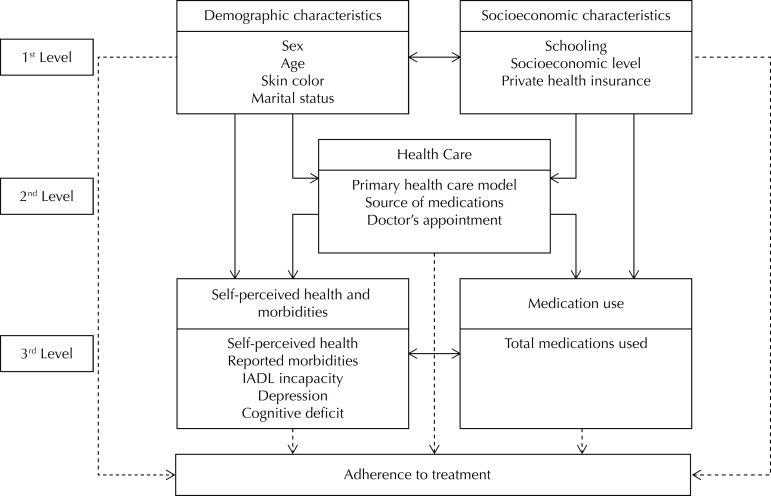
Cross-sectional population-based study, with a representative sample of 1,593 individuals aged 60 or older, living in the urban area of Bagé, RS, Southern Brazil, in 2008. A multiple stage sampling model was used. The data were collected through individual household interviews. The analyses of the association between low adherence regarding pharmacotherapy, measured using the Brief Medication Questionnaire (BMQ), and demographic, socioeconomic, behavioral, health, assistance and prescription factors were carried out applying Poisson regression model to assess crude and adjusted prevalence ratios, their respective 95% confidence intervals and p-value (Wald test).
Around 78.0% of individuals reported have taken at least one medication in the seven days prior to the interview. Of these, approximately one third (28.7%) were considered to have low adherence to the treatment. The factors significantly associated to low adherence to treatment were: age (65 to 74 years old), not having health insurance, having to purchase (totally or partially) their own medicines, having three or more morbidities, having functional disabilities and using three or more medicines.
The increased use of medicines by older adults, because of the high prevalence of non-communicable diseases in this group, and the access to the treatment need to be considered by health care professionals regarding fostering adherence to treatment, which increases therapeutic solutions and quality of life among older people.
评估与老年人药物治疗依从性低相关的因素。
基于人群的横断面研究,于2008年在巴西南部南里奥格兰德州巴热市城区选取了1593名60岁及以上的个体作为代表性样本。采用多阶段抽样模型。通过个人入户访谈收集数据。使用简明用药问卷(BMQ)衡量药物治疗依从性低的情况,并应用泊松回归模型分析其与人口统计学、社会经济、行为、健康、医疗救助及处方因素之间的关联,以评估粗患病率和调整患病率比值、各自的95%置信区间及p值( Wald检验)。
约78.0%的个体报告在访谈前七天内至少服用过一种药物。其中,约三分之一(28.7%)被认为治疗依从性低。与治疗依从性低显著相关的因素有:年龄(65至74岁)、没有医疗保险、必须(全部或部分)自行购买药品、患有三种或更多种疾病、有功能障碍以及使用三种或更多种药物。
由于该群体中非传染性疾病的高患病率,老年人用药量增加,医护人员在促进治疗依从性时需要考虑治疗的可及性,这会增加老年人的治疗方案并提高其生活质量。