Department of Public Health and Nursing, Faculty of Medicine and Health Sciences, Norwegian University of Science and Technology, 8905, N-7491 Trondheim, Norway.
Department of Public Health and Community Programs, Kathmandu University School of Medical Sciences, Dhulikhel 45200, Nepal.
Int J Environ Res Public Health. 2023 Jan 14;20(2):1537. doi: 10.3390/ijerph20021537.
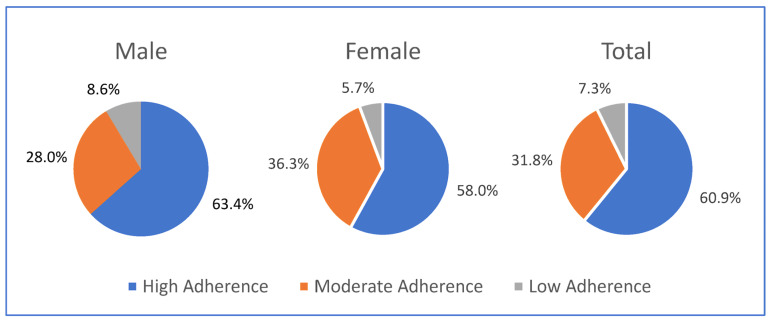
As diabetes increases globally, high mortality increases due to complications of uncontrolled sugar. Medication adherence is important to control blood sugar and prevent its complications. Objective of the study was to identify factors associated with medication adherence among type 2 diabetes patients. A cross-sectional study was conducted among 343 patients visiting Dhulikhel Hospital, Nepal, for their fasting blood sugar test from September to December 2016. Inclusion criteria: patients with type 2 diabetes, under diabetes medication for past three months (minimum), age ≥ 18 years. The outcome of the study was medication adherence measured using the eight-item Morisky medication adherence scale (MMAS-8) (© 2006 Donald E. Morisky). Multivariate logistic regression was used for the analysis. Results showed that 61% of respondents had high medication adherence; adherence was positively associated with formal education [AOR: 2.43 (95% CI: 1.34, 4.39)] and attendance at diabetes counseling [AOR: 1.76 (95% CI: 1.02, 3.04)] after adjusting for age, occupation, medicine intake duration and diabetes medicine types. The study concluded that formal education and attendance at diabetes counseling positively affected patients' adherence to medicine. We encourage healthcare institutions to provide counseling services to all the patients with type 2 diabetes and focus more on those who are less educated.
随着糖尿病在全球范围内的增加,由于血糖失控导致的并发症导致死亡率上升。药物治疗依从性对于控制血糖和预防其并发症非常重要。本研究的目的是确定与 2 型糖尿病患者药物治疗依从性相关的因素。本研究于 2016 年 9 月至 12 月在尼泊尔 Dhulikhel 医院进行了一项横断面研究,对 343 名进行空腹血糖测试的患者进行了研究。纳入标准:年龄≥18 岁、正在服用 2 型糖尿病药物(至少 3 个月)的 2 型糖尿病患者。本研究的结局指标是使用 Morisky 药物治疗依从性量表(MMAS-8)(© 2006 Donald E. Morisky)测量的药物治疗依从性。采用多变量逻辑回归进行分析。结果显示,61%的受访者具有较高的药物治疗依从性;在调整年龄、职业、药物服用时间和药物类型后,与药物治疗依从性呈正相关的因素有正规教育(AOR:2.43,95%CI:1.34,4.39)和参加糖尿病咨询(AOR:1.76,95%CI:1.02,3.04)。本研究得出结论,正规教育和参加糖尿病咨询对提高患者的药物治疗依从性有积极影响。我们鼓励医疗机构向所有 2 型糖尿病患者提供咨询服务,并更加关注教育程度较低的患者。