Department of Psychiatry, University of California San Francisco, San Francisco, California, United States of America.
PLoS One. 2013;8(3):e59645. doi: 10.1371/journal.pone.0059645. Epub 2013 Mar 18.
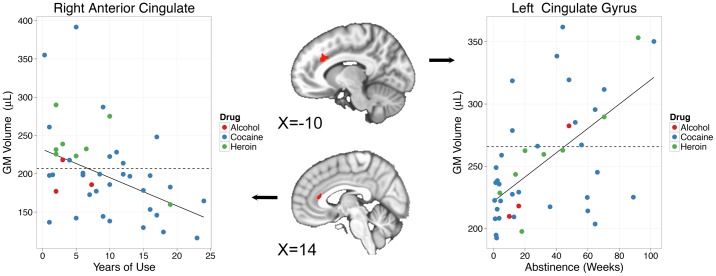
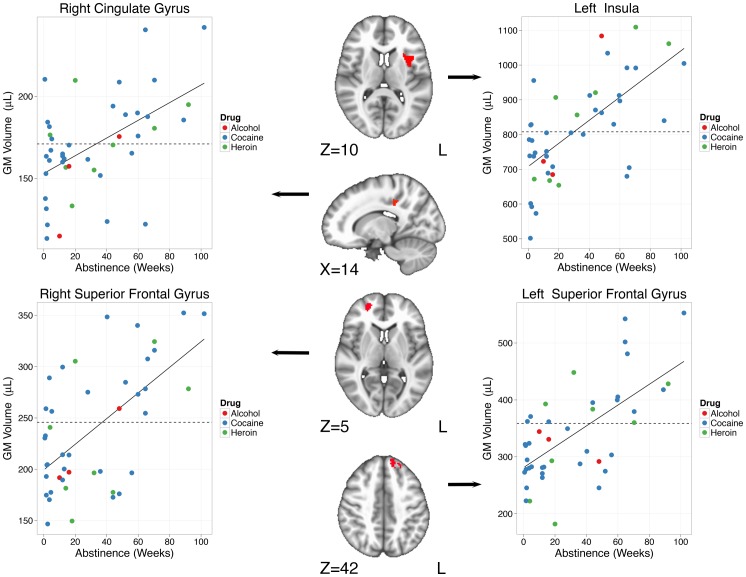
Extensive evidence indicates that current and recently abstinent cocaine abusers compared to drug-naïve controls have decreased grey matter in regions such as the anterior cingulate, lateral prefrontal and insular cortex. Relatively little is known, however, about the persistence of these deficits in long-term abstinence despite the implications this has for recovery and relapse. Optimized voxel based morphometry was used to assess how local grey matter volume varies with years of drug use and length of abstinence in a cross-sectional study of cocaine users with various durations of abstinence (1-102 weeks) and years of use (0.3-24 years). Lower grey matter volume associated with years of use was observed for several regions including anterior cingulate, inferior frontal gyrus and insular cortex. Conversely, higher grey matter volumes associated with abstinence duration were seen in non-overlapping regions that included the anterior and posterior cingulate, insular, right ventral and left dorsal prefrontal cortex. Grey matter volumes in cocaine dependent individuals crossed those of drug-naïve controls after 35 weeks of abstinence, with greater than normal volumes in users with longer abstinence. The brains of abstinent users are characterized by regional grey matter volumes, which on average, exceed drug-naïve volumes in those users who have maintained abstinence for more than 35 weeks. The asymmetry between the regions showing alterations with extended years of use and prolonged abstinence suggest that recovery involves distinct neurobiological processes rather than being a reversal of disease-related changes. Specifically, the results suggest that regions critical to behavioral control may be important to prolonged, successful, abstinence.
大量证据表明,与药物未滥用的对照组相比,目前和最近已戒除可卡因的滥用者在前扣带回、外侧前额叶和岛叶等区域的灰质减少。然而,尽管这对恢复和复发有影响,但长期戒除后这些缺陷是否持续存在,人们知之甚少。在一项对可卡因使用者的横断面研究中,使用优化的基于体素的形态计量学来评估随着药物使用年限和戒断时间的变化,局部灰质体积如何变化,这些可卡因使用者的戒断时间(1-102 周)和使用年限(0.3-24 年)各不相同。观察到几个与使用年限相关的灰质体积较低的区域,包括前扣带回、额下回和岛叶。相反,与戒断持续时间相关的较高灰质体积出现在不重叠的区域,包括前扣带和后扣带、岛叶、右侧腹侧和左侧背侧前额叶。在戒断 35 周后,可卡因依赖者的灰质体积与药物未滥用者的体积交叉,戒断时间较长的使用者的体积大于正常。戒断使用者的大脑表现出灰质体积的区域特征,平均而言,在那些已经戒断超过 35 周的使用者中,他们的灰质体积超过了药物未滥用者的体积。在延长的使用年限和延长的戒断期间表现出变化的区域之间的不对称性表明,恢复涉及到不同的神经生物学过程,而不是疾病相关变化的逆转。具体而言,研究结果表明,对行为控制至关重要的区域可能对延长、成功的戒断至关重要。