Komarov Botanical Institute, Russian Academy of Sciences St. Petersburg, Russia.
Department of Ecology, Environment and Plant Sciences Stockholm University, Stockholm, Sweden.
Front Plant Sci. 2014 Mar 5;5:74. doi: 10.3389/fpls.2014.00074. eCollection 2014.
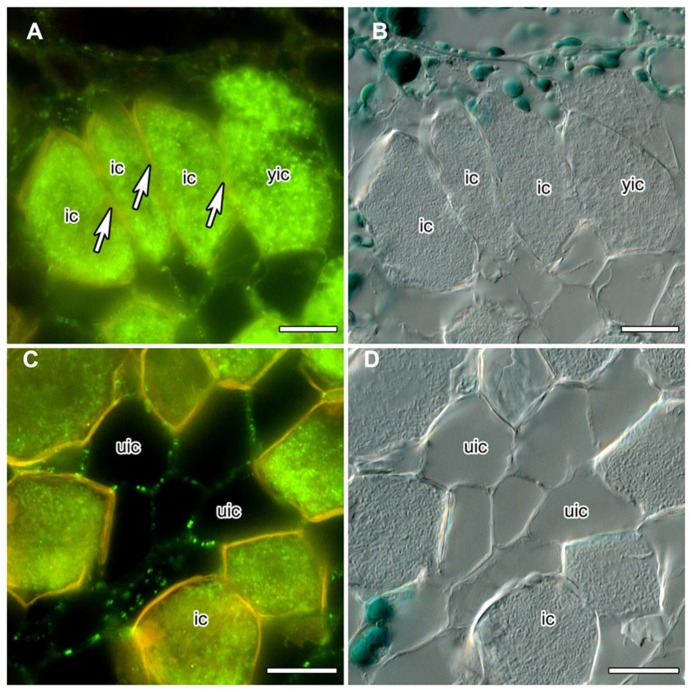
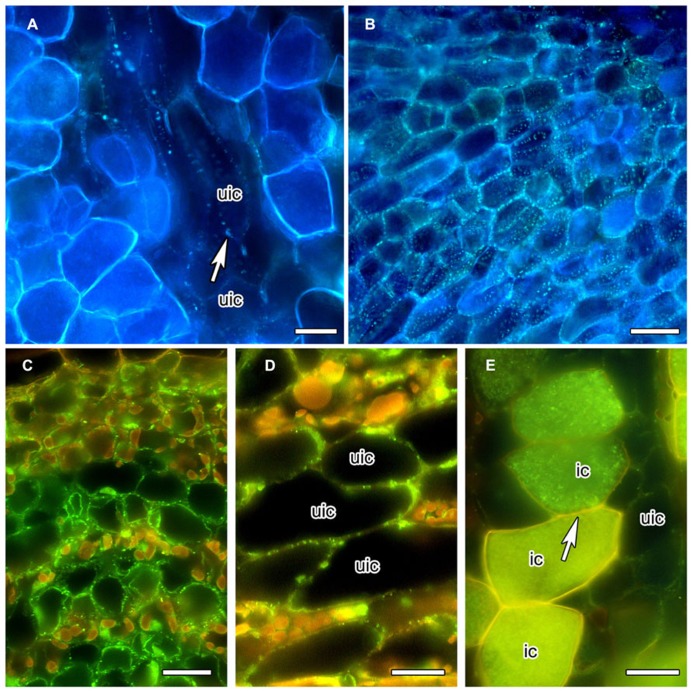
Plasmodesmata (PD) represent membrane-lined channels that link adjacent plant cells across the cell wall. PD of higher plants contain a central tube of endoplasmic reticulum (ER) called desmotubule. Membrane and lumen proteins seem to be able to move through the desmotubule, but most transport processes through PD occur through the cytoplasmic annulus (Brunkard etal., 2013). Calreticulin (CRT), a highly conserved Ca(2+)-binding protein found in all multicellular eukaryotes, predominantly located in the ER, was shown to localize to PD, though not all PD accumulate CRT. In nitrogen-fixing actinorhizal root nodules of the Australian tree Casuarina glauca, the primary walls of infected cells containing the microsymbiont become lignified upon infection. TEM analysis of these nodules showed that during the differentiation of infected cells, PD connecting infected cells, and connecting infected and adjacent uninfected cells, were reduced in number as well as diameter (Schubert etal., 2013). In contrast with PD connecting young infected cells, and most PD connecting mature infected and adjacent uninfected cells, PD connecting mature infected cells did not accumulate CRT. Furthermore, as shown here, these PD were not associated with callose, and based on their diameter, they probably had lost their desmotubules. We speculate that either this is a slow path to PD degradation, or that the loss of callose accumulation and presumably also desmotubules leads to the PD becoming open channels and improves metabolite exchange between cells.
胞间连丝(PD)是连接植物细胞的跨壁膜通道,这些细胞排列在细胞之间。高等植物的 PD 包含内质网(ER)的中心管,称为连丝小管。膜和腔蛋白似乎能够通过连丝小管移动,但 PD 中的大多数运输过程都是通过细胞质环(Brunkard 等人,2013)进行的。钙结合蛋白 CRT 是一种高度保守的 Ca(2+)结合蛋白,存在于所有多细胞真核生物中,主要位于内质网中,已被证明定位于 PD,但并非所有 PD 都积累 CRT。在澳大利亚树 Casuarina glauca 的固氮放线根瘤中,感染细胞的初生壁在感染后木质化,感染细胞中含有微生物共生体。对这些根瘤的 TEM 分析表明,在感染细胞的分化过程中,连接感染细胞和连接感染细胞和相邻未感染细胞的 PD 数量和直径都减少了(Schubert 等人,2013)。与连接年轻感染细胞的 PD 相反,以及连接成熟感染细胞和相邻未感染细胞的大多数 PD 都不积累 CRT。此外,正如这里所示,这些 PD 与胼胝质无关,并且根据其直径,它们可能已经失去了连丝小管。我们推测,这要么是 PD 降解的缓慢途径,要么是胼胝质积累和可能的连丝小管丢失导致 PD 成为开放通道,并改善细胞间代谢物交换。