Rogula-Kozłowska Wioletta, Klejnowski Krzysztof, Rogula-Kopiec Patrycja, Ośródka Leszek, Krajny Ewa, Błaszczak Barbara, Mathews Barbara
Institute of Environmental Engineering, Polish Academy of Sciences, 34 M. Skłodowska-Curie St., 41-819 Zabrze, Poland.
Monitoring and Modeling of Air Pollution Department, Institute of Meteorology and Water Management-National Research Institute, 10 Bratków St., 40-045 Katowice, Poland.
Air Qual Atmos Health. 2014;7(1):41-58. doi: 10.1007/s11869-013-0222-y. Epub 2013 Dec 8.
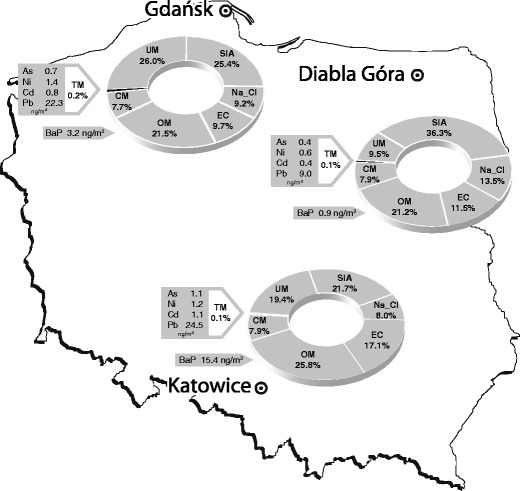
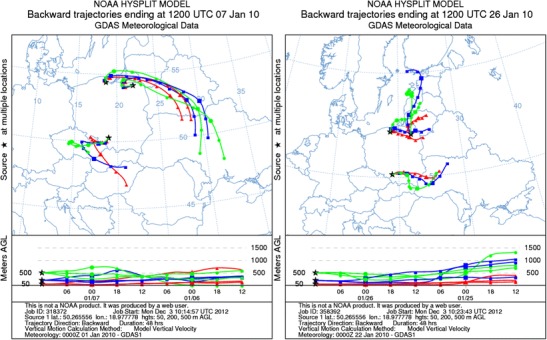
The seasonal changes in ambient mass concentrations and chemical composition of fine particulate matter (PM) were investigated in three locations in Poland. The analyses included PM-bound hazardous benzo()pyrene (BaP), As, Ni, Cd, and Pb. The samples of PM were collected daily in Katowice (southern Poland, urban background site), Gdańsk, and Diabla Góra (northern Poland, urban and regional background sites, respectively) during 1-year-long campaign in 2010. Based on monthly ambient concentrations of PM-bound carbon (organic and elemental), water-soluble ions (Na, NH, K, Mg, Ca, Cl, NO, SO), and elements As, Ni, Cd, Pb, Ti, Al, Fe, the chemical mass closure of PM was checked for each of the four seasons of the year and for the heating and non-heating periods at each site. Also, the annual concentrations of PM were determined and the annual PM mass closure checked. At each measuring point, the PM concentrations were high compared to its Polish yearly permissible value, 25 μg/m, and its concentrations elsewhere in Europe. The highest annual PM concentration, 43 μg/m, occurred in Katowice; it was twice the annual PM concentration in Gdańsk, and thrice the one in Diabla Góra. The high annual averages were due to very high monthly concentrations in the heating period, which were highest in the winter. PM consisted mainly of carbonaceous matter (elemental carbon (EC) + organic matter (OM), the sum of elemental carbon, EC, and organic matter, OM; its annual mass contributions to PM were 43, 31, and 33 % in Katowice, Gdansk, and Diabla Góra, respectively), secondary inorganic aerosol (SIA), the Na_Cl group, and crustal matter (CM)-in the decreasing order of their yearly mass contributions to PM. OM, EC, SIA, Na_Cl, and CM accounted for almost 81 % of the PM mass in Katowice, 74 % in Gdańsk, and 90 % in Diabla Góra. The annual average toxic metal contribution to the PM mass was not greater than 0.2 % at each site. In Katowice and Gdańsk, the yearly ambient BaP concentrations were high (15.4 and 3.2 ng/m, respectively); in rural Diabla Góra, the concentrations of BaP were almost equal to 1 ng/m, the Polish BaP annual limit. The great seasonal fluctuations of the shares of the component groups in PM and of the concentrations of PM and its components are due to the seasonal fluctuations of the emissions of PM and its precursors from hard and brown coal combustion for energy production, growing in a heating season, reaching maximum in winter, and decreasing in a non-heating period. In Gdańsk, northern Poland, especially in the spring and autumn, sea spray might have affected the chemical composition of PM. The greatest hazard from PM occurs in Katowice, southern Poland, in winter, when very high concentrations of PM and PM-related carbonaceous matter, including BaP, are maintained by poor natural ventilation in cities, weather conditions, and the highest level of industrialization in Poland. In less industrialized northern Poland, where the aeration in cities is better and rather gaseous than solid fuels are used, the health hazard from ambient PM is much lower.
对波兰三个地点细颗粒物(PM)的环境质量浓度和化学成分的季节变化进行了调查。分析包括与PM结合的有害苯并[a]芘(BaP)、砷(As)、镍(Ni)、镉(Cd)和铅(Pb)。2010年,在卡托维兹(波兰南部,城市背景站点)、格但斯克以及迪亚布拉戈拉(分别位于波兰北部,城市和区域背景站点)进行了为期一年的监测活动,每天采集PM样本。基于每月与PM结合的碳(有机碳和元素碳)、水溶性离子(Na⁺、NH₄⁺、K⁺、Mg²⁺、Ca²⁺、Cl⁻、NO₃⁻、SO₄²⁻)以及元素As、Ni、Cd、Pb、Ti、Al、Fe的环境浓度,对一年中的四个季节以及每个站点的供暖期和非供暖期的PM化学质量闭合进行了检查。此外,还测定了PM的年浓度并检查了年PM质量闭合情况。在每个测量点,与波兰每年允许值25μg/m³以及欧洲其他地方的浓度相比,PM浓度都很高。年PM浓度最高值为43μg/m³,出现在卡托维兹;是格但斯克年PM浓度的两倍,是迪亚布拉戈拉的三倍。年平均浓度高是由于供暖期每月浓度非常高,冬季最高。PM主要由含碳物质(元素碳(EC)+有机物(OM),元素碳EC和有机物OM的总和;其对PM的年质量贡献在卡托维兹、格但斯克和迪亚布拉戈拉分别为43%、31%和33%)、二次无机气溶胶(SIA)、NaCl组和地壳物质(CM)组成,按它们对PM的年质量贡献降序排列。OM、EC、SIA、NaCl和CM在卡托维兹占PM质量的近81% , 在格但斯克占74%,在迪亚布拉戈拉占90%。每个站点有毒金属对PM质量的年平均贡献不超过0.2%。在卡托维兹和格但斯克,年环境BaP浓度较高(分别为15.4和3.2 ng/m³);在农村的迪亚布拉戈拉,BaP浓度几乎等于1 ng/m³,即波兰BaP年限值。PM中各成分组的份额以及PM及其成分浓度的巨大季节性波动是由于用于能源生产的硬煤和褐煤燃烧产生的PM及其前体排放的季节性波动,在供暖季节增加,冬季达到最大值,在非供暖期减少。在波兰北部的格但斯克,尤其是在春季和秋季,海浪飞沫可能影响了PM的化学成分。PM造成的最大危害发生在波兰南部的卡托维兹冬季,此时城市自然通风不良、天气条件以及波兰最高的工业化水平导致PM以及与PM相关的含碳物质(包括BaP)浓度非常高。在工业化程度较低的波兰北部,城市通风较好且使用的燃料以气体而非固体燃料为主,环境PM对健康的危害要低得多。