Department of Immunology, Noguchi Memorial Institute for Medical Research, College of Health Sciences, University of Ghana, Legon, Ghana.
Malar J. 2014 Mar 17;13:103. doi: 10.1186/1475-2875-13-103.
Reported malaria cases continue to decline globally, and this has been attributed to strategic implementation of multiple malaria control tools. Gains made would however need to be sustained through continuous monitoring to ensure malaria elimination and eradication. Entomological inoculation rate (EIR) is currently the standard tool for transmission monitoring but this is not sensitive enough, especially in areas of very low transmission. Transmission estimation models based on seroconversion rates (λ) of antibodies to Plasmodium falciparum blood stage antigens are gaining relevance. Estimates of λ, which is the measure of transmission intensity, correlate with EIR but are limited by long-term persistence of antibodies to blood stage antigens. Seroprevalence of antibodies to sporozoite antigens may be better alternatives since these antigens usually have shorter immune exposure times. The aim of this study was to develop transmission estimation models based on the seroprevalence of antibodies to two P. falciparum sporozoite antigens (CSP, CelTOS) and compare with models based on the classical blood stage antigen AMA1.
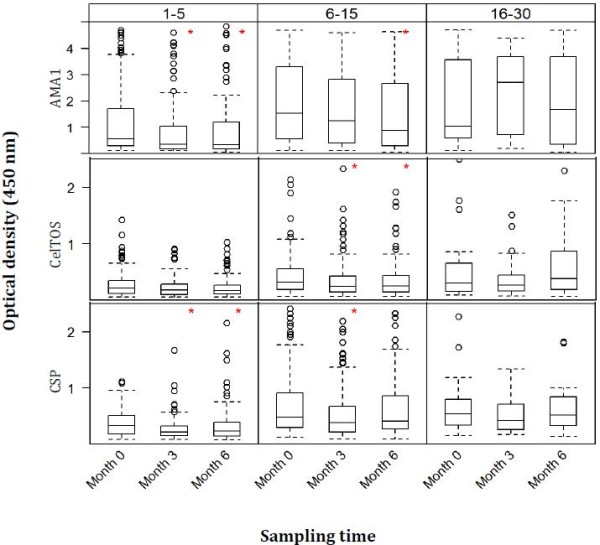
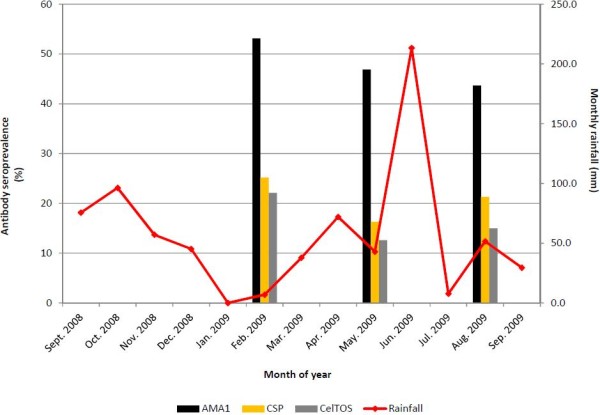
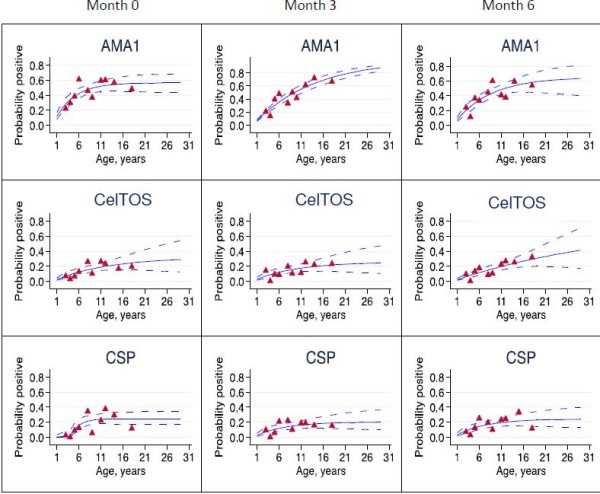
Antibody levels in archived plasma from three cross-sectional surveys conducted in 2009 in a low transmission area of Southern Ghana were assessed by indirect ELISA. Seroprevalence of antibodies against CSP, CelTOS and AMA1 were fitted to reversible catalytic models to estimate λ and corresponding seroreversion rates (ρ) for each antibody.
Of the three models developed, the anti-CSP model predicted a 13-fold decrease in λ four years prior to the time of sampling (2009). Anti-AMA1 antibodies formed at a four-fold greater rate compared to that of anti-CelTOS antibodies, and anti-CSP antibodies during the period of decreased λ. In contrast, anti-AMA1 antibodies decayed at a five-fold slower rate relative to that of anti-CSP antibodies while anti-AMA1 and anti-CelTOS antibody decay rates were not significantly different. Anti-CSP antibodies were relatively short-lived as they formed at an 11.6-fold slower rate relative to their decay during the period of decreased λ.
These features of anti-CSP antibodies can be exploited for the development of models for predicting seasonal, short-term changes in transmission intensity in malaria-endemic areas, especially as the elimination phase of malaria control is approached.
全球报告的疟疾病例持续下降,这归因于多种疟疾控制工具的战略实施。然而,为了确保消除和根除疟疾,需要通过持续监测来维持所取得的成果。昆虫接种率(EIR)目前是监测传播的标准工具,但它的灵敏度不够,尤其是在传播率非常低的地区。基于疟原虫裂殖体抗原抗体血清转化率(λ)的传播估计模型越来越受到关注。λ 是衡量传播强度的指标,与 EIR 相关,但受到裂殖体抗原抗体长期存在的限制。对疟原虫孢子抗原抗体的血清阳性率可能是更好的选择,因为这些抗原通常具有更短的免疫暴露时间。本研究旨在建立基于两种疟原虫孢子抗原(CSP、CelTOS)抗体血清阳性率的传播估计模型,并与基于经典裂殖体抗原 AMA1 的模型进行比较。
通过间接 ELISA 评估了 2009 年在加纳南部低传播地区进行的三项横断面研究中存档血浆中的抗体水平。对 CSP、CelTOS 和 AMA1 抗体的血清阳性率进行了可逆催化模型拟合,以估计每种抗体的 λ 和相应的血清转化率(ρ)。
在所建立的三个模型中,抗 CSP 模型预测λ在采样前四年(2009 年)下降了 13 倍。与抗 CelTOS 抗体相比,抗 AMA1 抗体的形成速度快四倍,而在 λ 下降期间形成抗 CSP 抗体。相反,与抗 CSP 抗体相比,抗 AMA1 抗体的衰减速度慢五倍,而抗 AMA1 和抗 CelTOS 抗体的衰减速度没有显著差异。抗 CSP 抗体的寿命相对较短,因为它们在 λ 下降期间形成的速度比衰减速度慢 11.6 倍。
这些抗 CSP 抗体的特征可用于开发预测疟疾流行地区季节性、短期传播强度变化的模型,特别是在接近疟疾控制消除阶段时。