Department of Otolaryngology-Head and Neck Surgery, School of Medicine, University of Minnesota, Minneapolis, Minnesota.
Cancer. 2014 Jun 15;120(12):1810-7. doi: 10.1002/cncr.28608. Epub 2014 Mar 17.
The objectives of this study were to identify factors associated with treatment differences, characterize changes in treatment patterns over time, and compare survival across treatment types in patients who received treatment for localized laryngeal cancer.
Using the Surveillance, Epidemiology, and End Results database, we conducted a retrospective cohort analysis of patients who were treated from 1995 to 2009 for localized laryngeal cancer. Four treatment groups were defined: (1) radiation only, (2) local surgery only, (3) local surgery and radiation, and (4) open surgery with or without radiation. Variations in treatment rates between these groups were evaluated according to demographic factors, and differences in treatment rates across time were calculated. Associations between treatment and mortality were assessed using Kaplan-Meier methods. Cox proportional hazards regression models were used to adjust for potential confounding covariates.
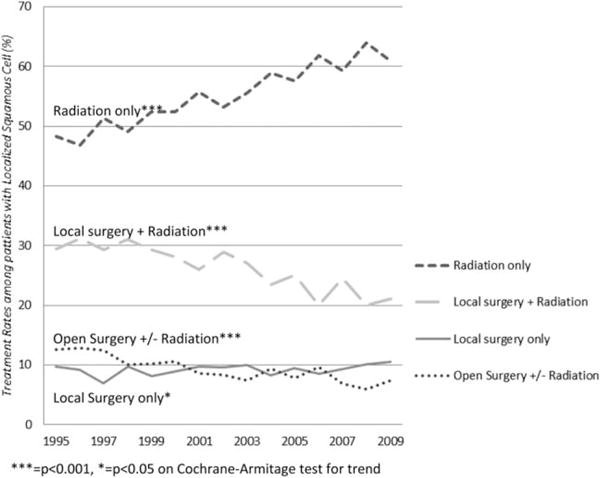
In total, 10,429 patients with localized laryngeal cancer were identified. Most patients (57%) were treated with radiation only; 25% with local surgery and radiation, 9% with local surgery only, and 9% with open surgery with or without radiation. Race, age, and registry were associated with differences in treatment. Receipt of single-modality treatment increased and receipt of combined-modality treatment decreased over the study period. Better survival was observed with white race, younger age, and treatment with local surgery. Survival differences associated with treatment type were observed within 3 years of diagnosis and persisted beyond 5 years after diagnosis.
Although treatment patterns became more adherent to treatment guidelines over time, we identified survival differences associated with treatment type that warrant further investigation into treatment decision-making for patients with localized laryngeal cancer.
本研究旨在确定与治疗差异相关的因素,描述随时间推移治疗模式的变化,并比较接受局部喉癌治疗的患者在不同治疗类型之间的生存情况。
我们使用监测、流行病学和最终结果数据库,对 1995 年至 2009 年期间接受局部喉癌治疗的患者进行了回顾性队列分析。定义了四个治疗组:(1)仅放疗,(2)仅局部手术,(3)局部手术加放疗,(4)开放手术加或不加放疗。根据人口统计学因素评估这些组之间的治疗率变化,并计算随时间推移的治疗率差异。使用 Kaplan-Meier 方法评估治疗与死亡率之间的关联。使用 Cox 比例风险回归模型调整潜在混杂协变量。
共确定了 10429 例局部喉癌患者。大多数患者(57%)接受了单纯放疗;25%接受了局部手术加放疗,9%接受了单纯局部手术,9%接受了开放手术加或不加放疗。种族、年龄和登记处与治疗差异有关。单模式治疗的接受率增加,联合模式治疗的接受率降低。白种人、年轻、接受局部手术治疗的患者生存率更好。在诊断后 3 年内观察到与治疗类型相关的生存差异,并在诊断后 5 年以上持续存在。
尽管治疗模式随时间的推移变得更加符合治疗指南,但我们发现与治疗类型相关的生存差异值得进一步研究,以了解局部喉癌患者的治疗决策。