School of Pharmacy, University of Auckland , Auckland , New Zealand ; Centre for Brain Research, University of Auckland , Auckland , New Zealand.
Department of Radiology, Athinoula A. Martinos Center for Biomedical Imaging, Massachusetts General Hospital , Boston, MA , USA ; Department of Neurology, Massachusetts General Hospital , Boston, MA , USA ; Harvard Medical School , Boston, MA , USA.
Front Psychiatry. 2014 Mar 6;5:20. doi: 10.3389/fpsyt.2014.00020. eCollection 2014.
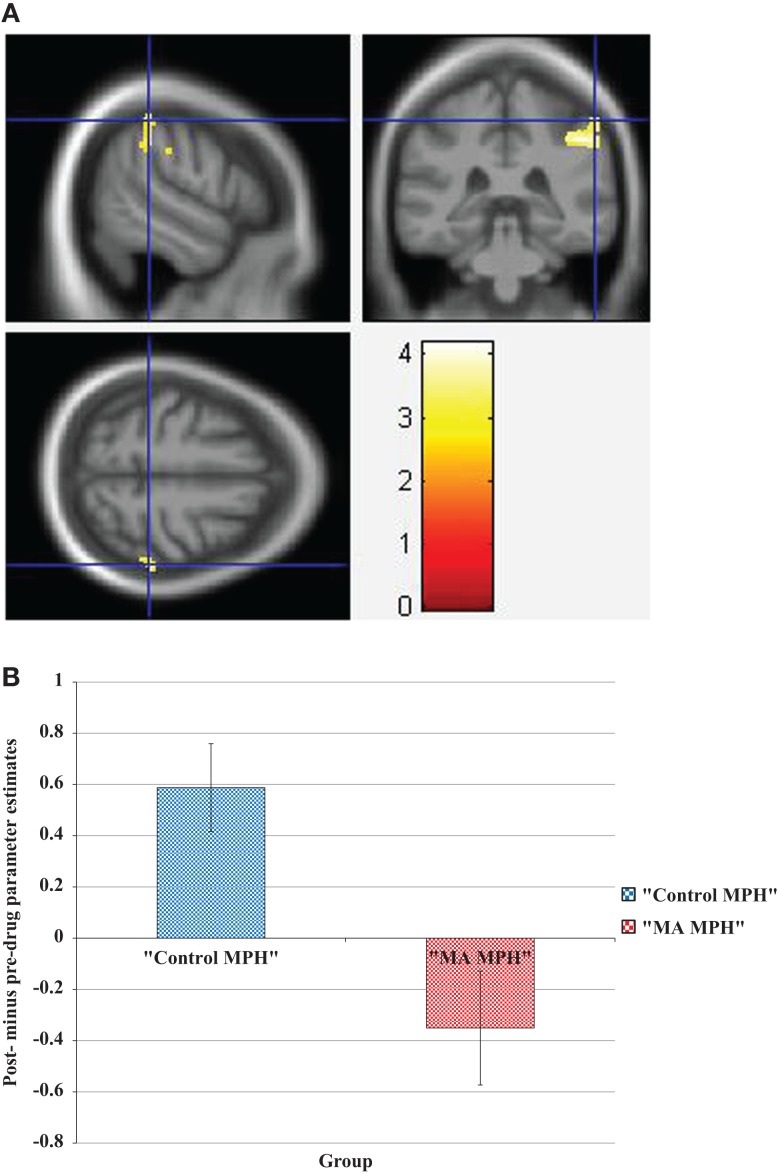
Methamphetamine (MA) dependence is associated with cognitive deficits. Methylphenidate (MPH) has been shown to improve inhibitory control in healthy and cocaine-dependent subjects. This study aimed to understand the neurophysiological effects before and after acute MPH administration in active MA-dependent and control subjects. Fifteen MA-dependent and 18 control subjects aged 18-46 years were scanned using functional magnetic resonance imaging before and after either a single oral dose of MPH (18 mg) or placebo while performing a color-word Stroop task. Baseline accuracy was lower (p = 0.026) and response time (RT) was longer (p < 0.0001) for the incongruent compared to congruent condition, demonstrating the task probed cognitive control. Increased activation of the dorsolateral prefrontal cortex (DLPFC) and parietal cortex during the incongruent and Stroop effect conditions, respectively was observed in MA-dependent compared to control subjects (p < 0.05), suggesting the need to recruit neural resources within these regions for conflict resolution. Post- compared to pre-MPH treatment, increased RT and DLPFC activation for the Stroop effect were observed in MA-dependent subjects (p < 0.05). In comparison to MPH-treated controls and placebo-treated MA-dependent subjects, MPH-treated MA-dependent subjects showed decreased activation of parietal and occipital regions during the incongruent and Stroop effect conditions (p < 0.05). These findings suggest that in MA-dependent subjects, MPH facilitated increased recruitment of the DLPFC for Stroop conflict resolution, and a decreased need for recruitment of neural resources in parietal and occipital regions compared to the other groups, while maintaining a comparable level of task performance to that achieved pre-drug administration. Due to the small sample size, the results from this study are preliminary; however, they inform us about the effects of MPH on the neural correlates of cognitive control in active MA-dependent subjects.
甲基苯丙胺(MA)依赖与认知缺陷有关。哌醋甲酯(MPH)已被证明可改善健康人和可卡因依赖者的抑制控制。本研究旨在了解在活跃的 MA 依赖者和对照组受试者中,急性 MPH 给药前后的神经生理效应。15 名 MA 依赖者和 18 名年龄在 18-46 岁的对照组受试者在口服单剂量 MPH(18mg)或安慰剂前后进行功能磁共振成像扫描,同时执行颜色-单词 Stroop 任务。与一致条件相比,不一致条件下的基线准确性较低(p=0.026),反应时间(RT)较长(p<0.0001),表明该任务探测到认知控制。与对照组相比,MA 依赖者在不一致和 Stroop 效应条件下分别观察到背外侧前额叶皮层(DLPFC)和顶叶皮层的激活增加(p<0.05),这表明需要在这些区域内招募神经资源来解决冲突。与治疗前相比,MA 依赖者在治疗后对 Stroop 效应的 RT 和 DLPFC 激活增加(p<0.05)。与 MPH 治疗的对照组和安慰剂治疗的 MA 依赖者相比,MPH 治疗的 MA 依赖者在不一致和 Stroop 效应条件下,顶叶和枕叶区域的激活减少(p<0.05)。这些发现表明,在 MA 依赖者中,MPH 促进了 DLPFC 对 Stroop 冲突解决的招募增加,与其他组相比,顶叶和枕叶区域的神经资源招募需求减少,同时保持与药物治疗前相当的任务表现水平。由于样本量小,本研究结果是初步的;然而,它们为我们提供了关于 MPH 对活跃的 MA 依赖者认知控制的神经相关物的影响的信息。