Moretta Lorenzo, Pietra Gabriella, Montaldo Elisa, Vacca Paola, Pende Daniela, Falco Michela, Del Zotto Genny, Locatelli Franco, Moretta Alessandro, Mingari Maria Cristina
Istituto Giannina Gaslini , Genova , Italy.
Department of Experimental Medicine and Center of Excellence for Biomedical Research, University of Genova , Genova , Italy ; IRCCS AOU San Martino-IST , Genova , Italy.
Front Immunol. 2014 Mar 7;5:87. doi: 10.3389/fimmu.2014.00087. eCollection 2014.
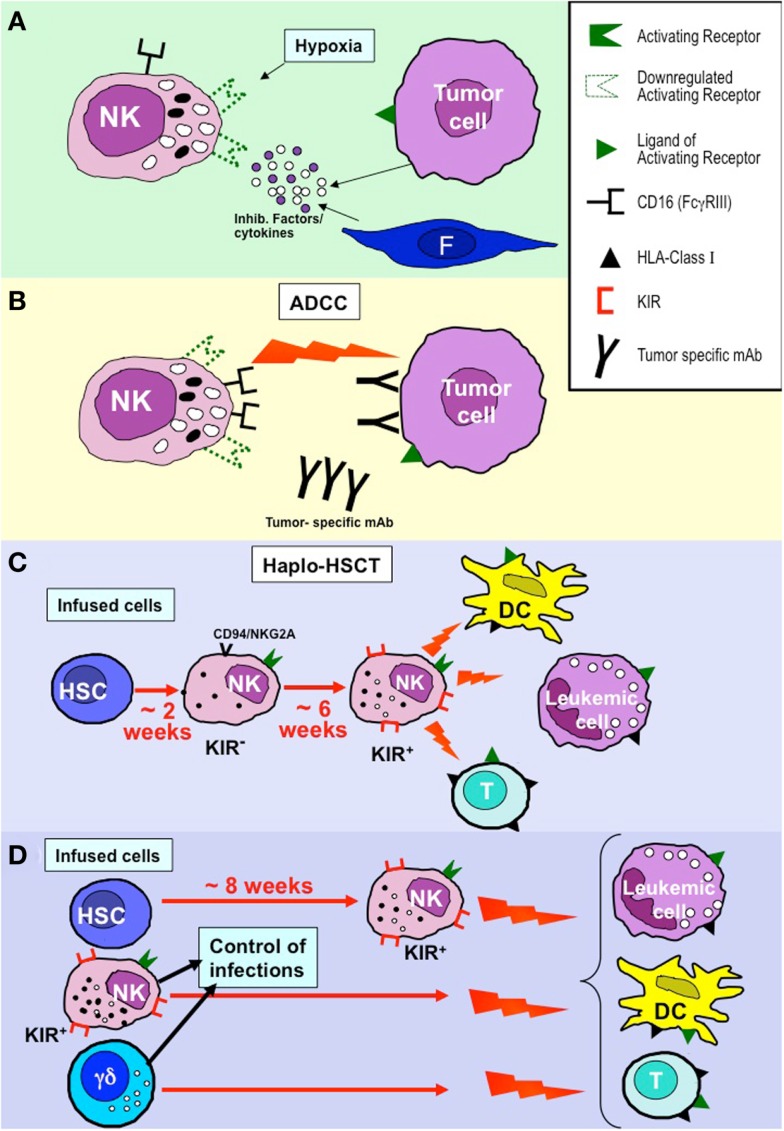
Natural Killer (NK) cells are major effector cells of the innate immunity. The discovery, over two decades ago, of major histocompatibility complex-class I-specific inhibitory NK receptors and subsequently of activating receptors, recognizing ligands expressed by tumor or virus-infected cells, paved the way to our understanding of the mechanisms of selective recognition and killing of tumor cells. Although NK cells can efficiently kill tumor cells of different histotypes in vitro, their activity may be limited in vivo by their inefficient trafficking to tumor lesions and by the inhibition of their function induced by tumor cells themselves and by the tumor microenvironment. On the other hand, the important role of NK cells has been clearly demonstrated in the therapy of high risk leukemias in the haploidentical hematopoietic stem cell (HSC) transplantation setting. NK cells derived from donor HSC kill leukemic cells residual after the conditioning regimen, thus preventing leukemia relapses. In addition, they also kill residual dendritic cells and T lymphocytes, thus preventing both GvH disease and graft rejection.
自然杀伤(NK)细胞是固有免疫的主要效应细胞。二十多年前,主要组织相容性复合体I类特异性抑制性NK受体以及随后识别肿瘤或病毒感染细胞所表达配体的激活受体的发现,为我们理解选择性识别和杀伤肿瘤细胞的机制铺平了道路。尽管NK细胞在体外能够有效杀伤不同组织类型的肿瘤细胞,但其活性在体内可能会受到限制,原因包括向肿瘤病灶的转运效率低下以及肿瘤细胞自身和肿瘤微环境对其功能的抑制。另一方面,在单倍体造血干细胞(HSC)移植治疗高危白血病的过程中,NK细胞的重要作用已得到明确证实。源自供体HSC的NK细胞可杀伤预处理方案后残留的白血病细胞,从而预防白血病复发。此外,它们还能杀伤残留的树突状细胞和T淋巴细胞,进而预防移植物抗宿主病和移植物排斥反应。