Yanguas-Casás Natalia, Barreda-Manso M Asunción, Nieto-Sampedro Manuel, Romero-Ramírez Lorenzo
Laboratorio de Plasticidad Neural, Instituto Cajal (CSIC), Avenida Doctor Arce 37, 28002 Madrid, Spain.
J Neuroinflammation. 2014 Mar 19;11:50. doi: 10.1186/1742-2094-11-50.
Bile acids are steroid acids found predominantly in the bile of mammals. The bile acid conjugate tauroursodeoxycholic acid (TUDCA) is a neuroprotective agent in different animal models of stroke and neurological diseases. However, the anti-inflammatory properties of TUDCA in the central nervous system (CNS) remain unknown.
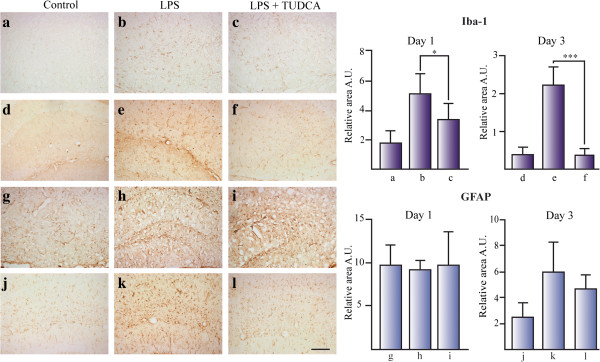
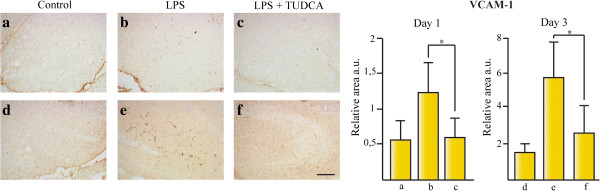
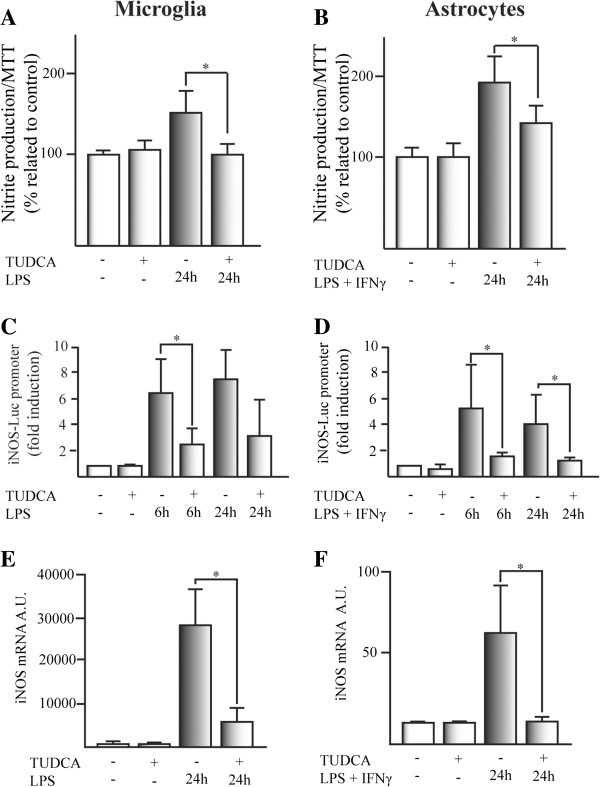
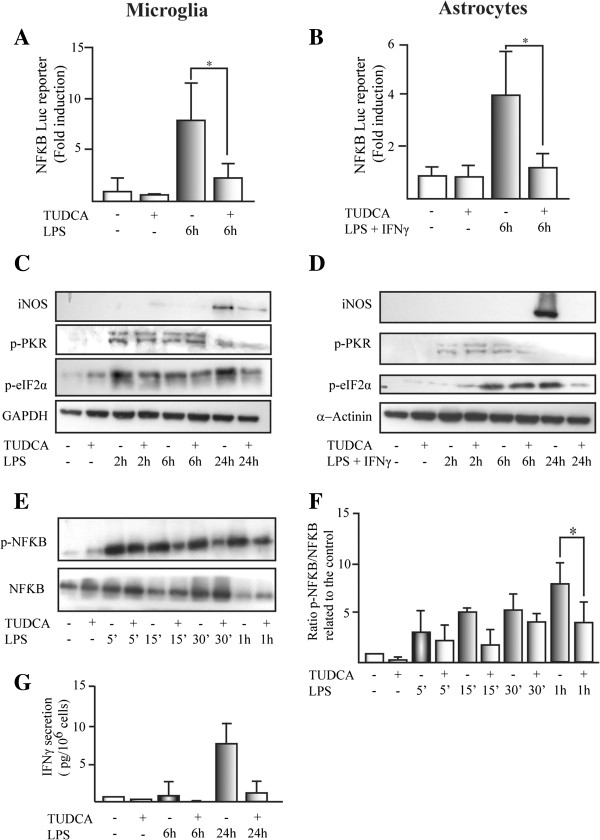
The acute neuroinflammation model of intracerebroventricular (icv) injection with bacterial lipopolysaccharide (LPS) in C57BL/6 adult mice was used herein. Immunoreactivity against Iba-1, GFAP, and VCAM-1 was measured in coronal sections in the mice hippocampus. Primary cultures of microglial cells and astrocytes were obtained from neonatal Wistar rats. Glial cells were treated with proinflammatory stimuli to determine the effect of TUDCA on nitrite production and activation of inducible enzyme nitric oxide synthase (iNOS) and NFκB luciferase reporters. We studied the effect of TUDCA on transcriptional induction of iNOS and monocyte chemotactic protein-1 (MCP-1) mRNA as well as induction of protein expression and phosphorylation of different proteins from the NFκB pathway.
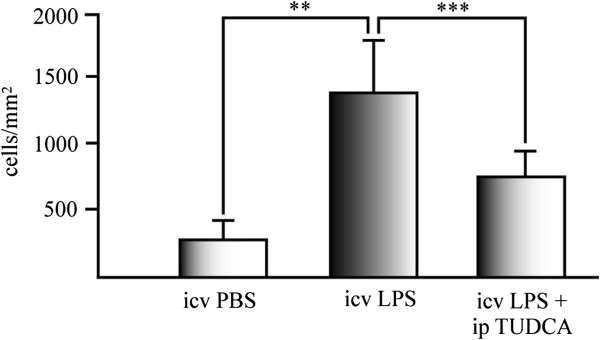
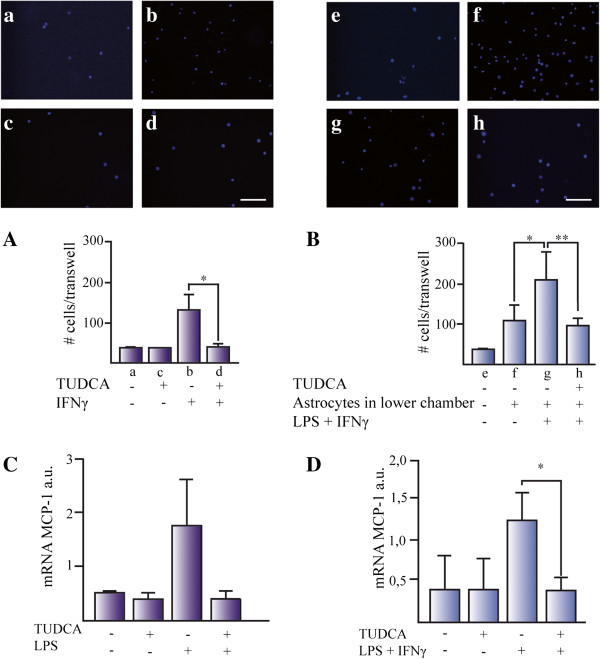
TUDCA specifically reduces microglial reactivity in the hippocampus of mice treated by icv injection of LPS. TUDCA treatment reduced the production of nitrites by microglial cells and astrocytes induced by proinflammatory stimuli that led to transcriptional and translational diminution of the iNOS. This effect might be due to inhibition of the NFκB pathway, activated by proinflammatory stimuli. TUDCA decreased in vitro microglial migration induced by both IFN-γ and astrocytes treated with LPS plus IFN-γ. TUDCA inhibition of MCP-1 expression induced by proinflammatory stimuli could be in part responsible for this effect. VCAM-1 inmunoreactivity in the hippocampus of animals treated by icv LPS was reduced by TUDCA treatment, compared to animals treated with LPS alone.
We show a triple anti-inflammatory effect of TUDCA on glial cells: i) reduced glial cell activation, ii) reduced microglial cell migratory capacity, and iii) reduced expression of chemoattractants (e.g., MCP-1) and vascular adhesion proteins (e.g., VCAM-1) required for microglial migration and blood monocyte invasion to the CNS inflammation site. Our results present a novel TUDCA anti-inflammatory mechanism, with therapeutic implications for inflammatory CNS diseases.
胆汁酸是主要存在于哺乳动物胆汁中的类固醇酸。胆汁酸共轭物牛磺熊去氧胆酸(TUDCA)在不同的中风和神经疾病动物模型中是一种神经保护剂。然而,TUDCA在中枢神经系统(CNS)中的抗炎特性仍不清楚。
本文使用C57BL/6成年小鼠脑室内(icv)注射细菌脂多糖(LPS)的急性神经炎症模型。在小鼠海马的冠状切片中测量针对Iba-1、GFAP和VCAM-1的免疫反应性。从新生Wistar大鼠获得小胶质细胞和星形胶质细胞的原代培养物。用促炎刺激处理胶质细胞,以确定TUDCA对亚硝酸盐产生以及诱导型一氧化氮合酶(iNOS)和NFκB荧光素酶报告基因激活的影响。我们研究了TUDCA对iNOS和单核细胞趋化蛋白-1(MCP-1)mRNA转录诱导以及NFκB途径中不同蛋白的蛋白表达和磷酸化诱导的影响。
TUDCA特异性降低了经icv注射LPS处理的小鼠海马中的小胶质细胞反应性。TUDCA处理减少了促炎刺激诱导的小胶质细胞和星形胶质细胞中亚硝酸盐的产生,这导致iNOS的转录和翻译减少。这种作用可能是由于抑制了由促炎刺激激活的NFκB途径。TUDCA降低了IFN-γ以及用LPS加IFN-γ处理的星形胶质细胞诱导的体外小胶质细胞迁移。TUDCA对促炎刺激诱导的MCP-1表达的抑制可能部分导致了这种作用。与单独用LPS处理的动物相比,TUDCA处理降低了经icv LPS处理的动物海马中的VCAM-1免疫反应性。
我们展示了TUDCA对胶质细胞的三重抗炎作用:i)降低胶质细胞活化,ii)降低小胶质细胞迁移能力,iii)降低小胶质细胞迁移和血液单核细胞侵入CNS炎症部位所需的趋化因子(如MCP-1)和血管粘附蛋白(如VCAM-1)的表达。我们的结果提出了一种新的TUDCA抗炎机制,对炎症性CNS疾病具有治疗意义。