EpiChron Research Group on Chronic Diseases, Aragón Health Sciences Institute (IACS), IIS Aragón, Miguel Servet University Hospital, Zaragoza, Spain.
BMC Psychiatry. 2014 Mar 20;14:84. doi: 10.1186/1471-244X-14-84.
The epidemiologic study of comorbidities of an index health problem represents a methodological challenge. This study cross-sectionally describes and analyzes the comorbidities associated with dementia in older patients and reviews the existing similarities and differences between identified comorbid diseases using the statistical methods most frequently applied in current research.
Cross-sectional study of 72,815 patients over 64 seen in 19 Spanish primary care centers during 2008. Chronic diseases were extracted from electronic health records and grouped into Expanded Diagnostic Clusters®. Three different statistical methods were applied (i.e., analysis of prevalence data, multiple regression and factor analysis), stratifying by sex.
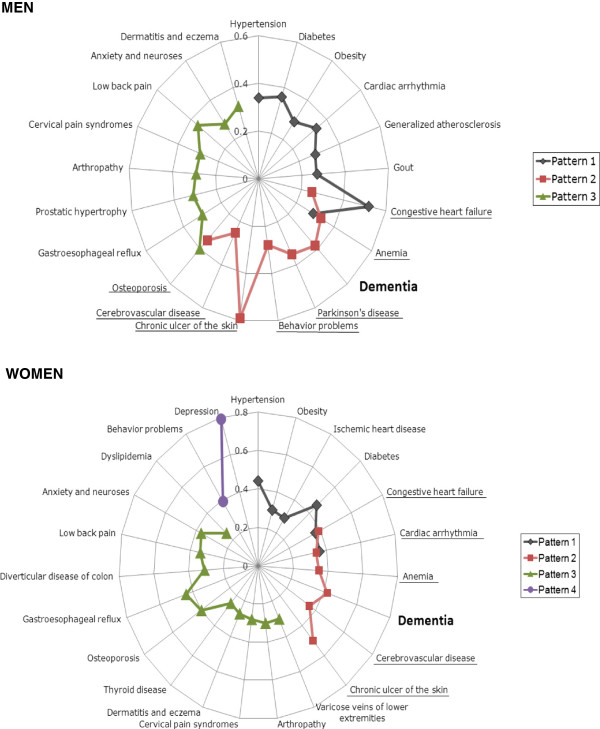
The two most frequent comorbidities both for men and women with dementia were hypertension and diabetes. Yet, logistic regression and factor analysis demonstrated that the comorbidities significantly associated with dementia were Parkinson's disease, congestive heart failure, cerebrovascular disease, anemia, cardiac arrhythmia, chronic skin ulcers, osteoporosis, thyroid disease, retinal disorders, prostatic hypertrophy, insomnia and anxiety and neurosis.
The analysis of the comorbidities associated with an index disease (e.g., dementia) must not be exclusively based on prevalence rates, but rather on methodologies that allow the discovery of non-random associations between diseases. A deep and reliable knowledge about how different diseases are grouped and associated around an index disease such as dementia may orient future longitudinal studies aimed at unraveling causal associations.
对索引健康问题的合并症进行流行病学研究是一项具有挑战性的方法学问题。本研究通过最常用于当前研究的统计方法,对 2008 年在 19 个西班牙初级保健中心就诊的 72815 名 64 岁以上患者进行横断面描述和分析,并对所确定的合并疾病进行了相似性和差异性分析。
对 2008 年在 19 个西班牙初级保健中心就诊的 72815 名 64 岁以上患者进行横断面研究。从电子健康记录中提取慢性疾病,并归入扩展诊断聚类。应用三种不同的统计方法(即患病率数据分析、多元回归和因子分析),按性别分层。
无论男性还是女性,痴呆症最常见的两种合并症都是高血压和糖尿病。然而,逻辑回归和因子分析表明,与痴呆症显著相关的合并症是帕金森病、充血性心力衰竭、脑血管疾病、贫血、心律失常、慢性皮肤溃疡、骨质疏松症、甲状腺疾病、视网膜疾病、前列腺肥大、失眠、焦虑和神经症。
对索引疾病(如痴呆症)相关合并症的分析不应仅基于患病率,而应基于能够发现疾病之间非随机关联的方法。深入了解不同疾病如何围绕索引疾病(如痴呆症)进行分组和关联,可能有助于未来旨在阐明因果关系的纵向研究。