Morrison Jennifer A, Pike Laura A, Sams Sharon B, Sharma Vibha, Zhou Qiong, Severson Jill J, Tan Aik-Choon, Wood William M, Haugen Bryan R
Department of Medicine, Division of Endocrinology, Diabetes, & Metabolism, University of Colorado Anschutz Medical Campus, Aurora, Colorado, USA.
Mol Cancer. 2014 Mar 19;13:62. doi: 10.1186/1476-4598-13-62.
Thyroid cancer is the most common endocrine malignancy, and many patients with metastatic differentiated thyroid cancer (DTC), poorly differentiated thyroid cancer (PDTC), and anaplastic thyroid cancer (ATC) fail to respond to conventional therapies, resulting in morbidity and mortality. Additional therapeutic targets and treatment options are needed for these patients. We recently reported that peroxisome proliferator-activated receptor gamma (PPARγ) is highly expressed in ATC and confers an aggressive phenotype when overexpressed in DTC cells.
Microarray analysis was used to identify downstream targets of PPARγ in ATC cells. Western blot analysis and immunohistochemistry (IHC) were used to assess thioredoxin interacting protein (TXNIP) expression in thyroid cancer cell lines and primary tumor specimens. Retroviral transduction was used to generate ATC cell lines that overexpress TXNIP, and assays that assess glucose uptake, viable cell proliferation, and invasion were used to characterize the in vitro properties of these cells. An orthotopic thyroid cancer mouse model was used to assess the effect of TXNIP overexpression in ATC cell lines in vivo.
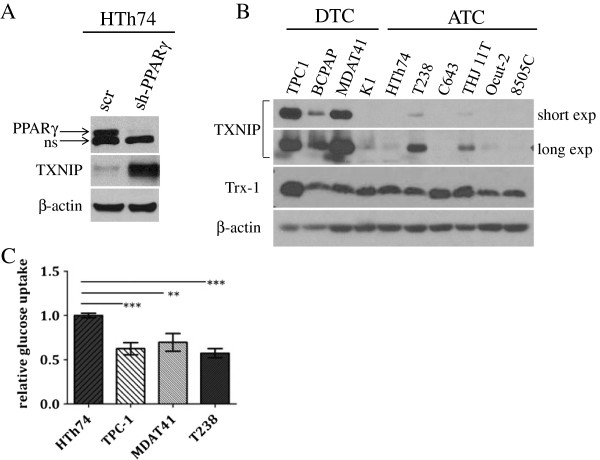
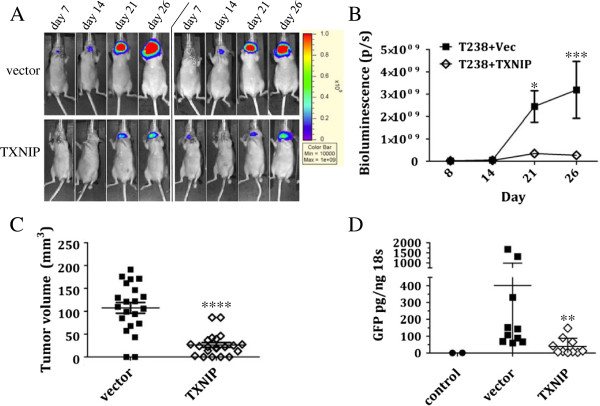
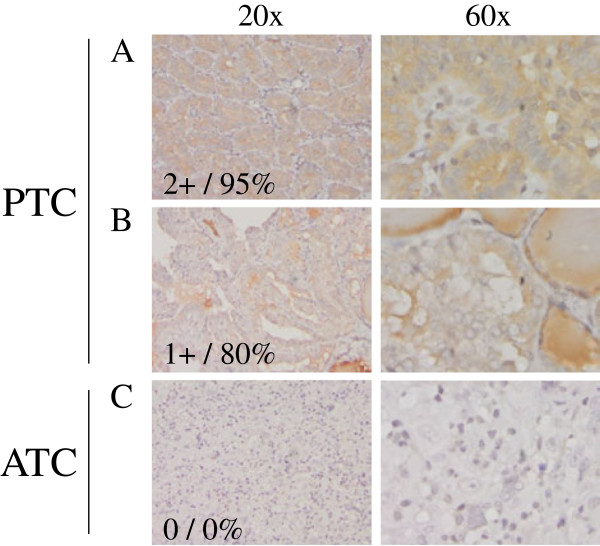
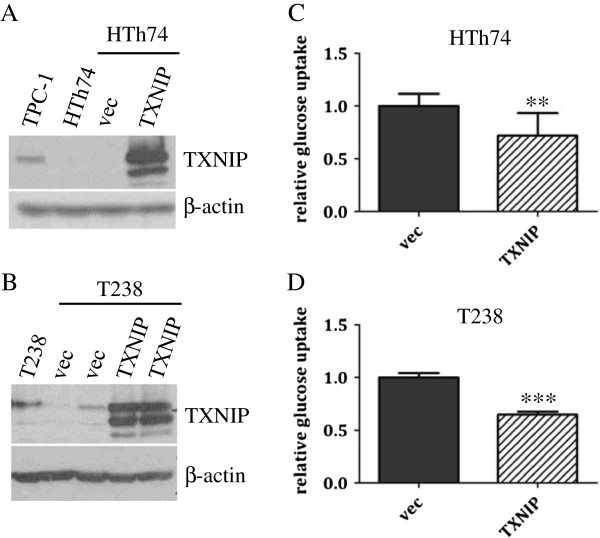
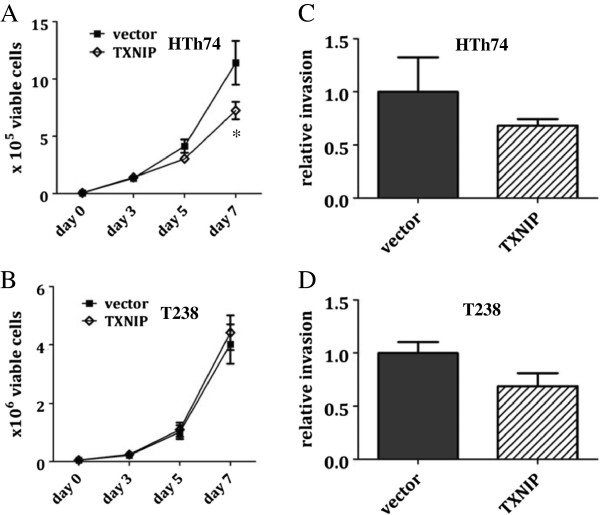
Using microarray analysis, we show that TXNIP is highly upregulated when PPARγ is depleted from ATC cells. Using Western blot analysis and IHC, we show that DTC and ATC cells exhibit differential TXNIP expression patterns. DTC cell lines and patient tumors have high TXNIP expression in contrast to low or absent expression in ATC cell lines and tumors. Overexpression of TXNIP decreases the growth of HTh74 cells compared to vector controls and inhibits glucose uptake in the ATC cell lines HTh74 and T238. Importantly, TXNIP overexpression in T238 cells results in attenuated tumor growth and decreased metastasis in an orthotopic thyroid cancer mouse model.
Our findings indicate that TXNIP functions as a tumor suppressor in thyroid cells, and its downregulation is likely important in the transition from differentiated to advanced thyroid cancer. These studies underscore the potential of TXNIP as a novel therapeutic target and prognostic indicator in advanced thyroid cancer.
甲状腺癌是最常见的内分泌恶性肿瘤,许多转移性分化型甲状腺癌(DTC)、低分化甲状腺癌(PDTC)和未分化甲状腺癌(ATC)患者对传统疗法无反应,导致发病和死亡。这些患者需要额外的治疗靶点和治疗选择。我们最近报道,过氧化物酶体增殖物激活受体γ(PPARγ)在ATC中高表达,在DTC细胞中过表达时赋予侵袭性表型。
采用微阵列分析鉴定ATC细胞中PPARγ的下游靶点。采用蛋白质免疫印迹分析和免疫组织化学(IHC)评估硫氧还蛋白相互作用蛋白(TXNIP)在甲状腺癌细胞系和原发性肿瘤标本中的表达。采用逆转录病毒转导生成过表达TXNIP的ATC细胞系,并采用评估葡萄糖摄取、活细胞增殖和侵袭的试验来表征这些细胞的体外特性。采用原位甲状腺癌小鼠模型评估TXNIP在ATC细胞系中过表达的体内效应。
通过微阵列分析,我们发现当ATC细胞中PPARγ缺失时,TXNIP高度上调。通过蛋白质免疫印迹分析和IHC,我们发现DTC和ATC细胞表现出不同的TXNIP表达模式。与ATC细胞系和肿瘤中低表达或无表达相比,DTC细胞系和患者肿瘤中TXNIP表达较高。与载体对照相比,TXNIP过表达降低了HTh74细胞的生长,并抑制了ATC细胞系HTh74和T238中的葡萄糖摄取。重要的是,T238细胞中TXNIP过表达导致原位甲状腺癌小鼠模型中的肿瘤生长减弱和转移减少。
我们的研究结果表明,TXNIP在甲状腺细胞中起肿瘤抑制作用,其下调可能在从分化型甲状腺癌向晚期甲状腺癌的转变中起重要作用。这些研究强调了TXNIP作为晚期甲状腺癌新治疗靶点和预后指标的潜力。