
较高的第二语言熟练程度可防止混响对听力理解产生影响。
High second-language proficiency protects against the effects of reverberation on listening comprehension.
作者信息
Sörqvist Patrik, Hurtig Anders, Ljung Robert, Rönnberg Jerker
机构信息
Department of Building, Energy and Environmental Engineering, University of Gävle, Gävle, Sweden; Linnaeus Centre HEAD, Swedish Institute for Disability Research, Linköping University, Linköping, Sweden.
出版信息
Scand J Psychol. 2014 Apr;55(2):91-6. doi: 10.1111/sjop.12115.
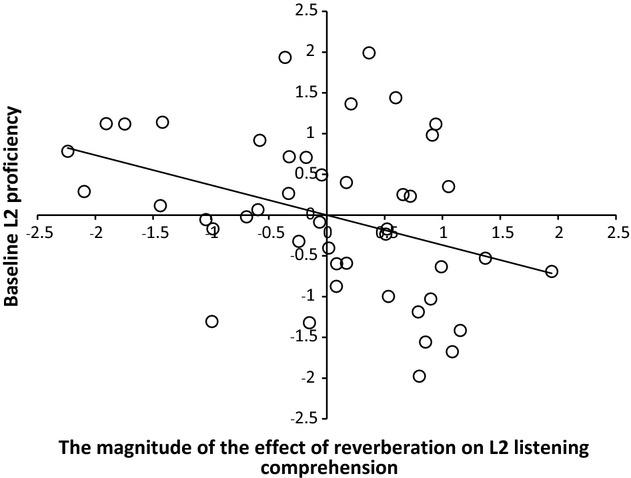
The purpose of this experiment was to investigate whether classroom reverberation influences second-language (L2) listening comprehension. Moreover, we investigated whether individual differences in baseline L2 proficiency and in working memory capacity (WMC) modulate the effect of reverberation time on L2 listening comprehension. The results showed that L2 listening comprehension decreased as reverberation time increased. Participants with higher baseline L2 proficiency were less susceptible to this effect. WMC was also related to the effect of reverberation (although just barely significant), but the effect of WMC was eliminated when baseline L2 proficiency was statistically controlled. Taken together, the results suggest that top-down cognitive capabilities support listening in adverse conditions. Potential implications for the Swedish national tests in English are discussed.
本实验的目的是研究教室混响是否会影响第二语言(L2)听力理解。此外,我们还研究了L2基础水平和工作记忆容量(WMC)的个体差异是否会调节混响时间对L2听力理解的影响。结果表明,随着混响时间的增加,L2听力理解能力下降。L2基础水平较高的参与者受此影响较小。WMC也与混响的影响有关(尽管只是勉强显著),但在对L2基础水平进行统计控制后,WMC的影响就消除了。综上所述,结果表明自上而下的认知能力有助于在不利条件下进行听力理解。文中还讨论了对瑞典英语国家考试的潜在影响。

 Zotero 插件