Lemmens Ryanne J M, Janssen-Potten Yvonne J M, Timmermans Annick A A, Defesche Anke, Smeets Rob J E M, Seelen Henk A M
Research School CAPHRI, Department of Rehabilitation Medicine, Maastricht University, Maastricht, The Netherlands.
BMC Neurol. 2014 Mar 19;14:52. doi: 10.1186/1471-2377-14-52.
Assessment of arm-hand use is very important in children with cerebral palsy (CP) who encounter arm-hand problems. To determine validity and reliability of new instruments to assess actual performance, a set of standardized test situations including activities of daily living (ADL) is required. This study gives information with which such a set for upper extremity skill research may be fine-tuned, relative to a specific research question. Aim of this study is to a) identify upper extremity related ADL children with CP want to improve on, b) determine the 10 most preferred goals of children with CP, and c) identify movement components of all goals identified.
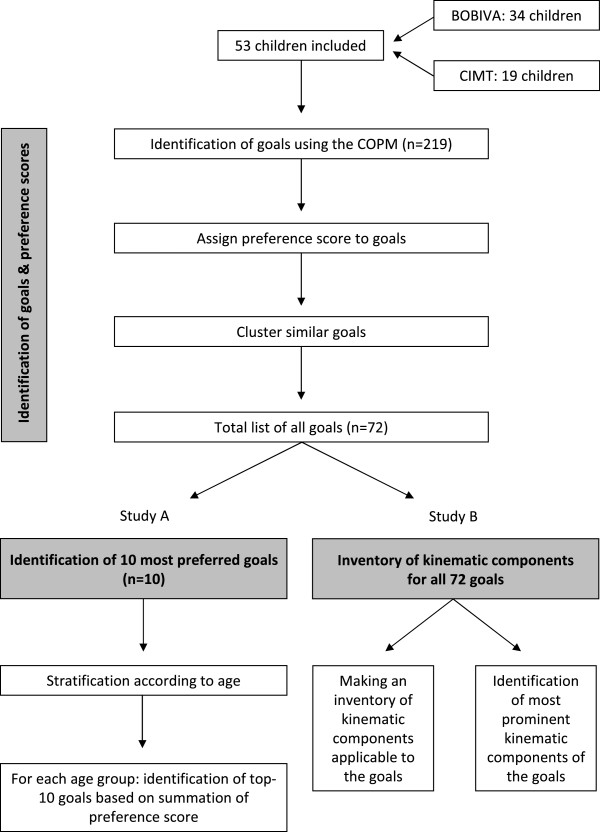
The Canadian Occupational Performance Measure was used to identify upper extremity-related ADL preferences (goals) of 53 children with CP encountering arm-hand problems (mean age 9 ± 4.5 year). Goals were ranked based on importance attributed to each goal and the number of times a goal was mentioned, resulting in a gross list with goals. Additionally, two studies were performed, i.e. study A to determine the 10 most preferred goals for 3 age groups (2.5-5 years; 6-11 years, 12-19 years), based on the total preference score, and study B to identify movement components, like reaching and grasping, of all goals identified for both the leading and the assisting arm-hand.
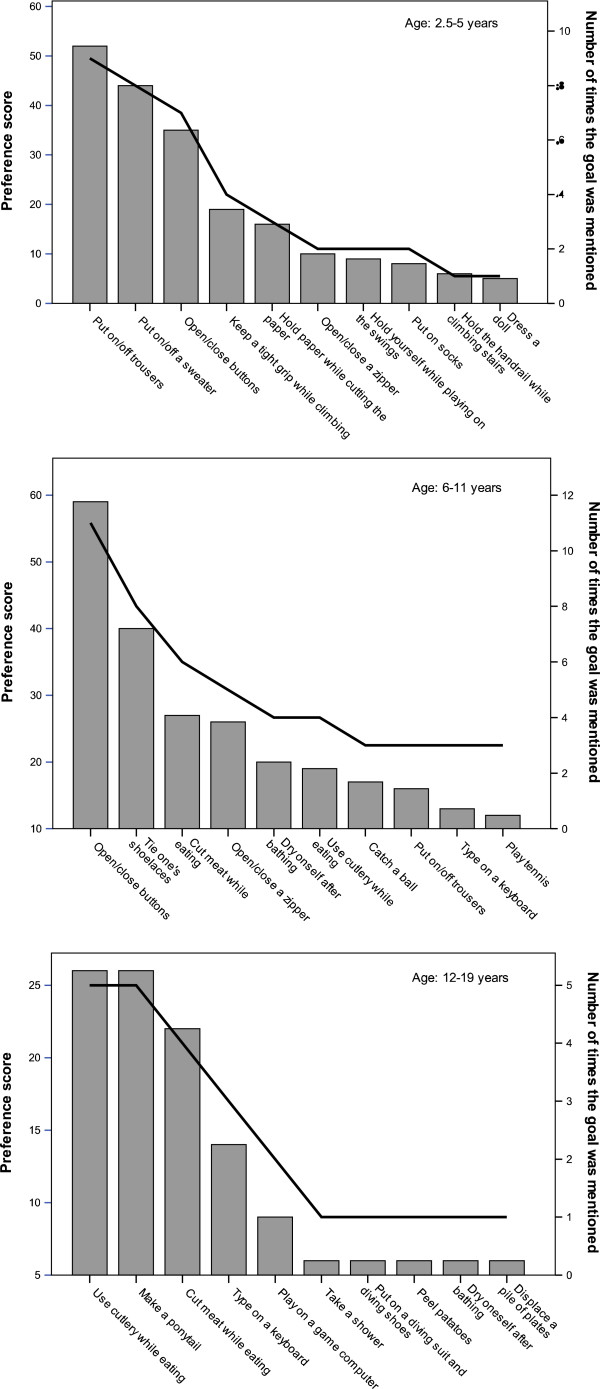
Seventy-two goals were identified. The 10 most preferred goals differed with age, changing from dressing and leisure-related goals in the youngest children to goals regarding personal care and eating for children aged 6-11 years. The oldest children preferred goals regarding eating, personal care and computer use. The movement components 'positioning', 'reach', 'grasp', and 'hold' were present in most tasks. 'Manipulating' was more important for the leading arm-hand, whereas 'fixating' was more important for the assisting arm-hand.
This study gave insight into the preferences regarding ADL children with CP would like to improve on, and the movement components characterizing these activities. This information can be used to create a set of standardized test situations, which can be used to assess the validity and reliability of new measurement instruments to gauge actual arm-hand skilled performance.
对于存在手臂和手部问题的脑瘫(CP)儿童,评估其手臂和手部的使用情况非常重要。为了确定用于评估实际表现的新工具的有效性和可靠性,需要一套包括日常生活活动(ADL)的标准化测试情境。本研究提供了相关信息,据此可针对特定研究问题对用于上肢技能研究的此类测试情境进行微调。本研究的目的是:a)确定CP儿童希望改善的与上肢相关的ADL;b)确定CP儿童最优先选择的10个目标;c)识别所有已确定目标的运动组成部分。
使用加拿大职业表现测量工具来确定53名存在手臂和手部问题的CP儿童(平均年龄9±4.5岁)与上肢相关的ADL偏好(目标)。根据每个目标的重要性以及提及该目标的次数对目标进行排序,从而得出一个包含目标的总清单。此外,还进行了两项研究,即研究A根据总偏好分数确定3个年龄组(2.5 - 5岁;6 - 11岁;12 - 19岁)最优先选择的10个目标,研究B识别主导手臂和辅助手臂及手部所有已确定目标的运动组成部分,如伸手和抓握。
共确定了72个目标。最优先选择的10个目标因年龄而异,从最小儿童组中与穿衣和休闲相关的目标,到6 - 11岁儿童组中与个人护理和进食相关的目标。年龄最大的儿童组更倾向于与进食、个人护理和使用电脑相关的目标。大多数任务中都存在“定位”“伸手”“抓握”和“握持”等运动组成部分。“操作”对于主导手臂和手部更为重要,而“固定”对于辅助手臂和手部更为重要。
本研究深入了解了CP儿童希望改善的ADL偏好以及表征这些活动的运动组成部分。这些信息可用于创建一套标准化测试情境,用于评估新测量工具评估实际手臂和手部技能表现的有效性和可靠性。