MRC Protein Phosphorylation and Ubiquitylation Unit, University of Dundee, Dundee, UK.
Open Biol. 2014 Mar 19;4(3):130213. doi: 10.1098/rsob.130213.
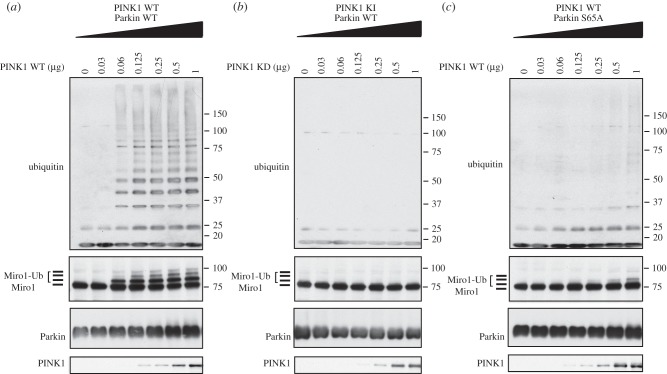
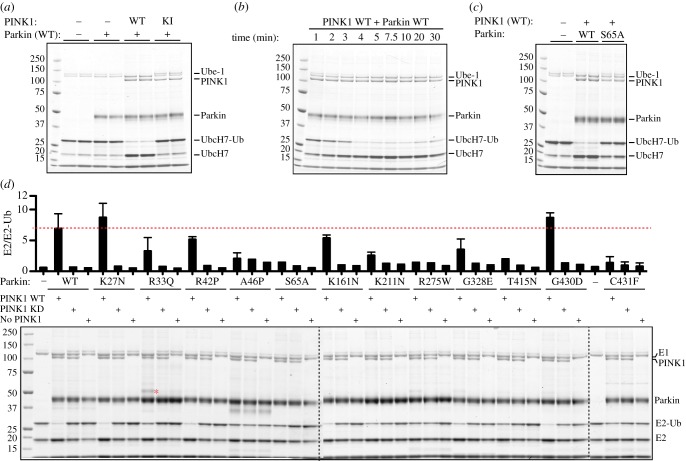
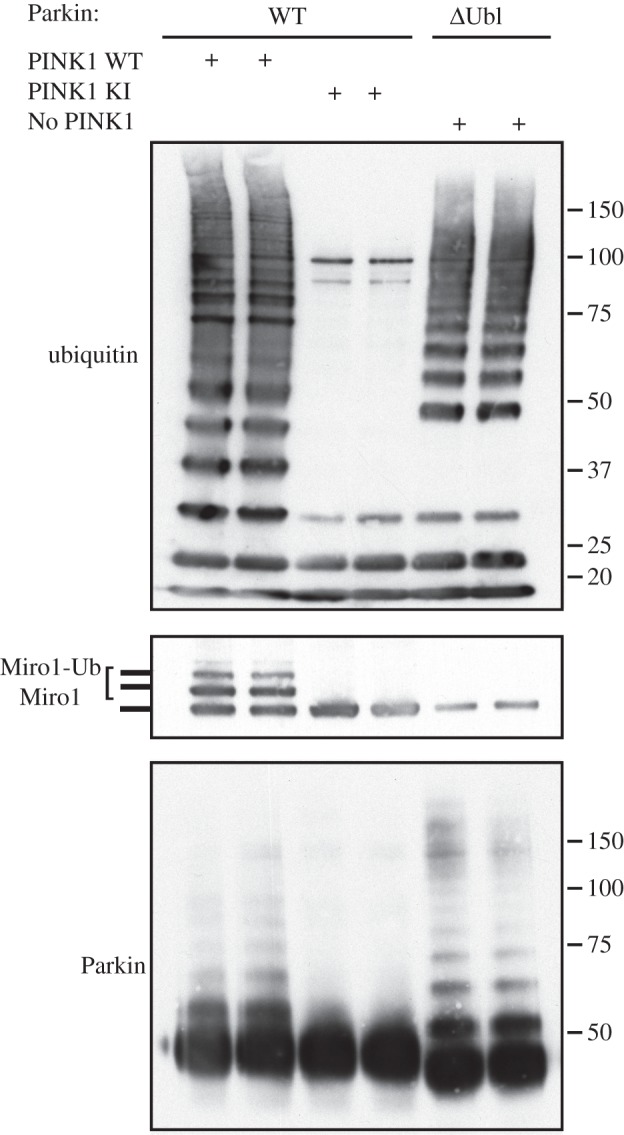
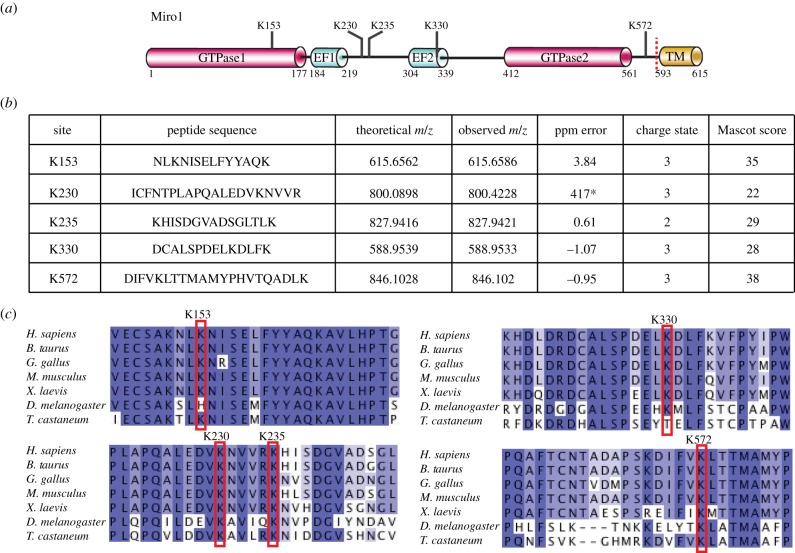
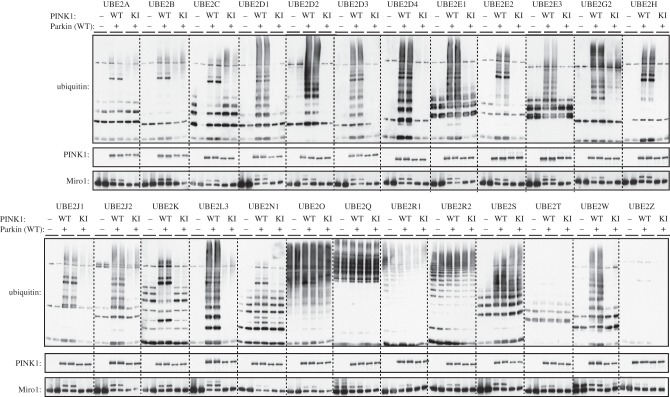
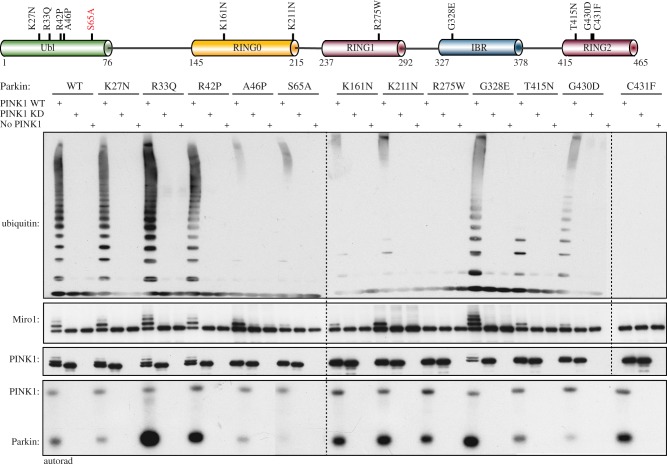
Mutations in PINK1 and Parkin are associated with early-onset Parkinson's disease. We recently discovered that PINK1 phosphorylates Parkin at serine65 (Ser(65)) within its Ubl domain, leading to its activation in a substrate-free activity assay. We now demonstrate the critical requirement of Ser(65) phosphorylation for substrate ubiquitylation through elaboration of a novel in vitro E3 ligase activity assay using full-length untagged Parkin and its putative substrate, the mitochondrial GTPase Miro1. We observe that Parkin efficiently ubiquitylates Miro1 at highly conserved lysine residues, 153, 230, 235, 330 and 572, upon phosphorylation by PINK1. We have further established an E2-ubiquitin discharge assay to assess Parkin activity and observe robust discharge of ubiquitin-loaded UbcH7 E2 ligase upon phosphorylation of Parkin at Ser(65) by wild-type, but not kinase-inactive PINK1 or a Parkin Ser65Ala mutant, suggesting a possible mechanism of how Ser(65) phosphorylation may activate Parkin E3 ligase activity. For the first time, to the best of our knowledge, we report the effect of Parkin disease-associated mutations in substrate-based assays using full-length untagged recombinant Parkin. Our mutation analysis indicates an essential role for the catalytic cysteine Cys431 and reveals fundamental new knowledge on how mutations may confer pathogenicity via disruption of Miro1 ubiquitylation, free ubiquitin chain formation or by impacting Parkin's ability to discharge ubiquitin from a loaded E2. This study provides further evidence that phosphorylation of Parkin at Ser(65) is critical for its activation. It also provides evidence that Miro1 is a direct Parkin substrate. The assays and reagents developed in this study will be important to uncover new insights into Parkin biology as well as aid in the development of screens to identify small molecule Parkin activators for the treatment of Parkinson's disease.
PINK1 和 Parkin 的突变与早发性帕金森病有关。我们最近发现,PINK1 在其 Ubl 结构域内将 Parkin 磷酸化丝氨酸 65(Ser(65)),导致其在无底物活性测定中激活。我们现在通过使用全长非标记 Parkin 及其假定底物线粒体 GTPase Miro1 的新型体外 E3 连接酶活性测定来证明 Ser(65)磷酸化对于底物泛素化的关键要求。我们观察到,在 PINK1 磷酸化后,Parkin 有效地将 Miro1 磷酸化高度保守的赖氨酸残基 153、230、235、330 和 572 进行泛素化。我们进一步建立了 E2-泛素释放测定法来评估 Parkin 的活性,并观察到野生型 Parkin 在 Ser(65)磷酸化后,对泛素加载的 UbcH7 E2 连接酶有强烈的释放,而激酶失活的 PINK1 或 Parkin Ser65Ala 突变体则没有,这表明 Ser(65)磷酸化可能激活 Parkin E3 连接酶活性的一种可能机制。据我们所知,这是首次在基于底物的全长非标记重组 Parkin 测定中报道帕金森病相关突变的影响。我们的突变分析表明催化半胱氨酸 Cys431 的重要作用,并揭示了有关突变如何通过破坏 Miro1 泛素化、游离泛素链形成或影响 Parkin 从负载 E2 释放泛素的能力来导致致病性的基本新知识。这项研究进一步证明了 Parkin 在 Ser(65)的磷酸化对其激活至关重要。它还提供了证据表明 Miro1 是 Parkin 的直接底物。本研究中开发的测定法和试剂将有助于深入了解 Parkin 生物学,并有助于开发用于治疗帕金森病的小分子 Parkin 激活剂的筛选。