Department of Orthopaedics and Traumatology , Odense University Hospital and University of Southern Denmark, Odense , Denmark.
Acta Orthop. 2014 Apr;85(2):141-6. doi: 10.3109/17453674.2014.899840.
To our knowledge, there is no evidence to support the use of local infiltration analgesia (LIA) for postoperative pain relief after periacetabular osteotomy (PAO). We investigated the effect of wound infiltration with a long-acting local anesthetic (ropivacaine) for postoperative analgesia after PAO.
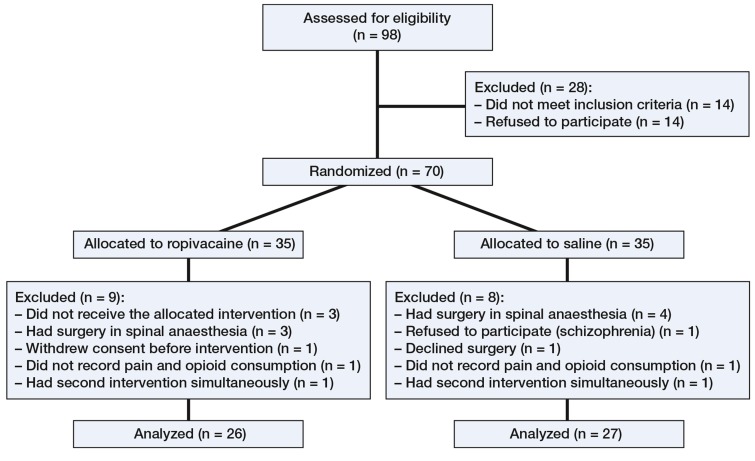
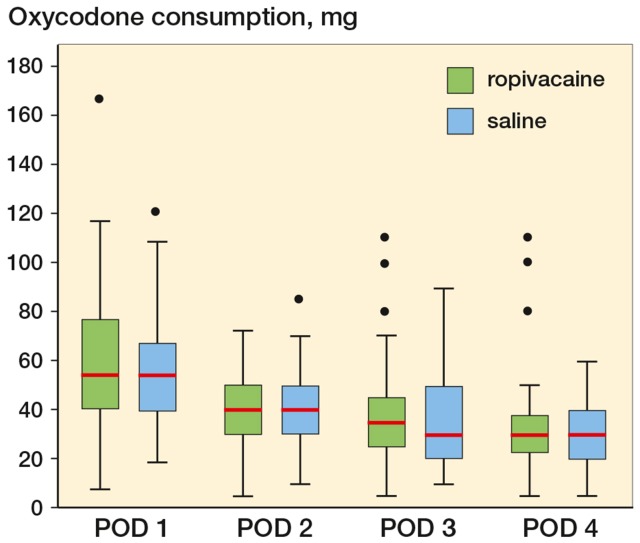
We performed a randomized, double-blind, placebo-controlled trial (ClinicalTrials.gov: NCT00815503) in 53 patients undergoing PAO to evaluate the effect of local anesthetic infiltration on postoperative pain and on postoperative opioid consumption. All subjects received intraoperative infiltration followed by 5 postoperative injections in 10-hour intervals through a multi-holed catheter placed at the surgical site. 26 patients received ropivacaine and 27 received saline. The intervention period was 2 days and the observational period was 4 days. All subjects received patient-controlled opioid analgesia without any restrictions on the total daily dose. Pain was assessed at specific postoperative time points and the daily opioid usage was registered.
Infiltration with 75 mL (150 mg) of ropivacaine did not reduce postoperative pain or opioid requirements during the first 4 days.
The clinical importance of ropivacaine as single component in postoperative treatment of pain is questionable, and we are planning further studies to explore the potential of LIA in larger volume-and also a multimodal regimen-to treat pain in this category of patients.
据我们所知,目前尚无证据支持在髋臼周围截骨术(PAO)后使用局部浸润镇痛(LIA)来缓解术后疼痛。我们研究了长效局部麻醉剂(罗哌卡因)在 PAO 后用于术后镇痛的效果。
我们在 53 例行 PAO 的患者中进行了一项随机、双盲、安慰剂对照试验(ClinicalTrials.gov:NCT00815503),以评估局部麻醉浸润对术后疼痛和术后阿片类药物消耗的影响。所有患者均接受术中浸润,随后通过放置在手术部位的多孔导管在 10 小时间隔内接受 5 次术后注射。26 例患者接受罗哌卡因,27 例患者接受生理盐水。干预期为 2 天,观察期为 4 天。所有患者均接受患者自控阿片类药物镇痛,不限制总日剂量。在特定的术后时间点评估疼痛,并记录每日阿片类药物的使用情况。
75 毫升(150 毫克)罗哌卡因的浸润并未在第 1 至 4 天减轻术后疼痛或阿片类药物的需求。
罗哌卡因作为单一成分在术后疼痛治疗中的临床重要性值得怀疑,我们正在计划进一步的研究,以探索 LIA 在更大容量下的潜力——以及多模式方案——来治疗这一类患者的疼痛。