Jennifer Samson Jegan, Muthiah Packianathan Thomas
School of Chemistry, Tiruchirappalli 620024 Tamil Nadu, India.
Chem Cent J. 2014 Mar 22;8:20. doi: 10.1186/1752-153X-8-20. eCollection 2014.
The utility of N-heterocyclic bases to obtain molecular complexes with carboxylic acids is well studied. Depending on the solid state interaction between the N-heterocyclic base and a carboxylic acid a variety of neutral or ionic synthons are observed. Meanwhile, pyridines and pyrimidines have been frequently chosen in the area of crystal engineering for their multipurpose functionality. HT (hetero trimers) and LHT (linear heterotetramers) are the well known synthons that are formed in the presence of pyrimidines and carboxylic acids.
Fourteen crystals involving various substituted thiophene carboxylic acid derivatives and nitrogenous bases were prepared and characterized by using single crystal X-ray diffraction. The 14 crystals can further be divided into two groups [1a-7a], [8b-14b] based on the nature of the nitrogenous base. Carboxylic acid to pyridine proton transfer has occurred in 3 compounds of each group. In addition to the commonly occurring hydrogen bond based pyridine/carboxylic acid and pyrimidine/carboxylic acid synthons which is the reason for assembly of primary motifs, various other interactions like Cl…Cl, Cl…O, C-H…Cl, C-H…S add additional support in organizing these supermolecules into extended architectures. It is also interesting to note that in all the compounds π-π stacking occurs between the pyrimidine-pyrimidine or pyridine-pyridine or acid-acid moieties rather than acid-pyrimidine/pyridine.
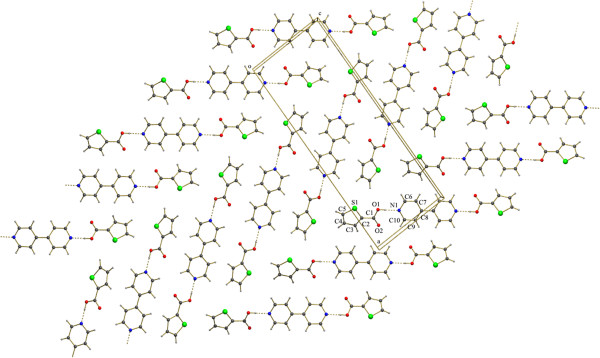
In all the compounds (1a-14b) either neutral O-H…Npyridyl/pyrimidine or charge-assisted Npyridinium-H…Ocarboxylate hydrogen bonds are present. The HT (hetero trimers) and LHT (linear heterotetramers) are dominant in the crystal structures of the adducts containing N-heterocyclic bases with two proton acceptors (1a-7a). Similar type supramolecular ladders are observed in 5TPC44BIPY (8b), TPC44BIPY (9b), TPC44TMBP (11b). Among the seven compounds [8b-14b] the extended ligands are linear in all except for the TMBP (10b, 11b, 12b). The structure of each compound depends on the dihedral angle between the carboxyl group and the nitrogenous base. All these compounds indicate three main synthons that regularly occur, namely linear heterodimer (HD), heterotrimer (HT) and heterotetramer (LHT).
N - 杂环碱与羧酸形成分子配合物的效用已得到充分研究。根据N - 杂环碱与羧酸之间的固态相互作用,可观察到多种中性或离子合成子。同时,吡啶和嘧啶因其多功能性在晶体工程领域中经常被选用。HT(杂三聚体)和LHT(线性杂四聚体)是在嘧啶和羧酸存在下形成的著名合成子。
制备了14种涉及各种取代噻吩羧酸衍生物和含氮碱的晶体,并通过单晶X射线衍射进行了表征。基于含氮碱的性质,这14种晶体可进一步分为两组[1a - 7a],[8b - 14b]。每组中的3种化合物发生了羧酸到吡啶的质子转移。除了常见的基于氢键的吡啶/羧酸和嘧啶/羧酸合成子(这是初级结构单元组装的原因)外,各种其他相互作用,如Cl…Cl、Cl…O、C - H…Cl、C - H…S,为将这些超分子组织成扩展结构提供了额外支持。还值得注意的是,在所有化合物中,π - π堆积发生在嘧啶 - 嘧啶或吡啶 - 吡啶或酸 - 酸部分之间,而非酸 - 嘧啶/吡啶之间。
在所有化合物(1a - 14b)中,要么存在中性的O - H…N吡啶基/嘧啶氢键,要么存在电荷辅助的N吡啶鎓 - H…O羧酸盐氢键。HT(杂三聚体)和LHT(线性杂四聚体)在含有具有两个质子受体的N - 杂环碱的加合物(1a - 7a)的晶体结构中占主导地位。在5TPC44BIPY(8b)、TPC44BIPY(9b)、TPC44TMBP(11b)中观察到类似类型的超分子梯子。在七种化合物[8b - 14b]中,除了TMBP(10b、11b、12b)外,扩展配体都是线性的。每种化合物的结构取决于羧基和含氮碱之间的二面角。所有这些化合物都表明有三种经常出现的主要合成子,即线性异二聚体(HD)、杂三聚体(HT)和杂四聚体(LHT)。