Lam Connie, Octavia Sophie, Ricafort Lawrence, Sintchenko Vitali, Gilbert Gwendolyn L, Wood Nicholas, McIntyre Peter, Marshall Helen, Guiso Nicole, Keil Anthony D, Lawrence Andrew, Robson Jenny, Hogg Geoff, Lan Ruiting
Emerg Infect Dis. 2014 Apr;20(4):626-33. doi: 10.3201/eid2004.131478.
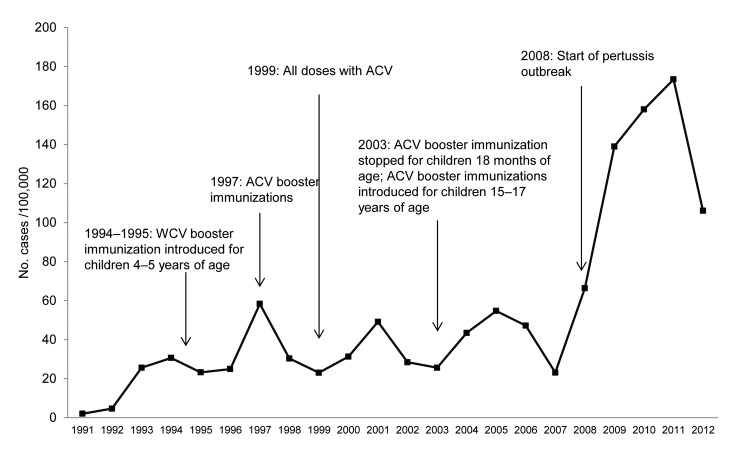
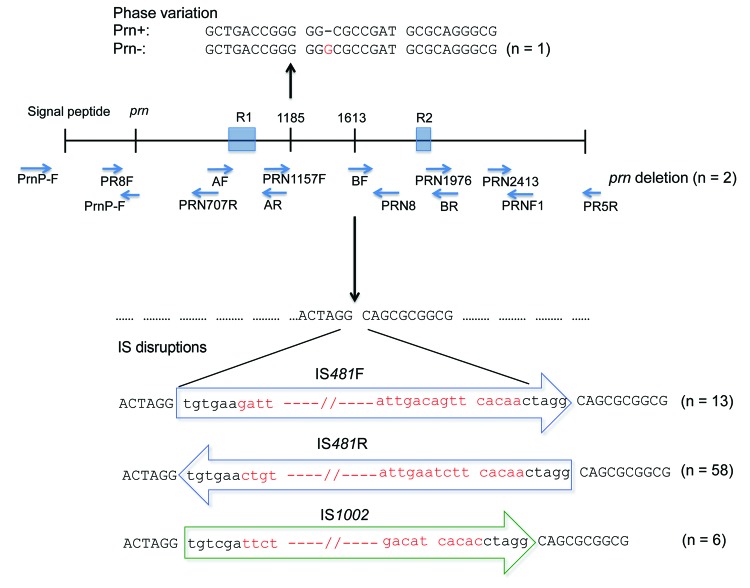
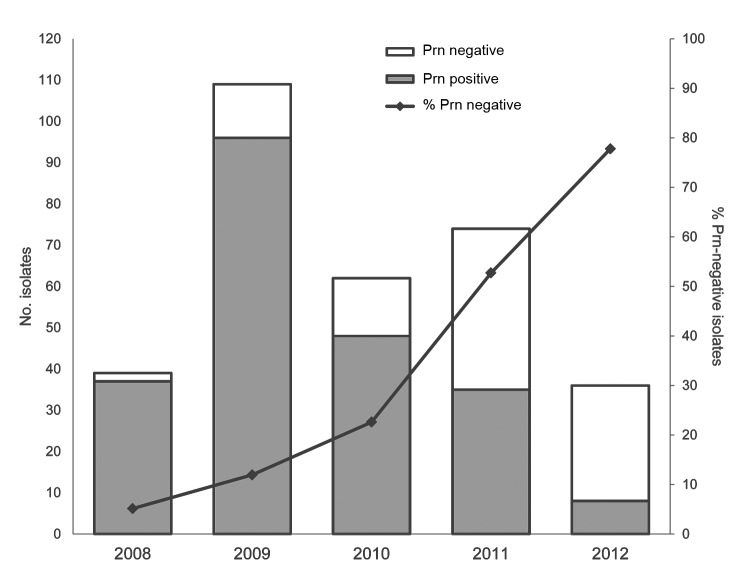
Acellular vaccines against Bordetella pertussis were introduced in Australia in 1997. By 2000, these vaccines had replaced whole-cell vaccines. During 2008-2012, a large outbreak of pertussis occurred. During this period, 30% (96/320) of B. pertussis isolates did not express the vaccine antigen pertactin (Prn). Multiple mechanisms of Prn inactivation were documented, including IS481 and IS1002 disruptions, a variation within a homopolymeric tract, and deletion of the prn gene. The mechanism of lack of expression of Prn in 16 (17%) isolates could not be determined at the sequence level. These findings suggest that B. pertussis not expressing Prn arose independently multiple times since 2008, rather than by expansion of a single Prn-negative clone. All but 1 isolate had ptxA1, prn2, and ptxP3, the alleles representative of currently circulating strains in Australia. This pattern is consistent with continuing evolution of B. pertussis in response to vaccine selection pressure.
1997年,澳大利亚引入了针对百日咳博德特氏菌的无细胞疫苗。到2000年,这些疫苗已取代了全细胞疫苗。在2008 - 2012年期间,发生了一次大规模百日咳疫情。在此期间,30%(96/320)的百日咳博德特氏菌分离株不表达疫苗抗原百日咳黏附素(Prn)。记录了多种Prn失活机制,包括IS481和IS1002破坏、同聚物区域内的变异以及prn基因的缺失。在16株(17%)分离株中,无法在序列水平确定Prn表达缺失的机制。这些发现表明,自2008年以来,不表达Prn的百日咳博德特氏菌多次独立出现,而非通过单个Prn阴性克隆的扩增。除1株分离株外,所有分离株均具有ptxA1、prn2和ptxP3,这些等位基因代表了澳大利亚目前流行菌株。这种模式与百日咳博德特氏菌在疫苗选择压力下持续进化一致。