Fogarty International Center, National Institutes of Health, Bethesda, USA.
Popul Health Metr. 2014 Mar 21;12(1):8. doi: 10.1186/1478-7954-12-8.
There is no standardized approach to comparing socioeconomic status (SES) across multiple sites in epidemiological studies. This is particularly problematic when cross-country comparisons are of interest. We sought to develop a simple measure of SES that would perform well across diverse, resource-limited settings.
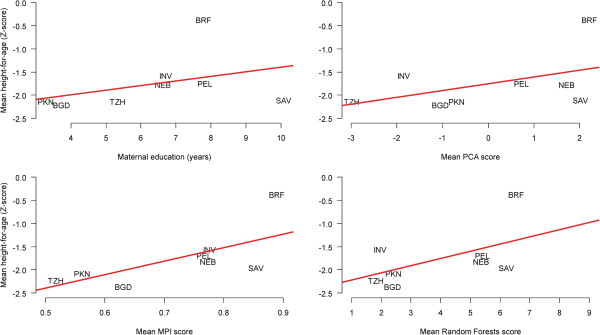
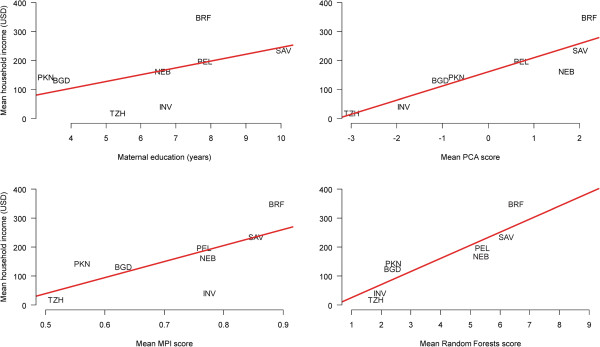
A cross-sectional study was conducted with 800 children aged 24 to 60 months across eight resource-limited settings. Parents were asked to respond to a household SES questionnaire, and the height of each child was measured. A statistical analysis was done in two phases. First, the best approach for selecting and weighting household assets as a proxy for wealth was identified. We compared four approaches to measuring wealth: maternal education, principal components analysis, Multidimensional Poverty Index, and a novel variable selection approach based on the use of random forests. Second, the selected wealth measure was combined with other relevant variables to form a more complete measure of household SES. We used child height-for-age Z-score (HAZ) as the outcome of interest.
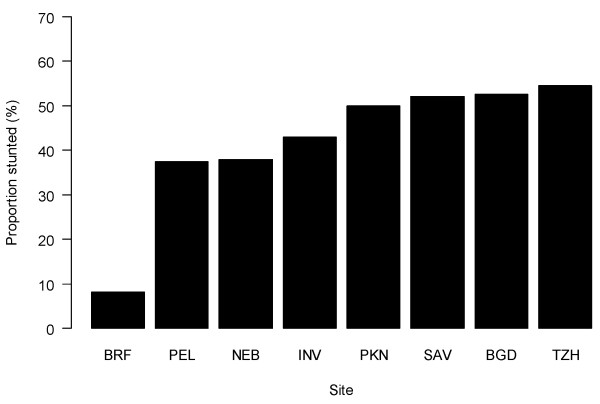
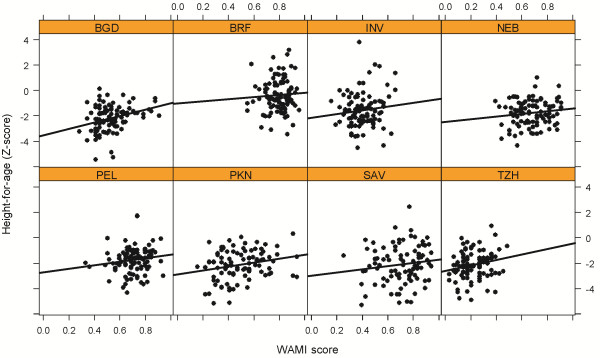
Mean age of study children was 41 months, 52% were boys, and 42% were stunted. Using cross-validation, we found that random forests yielded the lowest prediction error when selecting assets as a measure of household wealth. The final SES index included access to improved water and sanitation, eight selected assets, maternal education, and household income (the WAMI index). A 25% difference in the WAMI index was positively associated with a difference of 0.38 standard deviations in HAZ (95% CI 0.22 to 0.55).
Statistical learning methods such as random forests provide an alternative to principal components analysis in the development of SES scores. Results from this multicountry study demonstrate the validity of a simplified SES index. With further validation, this simplified index may provide a standard approach for SES adjustment across resource-limited settings.
在流行病学研究中,没有一种标准化的方法可以比较多个地点的社会经济地位(SES)。当涉及跨国比较时,这尤其成问题。我们试图开发一种简单的 SES 衡量标准,该标准在各种资源有限的环境中表现良好。
在八个资源有限的环境中,对 800 名年龄在 24 至 60 个月的儿童进行了一项横断面研究。要求父母回答家庭 SES 问卷,并测量每个孩子的身高。在两个阶段进行了统计分析。首先,确定了选择和加权家庭资产作为财富代理的最佳方法。我们比较了四种衡量财富的方法:母亲教育、主成分分析、多维贫困指数以及基于随机森林使用的新变量选择方法。其次,将所选的财富衡量标准与其他相关变量结合起来,形成一个更全面的家庭 SES 衡量标准。我们使用儿童身高年龄 Z 分数(HAZ)作为感兴趣的结果。
研究儿童的平均年龄为 41 个月,52%为男孩,42%为发育迟缓。使用交叉验证,我们发现随机森林在选择资产作为家庭财富衡量标准时产生的预测误差最小。最终的 SES 指数包括获得改善的水和卫生设施、八项选定资产、母亲教育和家庭收入(WAMI 指数)。WAMI 指数相差 25%与 HAZ 相差 0.38 个标准差(95%CI 0.22 至 0.55)呈正相关。
随机森林等统计学习方法为 SES 评分的开发提供了主成分分析的替代方法。这项多国家研究的结果证明了简化 SES 指数的有效性。经过进一步验证,这种简化的指数可以为资源有限的环境中的 SES 调整提供一种标准方法。