Wang Chengjie, Han Guodong, Wang Shiping, Zhai Xiajie, Brown Joel, Havstad Kris M, Ma Xiuzhi, Wilkes Andreas, Zhao Mengli, Tang Shiming, Zhou Pei, Jiang Yuanyuan, Lu Tingting, Wang Zhongwu, Li Zhiguo
College of Ecology and Environmental Science, Inner Mongolia Agricultural University, Huhhot 010018, China.
Laboratory of Alpine Ecology and Biodiversity, Institute of Tibetan Plateau Research, Chinese Academy of Sciences, Beijing 100101, China.
Sci Rep. 2014 Mar 24;4:4444. doi: 10.1038/srep04444.
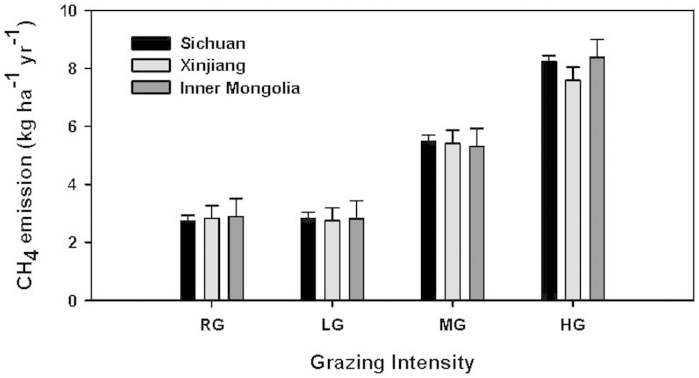
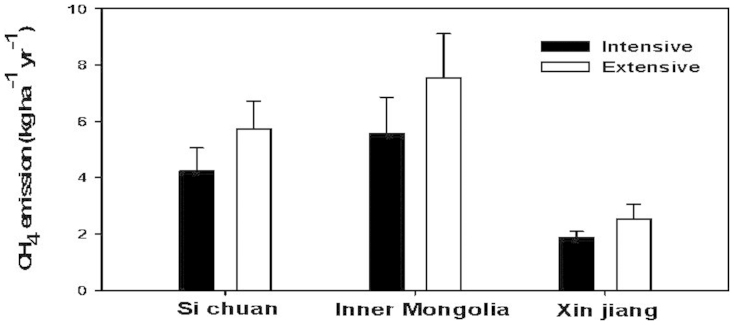
Considering their contribution to global warming, the sources and sinks of methane (CH4) should be accounted when undertaking a greenhouse gas inventory for grazed rangeland ecosystems. The aim of this study was to evaluate the mitigation potential of current ecological management programs implemented in the main rangeland regions of China. The influences of rangeland improvement, utilization and livestock production on CH4 flux/emission were assessed to estimate CH4 reduction potential. Results indicate that the grazed rangeland ecosystem is currently a net source of atmospheric CH4. However, there is potential to convert the ecosystem to a net sink by improving management practices. Previous assessments of capacity for CH4 uptake in grazed rangeland ecosystems have not considered improved livestock management practices and thus underestimated potential for CH4 uptake. Optimal fertilization, rest and light grazing, and intensification of livestock management contribute mitigation potential significantly.
考虑到甲烷(CH₄)对全球变暖的影响,在对放牧草地生态系统进行温室气体清单编制时,应核算其源汇情况。本研究的目的是评估中国主要草地地区目前实施的生态管理计划的减排潜力。评估了草地改良、利用和畜牧生产对CH₄通量/排放的影响,以估算CH₄减排潜力。结果表明,目前放牧草地生态系统是大气CH₄的净源。然而,通过改进管理措施,有可能将该生态系统转变为净汇。先前对放牧草地生态系统CH₄吸收能力的评估未考虑改进的畜牧管理措施,因此低估了CH₄吸收潜力。优化施肥、休牧和轻度放牧以及强化畜牧管理对减排潜力有显著贡献。