Pearson Carolyn M, Zapolski Tamika C B, Smith Gregory T
Department of Psychology, University of Kentucky, Lexington, Kentucky.
Int J Eat Disord. 2015 Mar;48(2):230-7. doi: 10.1002/eat.22277. Epub 2014 Mar 23.
The very early engagement in bulimic behaviors, such as binge eating, may be influenced by factors that dispose individuals to impulsive action as well as by factors that dispose individuals to depressive symptomatology. Using a longitudinal design, we conducted the first test of the simultaneous operation of both risk factors as children transition from elementary to middle school.
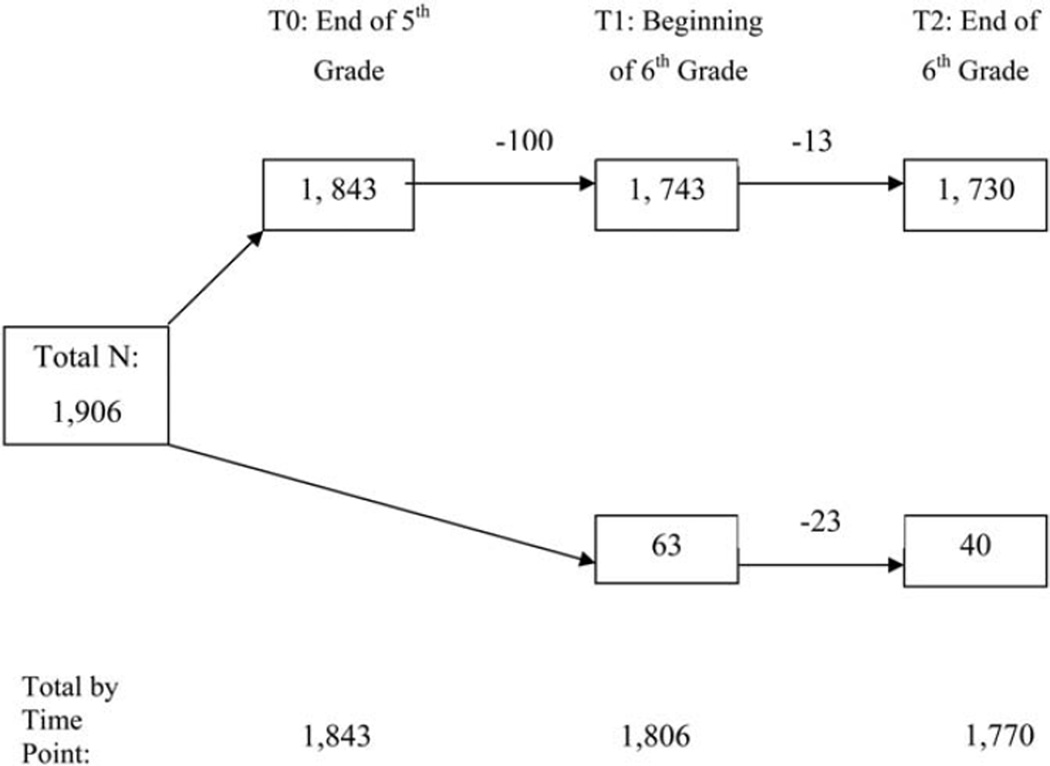
In a sample of 1,906 children, we assessed risk for impulsive action (negative urgency, which is the tendency to act rashly when distressed, and eating expectancies, which are learned anticipations that eating will alleviate negative mood) and risk for depression (negative affect and depressive symptomatology) and binge eating behavior at three time points using a longitudinal design: the end of fifth grade (last year of elementary school: T0), the beginning of sixth grade (first year of middle school: T1), and the end of sixth grade (T2).
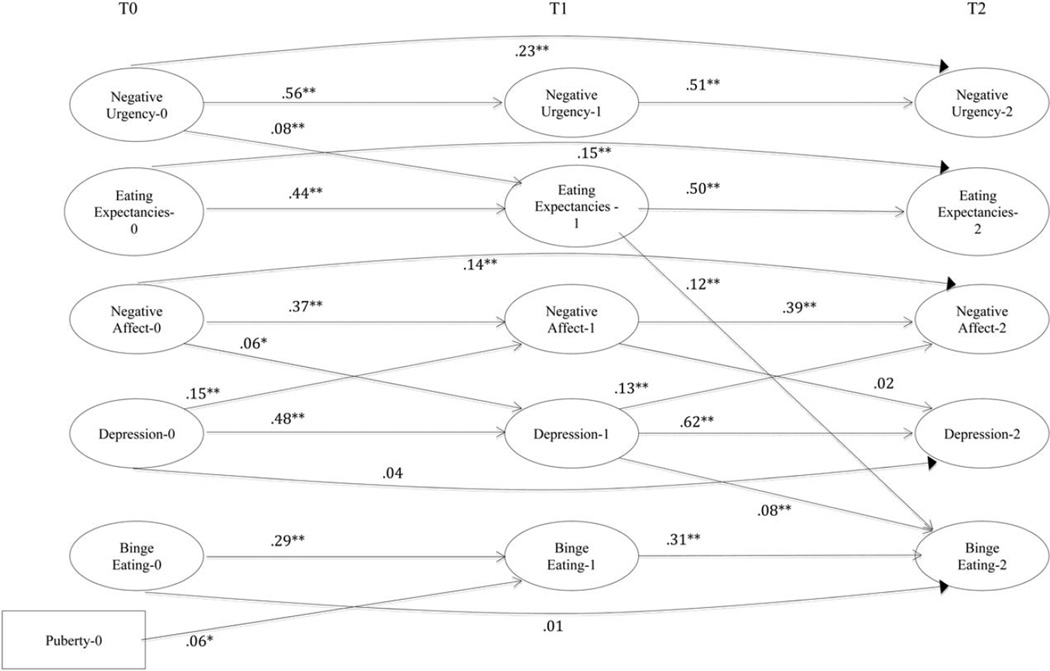
Both the impulsive action and depression pathways predicted very early engagement in binge eating: each accounted for variance beyond the other. Mediation tests found that T1 eating expectancies mediated the predictive influence of T0 negative urgency on T2 binge eating (z = 2.45, p < .01) and that T1 depressive symptoms mediated the influence of T0 negative affect on T2 binge eating (z = 2.04, p < .05).
In children, elevated levels of both negative urgency and negative affect predict early binge eating. This finding has important clinical implications because there are different interventions for the two different risk processes.
诸如暴饮暴食等早期出现的暴食行为,可能受到促使个体产生冲动行为的因素以及促使个体出现抑郁症状的因素的影响。我们采用纵向设计,首次对儿童从小学过渡到初中时这两种风险因素的同时作用进行了测试。
在一个包含1906名儿童的样本中,我们采用纵向设计,在三个时间点评估冲动行为风险(消极紧迫性,即苦恼时 rashly 行动的倾向,以及进食预期,即习得的认为进食会缓解消极情绪的预期)、抑郁风险(消极情绪和抑郁症状)以及暴饮暴食行为:五年级末(小学最后一年:T0)、六年级初(初中第一年:T1)和六年级末(T2)。
冲动行为和抑郁途径均预测了早期暴饮暴食行为:二者各自解释了超出对方的方差。中介检验发现,T1进食预期介导了T0消极紧迫性对T2暴饮暴食行为的预测影响(z = 2.45,p <.01),且T1抑郁症状介导了T0消极情绪对T2暴饮暴食行为的影响(z = 2.04,p <.05)。
在儿童中,消极紧迫性和消极情绪水平升高均预示着早期暴饮暴食行为。这一发现具有重要的临床意义,因为针对这两种不同的风险过程有不同的干预措施。