Bayala Bagora, Bassole Imaël Henri Nestor, Gnoula Charlemagne, Nebie Roger, Yonli Albert, Morel Laurent, Figueredo Gilles, Nikiema Jean-Baptiste, Lobaccaro Jean-Marc A, Simpore Jacques
Centre de Recherche Biomoléculaire Pietro Annigoni (CERBA), Laboratoire de Biologie et Génétique (LABIOGENE), Centre Médical Saint Camille, Ouagadougou, Université de Ouagadougou, Ouagadougou, Burkina Faso; Clermont Université, Université Blaise Pascal, Génétique Reproduction et Développement (GReD), Clermont-Ferrand, France; Centre National de la Recherche Scientifique (CNRS), Unité Mixte de Recherche (UMR) 6293, GReD, Aubière, France; Institut National de la Santé et de la Recherche Médicale (INSERM), UMR 1103, GReD, Aubière, France; Centre de Recherche en Nutrition Humaine d'Auvergne, Clermont-Ferrand, France.
Laboratoire de Biochimie Alimentaire, Enzymologie, Biotechnologies industrielles et Bioinformatique (BAEBIB), Unité de Formation et de Recherche en Sciences de la Vie et de la Terre (UFR-SVT), Université de Ouagadougou, Ouagadougou, Burkina Faso.
PLoS One. 2014 Mar 24;9(3):e92122. doi: 10.1371/journal.pone.0092122. eCollection 2014.
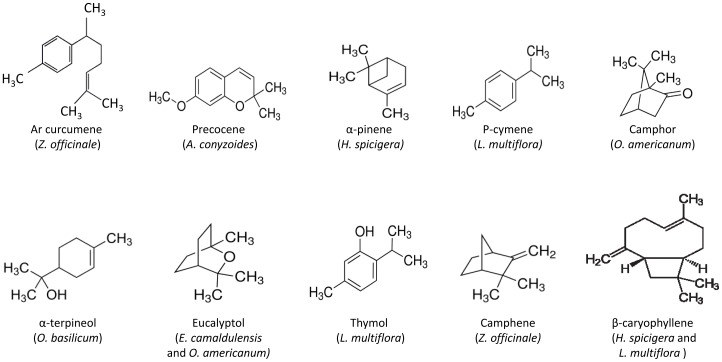
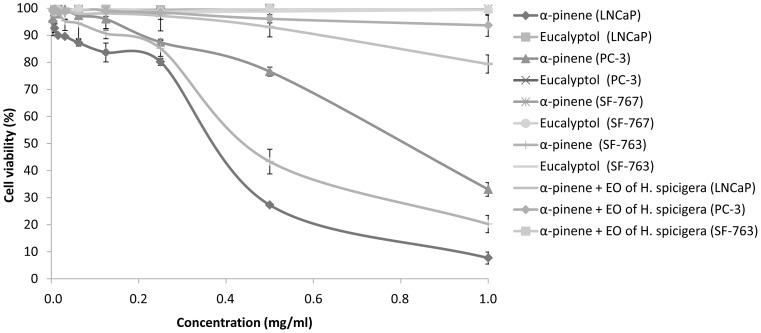
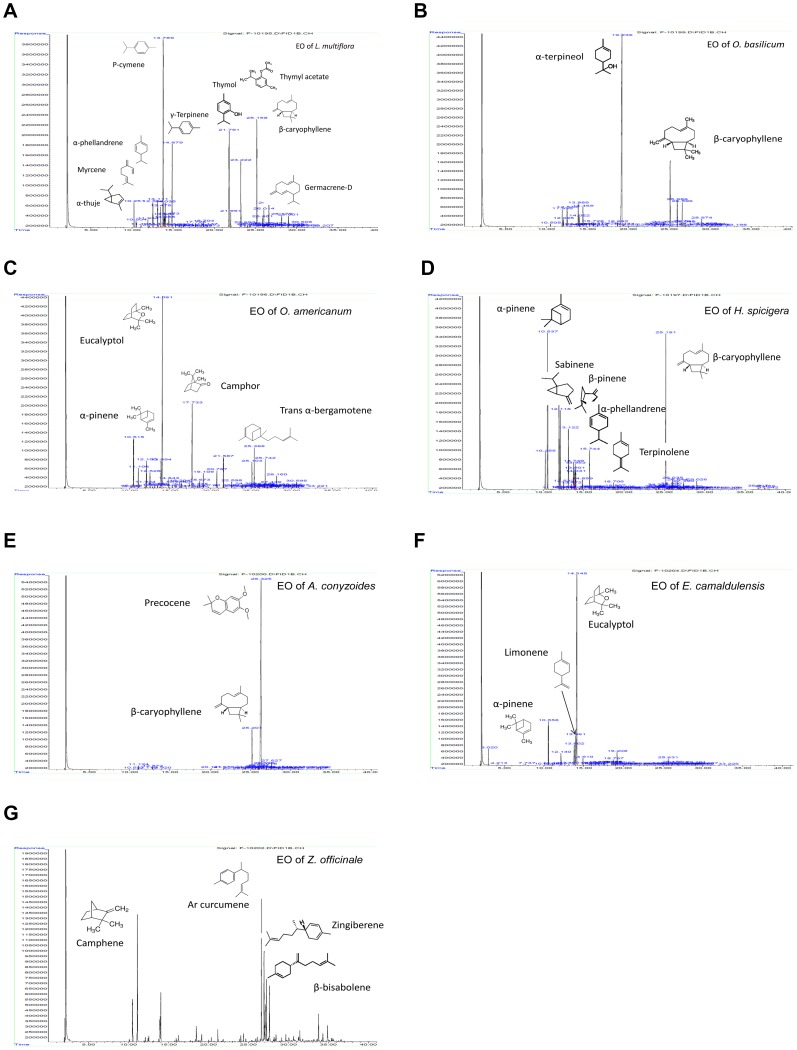
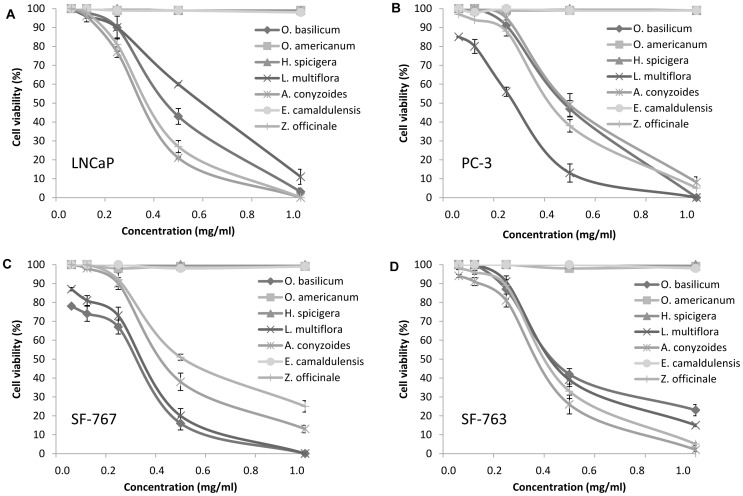
This research highlights the chemical composition, antioxidant, anti-inflammatory and anti-proliferative activities of essential oils from leaves of Ocimum basilicum, Ocimum americanum, Hyptis spicigera, Lippia multiflora, Ageratum conyzoides, Eucalyptus camaldulensis and Zingiber officinale. Essential oils were analyzed by gas chromatography-mass spectrometry and gas chromatography-flame ionization detector. Major constituents were α-terpineol (59.78%) and β-caryophyllene (10.54%) for Ocimum basilicum; 1, 8-cineol (31.22%), camphor (12.730%), α-pinene (6.87%) and trans α-bergamotene (5.32%) for Ocimum americanum; β-caryophyllene (21%), α-pinene (20.11%), sabinene (10.26%), β-pinene (9.22%) and α-phellandrene (7.03%) for Hyptis spicigera; p-cymene (25.27%), β-caryophyllene (12.70%), thymol (11.88), γ-terpinene (9.17%) and thymyle acetate (7.64%) for Lippia multiflora; precocene (82.10%)for Ageratum conyzoides; eucalyptol (59.55%), α-pinene (9.17%) and limonene (8.76%) for Eucalyptus camaldulensis; arcurcumene (16.67%), camphene (12.70%), zingiberene (8.40%), β-bisabolene (7.83%) and β-sesquiphellandrène (5.34%) for Zingiber officinale. Antioxidant activities were examined using 1,1-diphenyl-2-picryl-hydrazyl (DPPH) and 2,2'-azinobis-(3-ethylbenzothiazoline-6-sulfonic acid (ABTS) methods. O. basilicum and L. multiflora exhibited the highest antioxidant activity in DPPH and ABTS tests, respectively. Anti-inflammatory properties were evaluated by measuring the inhibition of lipoxygenase activity and essential oil of Z. officinale was the most active. Anti-proliferative effect was assayed by the measurement of MTT on LNCaP and PC-3 prostate cancer cell lines, and SF-763 and SF-767 glioblastoma cell lines. Essential oils from A. conyzoides and L. multiflora were the most active on LNCaP and PC-3 cell lines, respectively. The SF-767 glioblastoma cell line was the most sensitive to O. basilicum and L. multiflora EOs while essential oil of A. conyzoides showed the highest activity on SF-763 cells. Altogether these results justify the use of these plants in traditional medicine in Burkina Faso and open a new field of investigation in the characterization of the molecules involved in anti-proliferative processes.
本研究着重介绍了罗勒、美洲罗勒、穗状香科塔、多花过江藤、藿香、桉和姜等植物叶片精油的化学成分、抗氧化、抗炎及抗增殖活性。采用气相色谱 - 质谱联用仪和气相色谱 - 火焰离子化检测器对精油进行分析。罗勒精油的主要成分为α - 萜品醇(59.78%)和β - 石竹烯(10.54%);美洲罗勒精油的主要成分为1,8 - 桉叶素(31.22%)、樟脑(12.730%)、α - 蒎烯(6.87%)和反式α - 佛手柑油烯(5.32%);穗状香科塔精油的主要成分为β - 石竹烯(21%)、α - 蒎烯(20.11%)、桧烯(10.26%)、β - 蒎烯(9.22%)和α - 水芹烯(7.03%);多花过江藤精油的主要成分为对伞花烃(25.27%)、β - 石竹烯(12.70%)、百里香酚(11.88)、γ - 萜品烯(9.17%)和乙酸百里酯(7.64%);藿香精油的主要成分为早熟素(82.10%);桉精油的主要成分为桉叶油素(59.55%)、α - 蒎烯(9.17%)和柠檬烯(8.76%);姜精油的主要成分为莪术烯(16.67%)、莰烯(12.70%)、姜烯(8.40%)、β - 红没药烯(7.83%)和β - 倍半水芹烯(5.34%)。采用1,1 - 二苯基 - 2 - 苦基肼(DPPH)法和2,2'- 联氮 - 双 -(3 - 乙基苯并噻唑啉 - 6 - 磺酸)(ABTS)法检测抗氧化活性。罗勒和多花过江藤分别在DPPH和ABTS试验中表现出最高的抗氧化活性。通过测定脂氧合酶活性评估抗炎特性,姜精油的活性最强。采用MTT法检测对LNCaP和PC - 3前列腺癌细胞系以及SF - 763和SF - 767胶质母细胞瘤细胞系的抗增殖作用。藿香和多花过江藤精油分别对LNCaP和PC - 3细胞系活性最强。SF - 767胶质母细胞瘤细胞系对罗勒和多花过江藤精油最敏感,而藿香精油对SF - 763细胞活性最高。总之,这些结果证明了布基纳法索传统医学中使用这些植物的合理性,并为抗增殖过程中涉及分子的表征开辟了新的研究领域。