Yu Zheng, Yang Jun, Liu Lemian
Aquatic EcoHealth Group, Key Laboratory of Urban Environment and Health, Institute of Urban Environment, Chinese Academy of Sciences, Xiamen, P. R. China; University of Chinese Academy of Sciences, Beijing, P. R. China.
Aquatic EcoHealth Group, Key Laboratory of Urban Environment and Health, Institute of Urban Environment, Chinese Academy of Sciences, Xiamen, P. R. China.
PLoS One. 2014 Mar 24;9(3):e92055. doi: 10.1371/journal.pone.0092055. eCollection 2014.
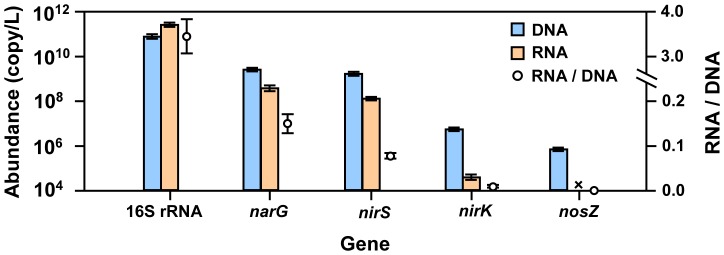
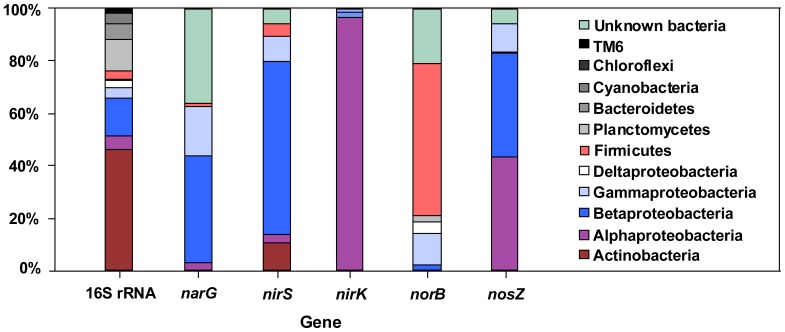
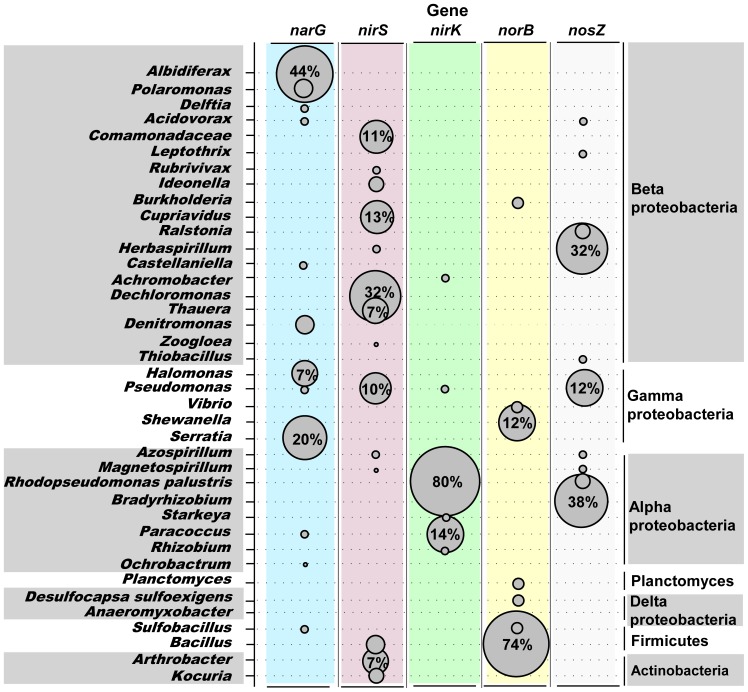
Denitrification is an important pathway for nitrogen removal from aquatic systems and this could benefit water quality. However, little is known about the denitrifier community composition and key steps of denitrification in the freshwater environments, and whether different bacteria have a role in multiple processes of denitrification reduction. In this study, quantitative PCR, quantitative RT-PCR, clone library and 454 pyrosequencing were used together to investigate the bacterial and denitrifier community in a subtropical deep reservoir during the strongly stratified period. Our results indicated that the narG gene recorded the highest abundance among the denitrifying genes (2.76×10⁹ copies L-1 for DNA and 4.19×10⁸ copies L-1 for RNA), and the lowest value was nosZ gene (7.56×10⁵ copies L-1 for DNA and undetected for RNA). The RNA: DNA ratios indicated that narG gene was the most active denitrifying gene in the oxygen minimum zone of Dongzhen Reservoir. Further, α-, β- and γ- Proteobacteria were the overwhelmingly dominant classes of denitrifier communities. Each functional gene had its own dominant groups which were different at the genus level: the narG gene was dominated by Albidiferax, while nirS gene was dominated by Dechloromonas. The main OTU of nirK gene was Rhodopseudomonas palustris, but for norB and nosZ genes, they were Bacillus and Bradyrhizobium, respectively. These results contribute to the understanding of linkages between denitrifier community, function and how they work together to complete the denitrification process. Studies on denitrifier community and activity may be useful in managing stratified reservoirs for the ecosystem services and aiding in constructing nitrogen budgets.
反硝化作用是水生系统中氮去除的重要途径,这有利于水质改善。然而,对于淡水环境中反硝化细菌群落组成和反硝化作用的关键步骤,以及不同细菌在反硝化还原的多个过程中是否发挥作用,我们了解得还很少。在本研究中,我们联合使用定量PCR、定量RT-PCR、克隆文库和454焦磷酸测序技术,对亚热带深水库在强烈分层期的细菌和反硝化细菌群落进行了调查。我们的结果表明,在反硝化基因中,narG基因的丰度最高(DNA为2.76×10⁹拷贝/升,RNA为4.19×108拷贝/升),而nosZ基因的值最低(DNA为7.56×105拷贝/升,RNA未检测到)。RNA:DNA比率表明,narG基因是东圳水库氧最小区域中最活跃的反硝化基因。此外,α-、β-和γ-变形菌是反硝化细菌群落中绝对占主导地位的类群。每个功能基因都有其在属水平上不同的优势菌群:narG基因以白色杆菌属为主,而nirS基因以脱氯单胞菌属为主。nirK基因的主要OTU是沼泽红假单胞菌,但对于norB和nosZ基因,它们分别是芽孢杆菌属和慢生根瘤菌属。这些结果有助于理解反硝化细菌群落、功能之间的联系,以及它们如何共同完成反硝化过程。对反硝化细菌群落和活性的研究可能有助于管理分层水库以提供生态系统服务,并有助于构建氮收支。