Guh Alice Y, Limbago Brandi M, Kallen Alexander J
Division of Healthcare Quality Promotion, Centers for Disease Control and Prevention, Atlanta, GA, USA.
Expert Rev Anti Infect Ther. 2014 May;12(5):565-80. doi: 10.1586/14787210.2014.902306. Epub 2014 Mar 25.
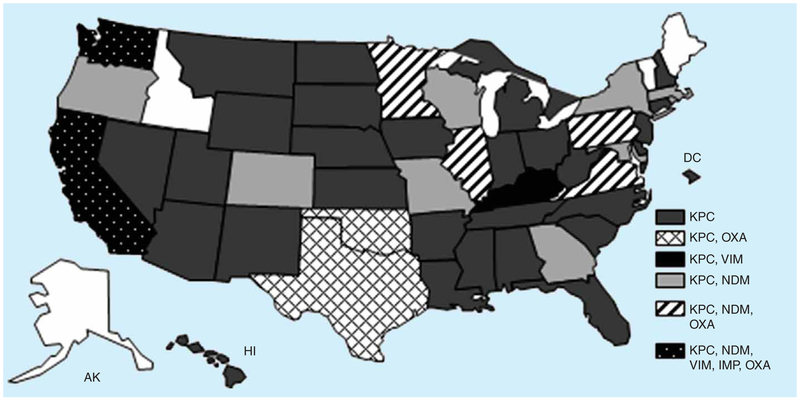
Carbapenem-resistant Enterobacteriaceae (CRE) are multidrug-resistant organisms with few treatment options that cause infections associated with substantial morbidity and mortality. CRE outbreaks have been increasingly reported worldwide and are mainly due to the emergence and spread of strains that produce carbapenemases. In the United States, transmission of CRE is primarily driven by the spread of organisms carrying the Klebsiella pneumoniae carbapenemase enzyme, but other carbapenemase enzymes, such as the New-Delhi metallo-β-lactamase, have also emerged. Currently recommended control strategies for healthcare facilities include the detection of patients infected or colonized with CRE and implementation of measures to prevent further spread. In addition to efforts in individual facilities, effective CRE control requires coordination across all healthcare facilities in a region. This review describes the current epidemiology and surveillance of CRE in the United States and the recommended approach to prevention.
耐碳青霉烯类肠杆菌科细菌(CRE)是多重耐药菌,治疗选择有限,可导致伴有严重发病率和死亡率的感染。全球范围内,CRE暴发的报告日益增多,主要原因是产碳青霉烯酶菌株的出现和传播。在美国,CRE的传播主要由携带肺炎克雷伯菌碳青霉烯酶的细菌传播所驱动,但其他碳青霉烯酶,如新德里金属β-内酰胺酶,也已出现。目前,医疗机构推荐的控制策略包括检测感染或定植CRE的患者,并采取措施防止进一步传播。除了各医疗机构自身的努力外,有效的CRE控制还需要一个地区内所有医疗机构的协调配合。本综述描述了美国目前CRE的流行病学和监测情况以及推荐的预防方法。