Kayamba Violet, Chomba Mumba, Kelly Paul
Department of Internal Medicine, Tropical Gastroenterology & Nutrition group, University of Zambia School of Medicine, Nationalist Road, Lusaka, Zambia.
BMC Gastroenterol. 2014 Mar 25;14:52. doi: 10.1186/1471-230X-14-52.
Gastric cancer is a major contributor to cancer deaths in Zambia but, as elsewhere, no preventive strategies have been identified. We set out to investigate the possibility of reducing gastric atrophy, a premalignant lesion, using micronutrient-antioxidant supplementation.
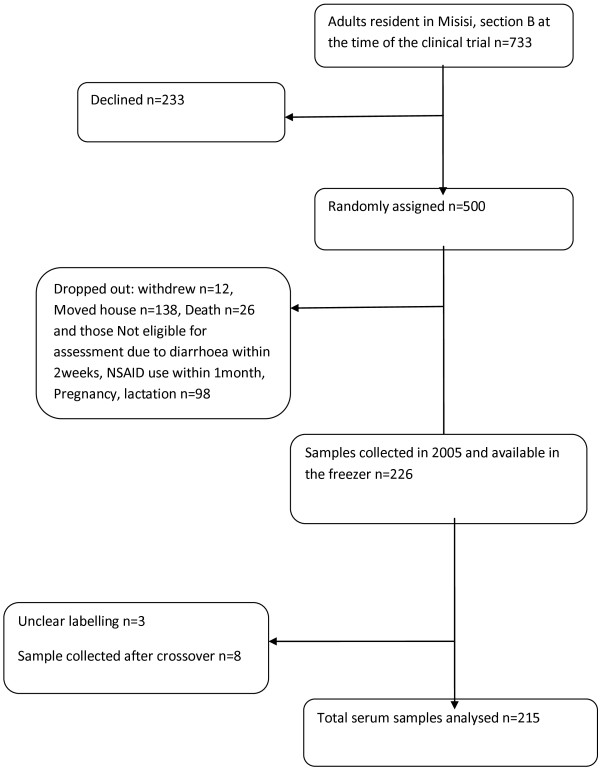
We analysed 215 archival samples from a randomised controlled trial of micronutrient-antioxidant supplementation carried out from 2003 to 2006. Participants were randomised to receive either the supplement or placebo and had been taking the allocated intervention for a mean of 18 (range 14-27) months when the samples used in this study were taken. We used low pepsinogen 1 to 2 (PEP1:2) ratio as a surrogate marker of gastric atrophy. A PEP 1:2 ratio of less than three was considered low. HIV serology, age, nutritional status, smoking, alcohol intake and gastric pH were also analysed. Ethical approval was obtained from the University of Zambia Biomedical Research Ethics Committee (011-04-12). The randomized trial was registered (ISRCTN31173864).
The overall prevalence of low PEP 1:2 ratio was 15/215 (7%) and it did not differ between the placebo (8/103, 7.8%) and micronutrient groups (7/112, 6.3%; HR 1.24; 95% CI 0.47-3.3; P = 0.79). The presence of low PEP 1:2 ratio was not influenced by HIV infection (HR 1.07; 95% CI 0.37-3.2; P =0.89) or nutritional status but it inversely correlated with gastric pH (Spearman's rho = -0.34; P = 0.0001). Age above 40 years was associated with atrophy, but neither alcohol nor smoking had any influence.
Short term micronutrient supplementation does not have any impact on PEP 1:2 ratio, a serological marker of gastric atrophy. PEP 1:2 ratio inversely correlates with gastric pH.
在赞比亚,胃癌是导致癌症死亡的主要原因之一,但与其他地方一样,尚未确定预防策略。我们着手研究使用微量营养素 - 抗氧化剂补充剂来降低癌前病变——胃萎缩的可能性。
我们分析了2003年至2006年进行的微量营养素 - 抗氧化剂补充剂随机对照试验中的215份存档样本。参与者被随机分配接受补充剂或安慰剂,在采集本研究使用的样本时,他们平均服用分配的干预措施18个月(范围14 - 27个月)。我们使用低胃蛋白酶原1与2(PEP1:2)比值作为胃萎缩的替代标志物。PEP 1:2比值小于3被认为是低的。还分析了艾滋病毒血清学、年龄、营养状况、吸烟、饮酒和胃pH值。获得了赞比亚大学医学研究伦理委员会的伦理批准(011 - 04 - 12)。该随机试验已注册(ISRCTN31173864)。
低PEP 1:2比值的总体患病率为15/215(7%),在安慰剂组(8/103,7.8%)和微量营养素组(7/112,6.3%;风险比1.24;95%置信区间0.47 - 3.3;P = 0.79)之间没有差异。低PEP 1:2比值的存在不受艾滋病毒感染(风险比1.07;95%置信区间0.37 - 3.2;P = 0.89)或营养状况的影响,但与胃pH值呈负相关(斯皮尔曼等级相关系数= -0.34;P = 0.0001)。40岁以上的年龄与萎缩有关,但饮酒和吸烟均无任何影响。
短期补充微量营养素对PEP 1:2比值(胃萎缩的血清学标志物)没有任何影响。PEP 1:2比值与胃pH值呈负相关。