Chen Hong-Mei, Liu Hong-Li, Yang Yu-Cong, Cheng Xiao-Li, Wang Yue-Fei, Xing Fan-Fan, Zhao Ying-Ren
Department of Infectious Diseases, First Affiliated Hospital of Medical College, Xi'an Jiaotong University, Xi'an, Shaanxi 710061, P.R. China.
Exp Ther Med. 2014 Apr;7(4):1013-1019. doi: 10.3892/etm.2014.1533. Epub 2014 Feb 10.
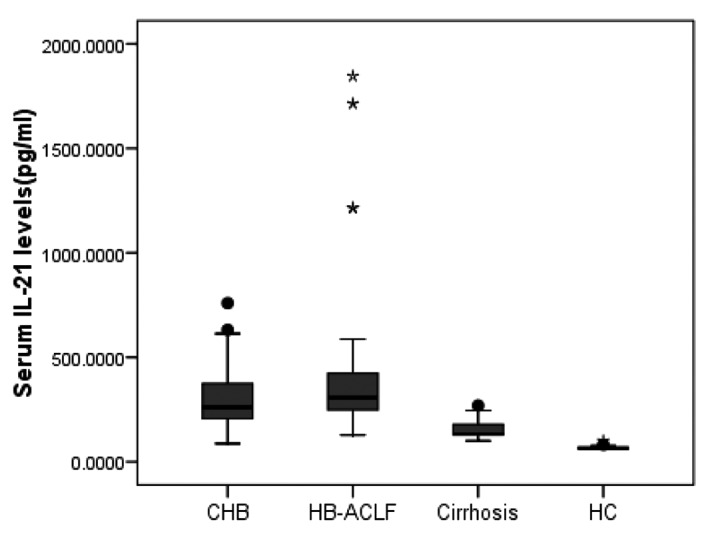
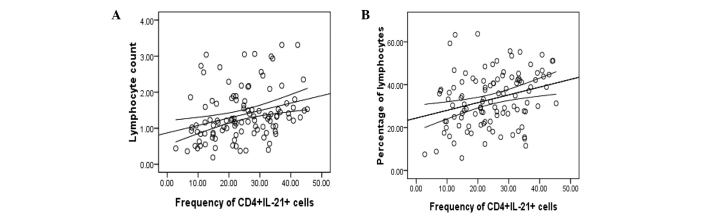
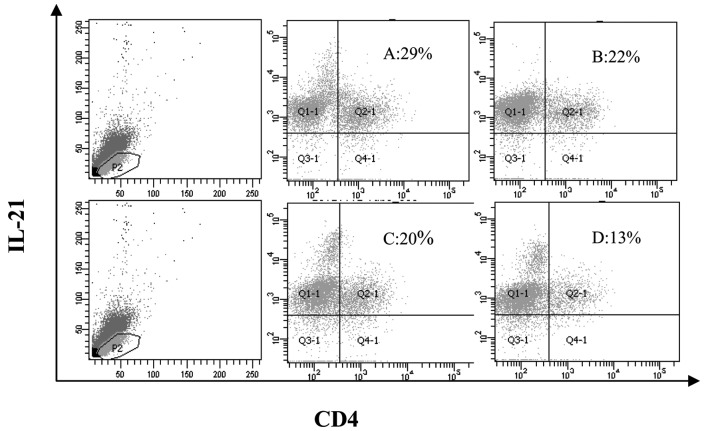
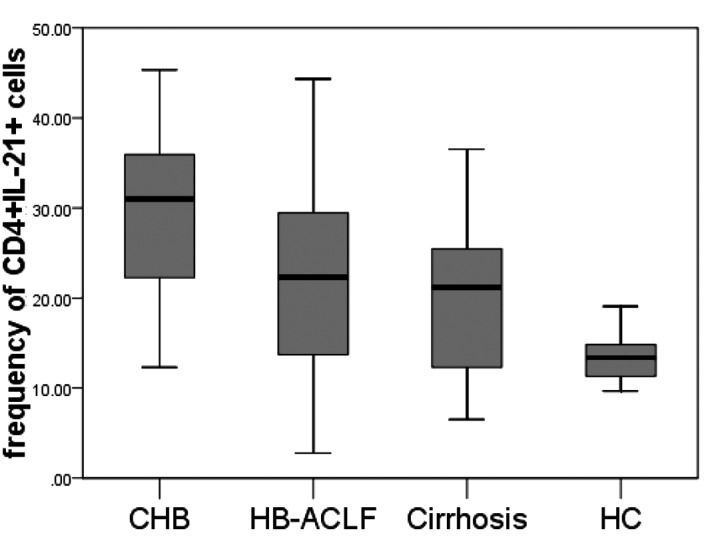
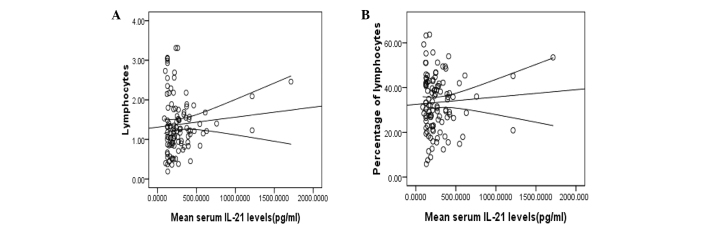
The aim of the present study was to investigate the role of interleukin (IL)-21 in chronic hepatitis B virus (HBV) infection. IL-21 stimulates T and B cell responses and plays a role in the control of chronic viral infections. Serum IL-21 levels were measured by enzyme immunoassay in 109 patients with chronic HBV infection at various clinical stages, as well as in 19 healthy controls (HCs). The proportion of T cells producing IL-21 in the peripheral blood was assessed by intracellular cytokine staining and flow cytometry. Mean serum IL-21 levels in patients with chronic hepatitis B (CHB) and the HCs were 303.54±152.77 pg/ml and 68.24±9.06 pg/ml, respectively (P=0.003). In addition, the mean serum IL-21 level in patients with hepatitis B-related acute-on-chronic liver failure (HB-ACLF) was 455.38±412.38 pg/ml, which exhibited a statistically significant difference when compared with the HCs (P=0.000). Serum IL-21 levels were highest in the patients with HB-ACLF (455.38±412.38 pg/ml) and exhibited a significant difference when compared with the CHB patients (P=0.04). The mean serum IL-21 levels in patients with cirrhosis also increased, but there was no statistically significant difference when compared with the HCs (P=0.82). The frequency of IL-21+CD4+ cells also increased compared with the HCs and correlated with the number and percentage of lymphocytes in the peripheral blood. Serum IL-21 levels increased in CHB and HB-ACLF patients. Relatively low serum IL-21 levels in CHB may have a causal role in the persistence of HBV infection. Higher serum levels in HB-ACLF may activate T and B cells to eliminate the virus or injure the liver via the release of inflammatory cytokines.
本研究的目的是探讨白细胞介素(IL)-21在慢性乙型肝炎病毒(HBV)感染中的作用。IL-21刺激T和B细胞反应,并在慢性病毒感染的控制中发挥作用。采用酶免疫测定法检测了109例处于不同临床阶段的慢性HBV感染患者以及19名健康对照者(HCs)的血清IL-21水平。通过细胞内细胞因子染色和流式细胞术评估外周血中产生IL-21的T细胞比例。慢性乙型肝炎(CHB)患者和HCs的血清IL-21平均水平分别为303.54±152.77 pg/ml和68.24±9.06 pg/ml(P=0.003)。此外,乙型肝炎相关慢加急性肝衰竭(HB-ACLF)患者的血清IL-21平均水平为455.38±412.38 pg/ml,与HCs相比有统计学显著差异(P=0.000)。血清IL-21水平在HB-ACLF患者中最高(455.38±412.38 pg/ml),与CHB患者相比有显著差异(P=0.04)。肝硬化患者的血清IL-21平均水平也有所升高,但与HCs相比无统计学显著差异(P=0.82)。与HCs相比,IL-21+CD4+细胞的频率也增加,且与外周血淋巴细胞的数量和百分比相关。CHB和HB-ACLF患者的血清IL-21水平升高。CHB患者相对较低的血清IL-21水平可能在HBV感染的持续存在中起因果作用。HB-ACLF患者较高的血清水平可能激活T和B细胞以清除病毒或通过释放炎性细胞因子损伤肝脏。