Honma Hajime, Hirai Makoto, Nakamura Shota, Hakimi Hassan, Kawazu Shin-Ichiro, Palacpac Nirianne M Q, Hisaeda Hajime, Matsuoka Hiroyuki, Kawai Satoru, Endo Hiroyoshi, Yasunaga Teruo, Ohashi Jun, Mita Toshihiro, Horii Toshihiro, Furusawa Mitsuru, Tanabe Kazuyuki
Laboratory of Malariology, Research Institute for Microbial Diseases, Osaka University, Suita, Osaka 565-0871, Japan Department of Molecular Protozoology, Research Institute for Microbial Diseases, Osaka University, Suita, Osaka 565-0871, Japan.
Department of Parasitology, Graduate School of Medicine, Gunma University, Maebashi, Gunma 371-8511, Japan
DNA Res. 2014 Aug;21(4):439-46. doi: 10.1093/dnares/dsu009. Epub 2014 Mar 25.
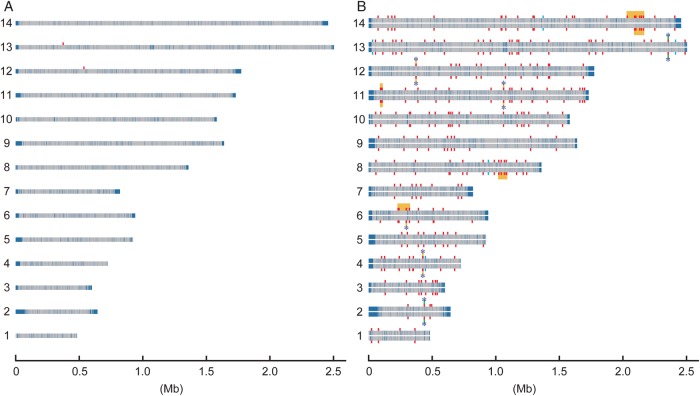
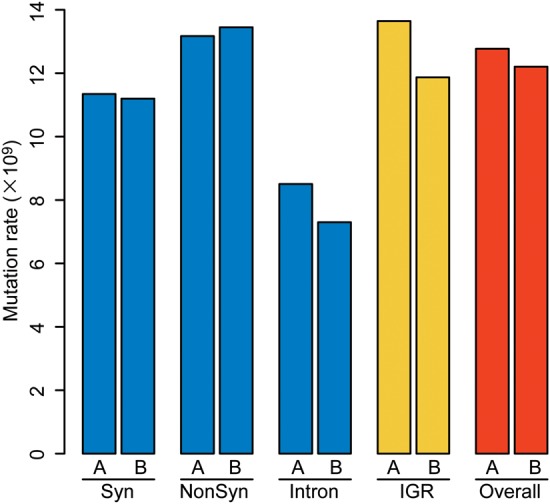
Plasmodium falciparum malaria imposes a serious public health concern throughout the tropics. Although genetic tools are principally important to fully investigate malaria parasites, currently available forward and reverse tools are fairly limited. It is expected that parasites with a high mutation rate can readily acquire novel phenotypes/traits; however, they remain an untapped tool for malaria biology. Here, we generated a mutator malaria parasite (hereinafter called a 'malaria mutator'), using site-directed mutagenesis and gene transfection techniques. A mutator Plasmodium berghei line with a defective proofreading 3' → 5' exonuclease activity in DNA polymerase δ (referred to as PbMut) and a control P. berghei line with wild-type DNA polymerase δ (referred to as PbCtl) were maintained by weekly passage in ddY mice for 122 weeks. High-throughput genome sequencing analysis revealed that two PbMut lines had 175-178 mutations and a 86- to 90-fold higher mutation rate than that of a PbCtl line. PbMut, PbCtl, and their parent strain, PbWT, showed similar course of infection. Interestingly, PbMut lost the ability to form gametocytes during serial passages. We believe that the malaria mutator system could provide a novel and useful tool to investigate malaria biology.
恶性疟原虫疟疾在整个热带地区引发了严重的公共卫生问题。尽管遗传工具对于全面研究疟原虫至关重要,但目前可用的正向和反向工具相当有限。预计具有高突变率的寄生虫能够轻易获得新的表型/性状;然而,它们仍是疟疾生物学中尚未开发的工具。在此,我们利用定点诱变和基因转染技术生成了一种突变疟原虫(以下称为“疟疾突变体”)。通过在ddY小鼠中每周传代122周,维持了一种在DNA聚合酶δ中具有缺陷的校对3'→5'核酸外切酶活性的伯氏疟原虫突变体系(称为PbMut)和一种具有野生型DNA聚合酶δ的对照伯氏疟原虫系(称为PbCtl)。高通量基因组测序分析显示,两个PbMut系有175 - 178个突变,且突变率比PbCtl系高86至90倍。PbMut、PbCtl及其亲本菌株PbWT表现出相似的感染过程。有趣的是,PbMut在连续传代过程中失去了形成配子体的能力。我们认为疟疾突变体系统可为研究疟疾生物学提供一种新颖且有用的工具。