Chekmareva Natalia Yurievna, Sotnikov Sergey V, Diepold Rebekka P, Naik Roshan R, Landgraf Rainer, Czibere Ludwig
Department of Behavioral Neuroendocrinology, Max Planck Institute of Psychiatry Munich, Germany ; Department of Normal Physiology, Sechenov First Moscow State Medical University Moscow, Russia.
Department of Behavioral Neuroendocrinology, Max Planck Institute of Psychiatry Munich, Germany.
Front Behav Neurosci. 2014 Mar 18;8:87. doi: 10.3389/fnbeh.2014.00087. eCollection 2014.
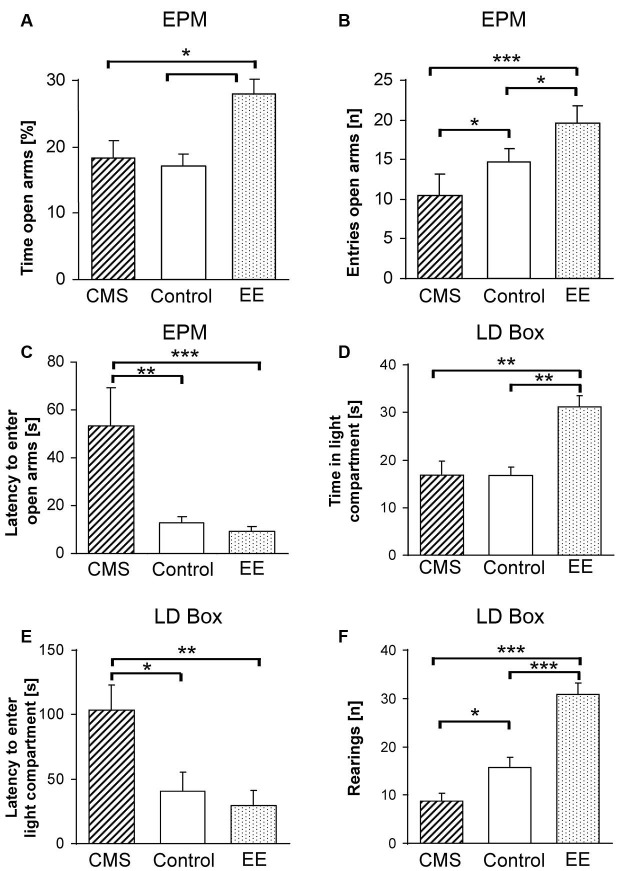
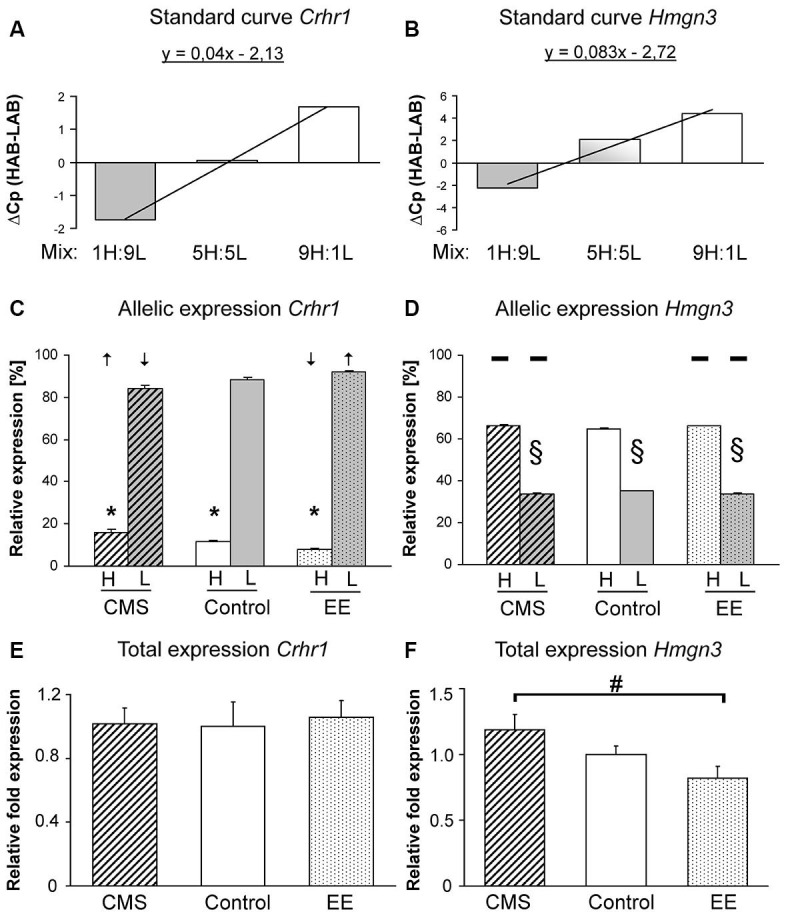
Although gene-environment interactions are known to significantly influence psychopathology-related disease states, only few animal models cover both the genetic background and environmental manipulations. Therefore, we have taken advantage of the bidirectionally inbred high (HAB) and low (LAB) anxiety-related behavior mouse lines to generate HAB × LAB F1 hybrids that intrinsically carry both lines' genetic characteristics, and subsequently raised them in three different environments-standard, enriched (EE) and chronic mild stress (CMS). Assessing genetic correlates of trait anxiety, we focused on two genes already known to play a role in HAB vs. LAB mice, corticotropin releasing hormone receptor type 1 (Crhr1) and high mobility group nucleosomal binding domain 3 (Hmgn3). While EE F1 mice showed decreased anxiety-related and increased explorative behaviors compared to controls, CMS sparked effects in the opposite direction. However, environmental treatments affected the expression of the two genes in distinct ways. Thus, while expression ratios of Hmgn3 between the HAB- and LAB-specific alleles remained equal, total expression resembled the one observed in HAB vs. LAB mice, i.e., decreased after EE and increased after CMS treatment. On the other hand, while total expression of Crhr1 remained unchanged between the groups, the relative expression of HAB- and LAB-specific alleles showed a clear effect following the environmental modifications. Thus, the environmentally driven bidirectional shift of trait anxiety in this F1 model strongly correlated with Hmgn3 expression, irrespective of allele-specific expression patterns that retained the proportions of basic differential HAB vs. LAB expression, making this gene a match for environment-induced modifications. An involvement of Crhr1 in the bidirectional behavioral shift could, however, rather be due to different effects of the HAB- and LAB-specific alleles described here. Both candidate genes therefore deserve attention in the complex regulation of anxiety-related phenotypes including environment-mediated effects.
尽管已知基因-环境相互作用会显著影响与精神病理学相关的疾病状态,但只有少数动物模型涵盖了遗传背景和环境操纵。因此,我们利用双向近交的高焦虑相关行为(HAB)和低焦虑相关行为(LAB)小鼠品系,培育出内在携带两个品系遗传特征的HAB×LAB F1杂交种,随后将它们饲养在三种不同环境中——标准环境、丰富环境(EE)和慢性轻度应激(CMS)环境。在评估特质焦虑的遗传相关性时,我们重点关注了两个已知在HAB小鼠与LAB小鼠中起作用的基因,即促肾上腺皮质激素释放激素受体1型(Crhr1)和高迁移率族核小体结合结构域3(Hmgn3)。与对照组相比,EE环境下的F1小鼠表现出焦虑相关行为减少且探索行为增加,而CMS环境则产生相反的效果。然而,环境处理以不同方式影响这两个基因的表达。因此,虽然Hmgn3在HAB特异性等位基因和LAB特异性等位基因之间的表达比率保持相等,但总表达类似于在HAB小鼠与LAB小鼠中观察到的情况,即在EE处理后降低,在CMS处理后升高。另一方面,虽然Crhr1的总表达在各组之间保持不变,但HAB特异性等位基因和LAB特异性等位基因的相对表达在环境改变后显示出明显的影响。因此,在这个F1模型中,环境驱动的特质焦虑双向转变与Hmgn3表达密切相关,而与保留基本差异HAB与LAB表达比例的等位基因特异性表达模式无关,这使得该基因成为环境诱导修饰的一个匹配对象。然而,Crhr1参与双向行为转变可能更多是由于这里描述的HAB特异性等位基因和LAB特异性等位基因的不同作用。因此,这两个候选基因在包括环境介导效应在内的焦虑相关表型的复杂调控中都值得关注。