Department of Physical Medicine and Rehabilitation, College of Medicine, Yeungnam University Daegu, South Korea.
Front Hum Neurosci. 2014 Mar 18;8:153. doi: 10.3389/fnhum.2014.00153. eCollection 2014.
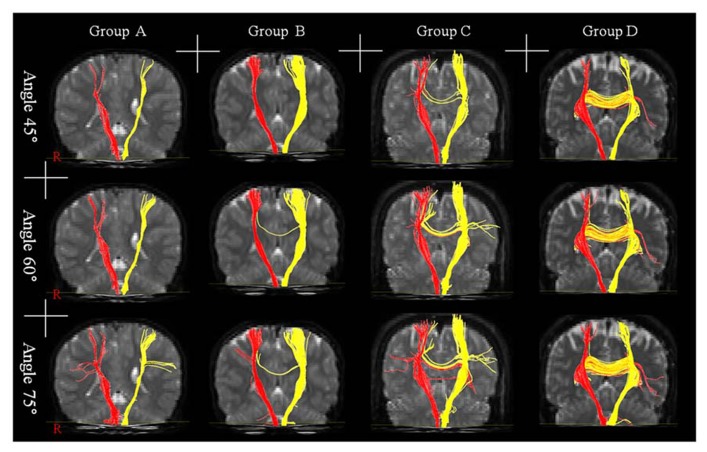
Transcallosal motor fiber (TCMF) plays a role in interhemispheric inhibition (IHI) between two primary motor cortices. IHI has been an important concept in development of the motor system of the brain. Many studies have focused on the research of the topography of TCMF, however, little is known about development of TCMF. In the current study, we attempted to investigate development of TCMF from the corticospinal tract (CST) in the human brain using diffusion tensor tractography. A total of 76 healthy subjects were recruited for this study. We reconstructed the TCMF, which was derived from the CST, by selection of two regions of interest below the corpus callosum (upper and middle pons). Termination criteria used for fiber tracking were fractional anisotropy <0.2 and three tract turning angles of <45, 60, and 75(°). The subjects were classified into four groups according to age: group A (0-5 years), group B (6-10 years), group C (11-15 years), and group D (16-20 years). Significant differences in the incidence of TCMF were observed between group B and group C, and between group B and group D, with tract turning angles of 60 and 75(°) (p < 0.05). However, no significant differences in any tract turning angle were observed between group C and group D (p > 0.05). In addition, in terms of the incidence of TCMF, no significant differences were observed between the three tract turning angles (p > 0.05). We obtained visualized TCMF from the CST with development and found that the incidence of TCMF differed significantly around the approximate age of 10 years. As a result, we demonstrated structural evidence for development of TCMF in the human brain.
胼胝体皮质运动纤维(TCMF)在两个初级运动皮质之间的半球间抑制(IHI)中发挥作用。IHI 一直是大脑运动系统发育的一个重要概念。许多研究都集中在 TCMF 的拓扑结构研究上,但对 TCMF 的发育知之甚少。在本研究中,我们试图使用弥散张量纤维束追踪技术从大脑皮质脊髓束(CST)研究 TCMF 的发育。共招募了 76 名健康受试者参与本研究。我们通过在胼胝体下方选择两个感兴趣区(上、中脑桥)来重建源自 CST 的 TCMF。纤维追踪的终止标准为各向异性分数 <0.2 和三个纤维束转向角 <45、60 和 75(°)。根据年龄将受试者分为四组:A 组(0-5 岁)、B 组(6-10 岁)、C 组(11-15 岁)和 D 组(16-20 岁)。B 组与 C 组、B 组与 D 组之间,60°和 75°纤维束转向角的 TCMF 发生率存在显著差异(p<0.05)。但 C 组与 D 组之间各纤维束转向角无显著差异(p>0.05)。此外,就 TCMF 的发生率而言,三个纤维束转向角之间无显著差异(p>0.05)。我们从 CST 获得了与发育相关的 TCMF,并发现 TCMF 的发生率在大约 10 岁左右有显著差异。因此,我们为人类大脑 TCMF 的发育提供了结构证据。