Cheng Jennifer K, Wen Xiaozhong, Coletti Kristen D, Cox Joanne E, Taveras Elsie M
Division of General Pediatrics, Department of Medicine, Boston Children's Hospital, Boston, MA 02115, USA.
Division of Behavioral Medicine, Department of Pediatrics, School of Medicine and Biomedical Sciences, State University of New York at Buffalo, Buffalo, NY 14214, USA.
Int J Pediatr. 2014;2014:152586. doi: 10.1155/2014/152586. Epub 2014 Jan 30.
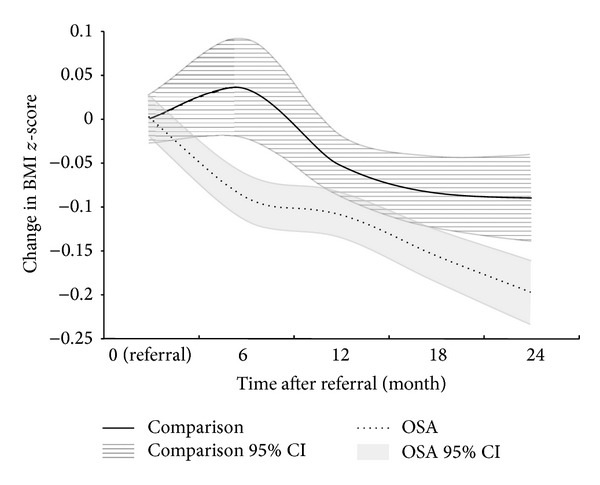
Objective. To examine body mass index (BMI) changes among pediatric multidisciplinary weight management participants and nonparticipants. Design. In this retrospective database analysis, we used multivariable mixed effect models to compare 2-year BMI z-score trajectories among 583 eligible overweight or obese children referred to the One Step Ahead program at the Boston Children's Primary Care Center between 2003 and 2009. Results. Of the referred children, 338 (58%) attended the program; 245 (42%) did not participate and were instead followed by their primary care providers within the group practice. The mean BMI z-score of program participants decreased modestly over a 2-year period and was lower than that of nonparticipants. The group-level difference in the rate of change in BMI z-score between participants and nonparticipants was statistically significant for 0-6 months (P = 0.001) and 19-24 months (P = 0.008); it was marginally significant for 13-18 months (P = 0.051) after referral. Younger participants (<5 years) had better outcomes across all time periods examined. Conclusion. Children attending a multidisciplinary program experienced greater BMI z-score reductions compared with usual primary care in a real world practice; younger participants had significantly better outcomes. Future research should consider early intervention and cost-effectiveness analyses.
目的。研究儿童多学科体重管理参与者与非参与者的体重指数(BMI)变化情况。设计。在这项回顾性数据库分析中,我们使用多变量混合效应模型,比较了2003年至2009年间转介至波士顿儿童初级保健中心“先行一步”项目的583名符合条件的超重或肥胖儿童的2年BMI z评分轨迹。结果。在被转介的儿童中,338名(58%)参加了该项目;245名(42%)未参加,而是由其在团体医疗实践中的初级保健提供者进行随访。项目参与者的平均BMI z评分在2年期间略有下降,且低于非参与者。参与者与非参与者之间BMI z评分变化率的组间差异在0至6个月(P = 0.001)和19至24个月(P = 0.008)时具有统计学意义;转介后13至18个月时差异边缘显著(P = 0.051)。年龄较小的参与者(<5岁)在所有检查时间段内的结果更好。结论。在实际临床实践中,参加多学科项目的儿童与接受常规初级保健的儿童相比,BMI z评分降低幅度更大;年龄较小的参与者结果明显更好。未来的研究应考虑早期干预和成本效益分析。