Chakravorty Subhajit, Jackson Nicholas, Chaudhary Ninad, Kozak Philip J, Perlis Michael L, Shue Holly R, Grandner Michael A
MIRECC VISN-4, Philadelphia Veterans Affairs Medical Center, University & Woodland Avenues, Philadelphia, PA 19104, USA ; Perelman School of Medicine, University of Pennsylvania, Philadelphia, PA 19104, USA.
University of Southern California, Los Angeles, CA 90033, USA.
Sleep Disord. 2014;2014:959152. doi: 10.1155/2014/959152. Epub 2014 Jan 29.
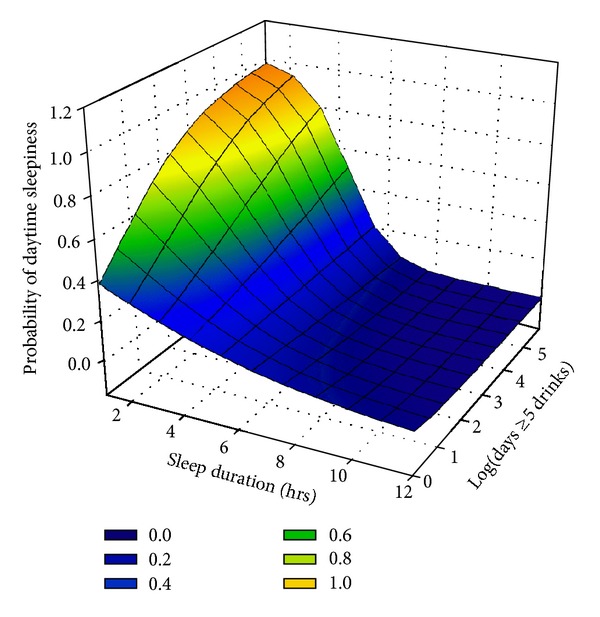
The aim of the current analysis was to investigate the relationship of daytime sleepiness with alcohol consumption and sleep duration using a population sample of adult Americans. Data was analyzed from adult respondents of the National Health and Nutritional Examination Survey (NHANES) 2007-2008 (N = 2919) using self-reported variables for sleepiness, sleep duration, and alcohol consumption (quantity and frequency of alcohol use). A heavy drinking episode was defined as the consumption of ≥5 standard alcoholic beverages in a day. Logistic regression models adjusted for sociodemographic variables and insomnia covariates were used to evaluate the relationship between daytime sleepiness and an interaction of alcohol consumption variables with sleep duration. The results showed that daytime sleepiness was reported by 15.07% of the subjects. In univariate analyses adjusted for covariates, an increased probability of daytime sleepiness was predicted by decreased log drinks per day [OR = 0.74 (95% CI, 0.58-0.95)], a decreased log drinking frequency [0.90 (95% CI, 0.83-0.98)], and lower sleep duration [OR = 0.75 (95% CI, 0.67-0.84)]. An interaction between decreased sleep duration and an increased log heavy drinking frequency predicted increased daytime sleepiness (P = 0.004). Thus, the effect of sleep duration should be considered when evaluating the relationship between daytime sleepiness and heavy drinking.
本次分析的目的是利用成年美国人的总体样本,研究日间嗜睡与酒精摄入量及睡眠时间之间的关系。使用来自2007 - 2008年美国国家健康与营养检查调查(NHANES)成年受访者的数据(N = 2919),这些数据涉及自我报告的嗜睡、睡眠时间和酒精摄入量(饮酒量和饮酒频率)变量。一次大量饮酒事件定义为一天内饮用≥5标准杯酒精饮料。使用针对社会人口统计学变量和失眠协变量进行调整的逻辑回归模型,来评估日间嗜睡与酒精摄入变量和睡眠时间之间的相互作用关系。结果显示,15.07%的受试者报告有日间嗜睡。在针对协变量进行调整的单因素分析中,每日饮酒量对数降低[比值比(OR)= 0.74(95%置信区间,0.58 - 0.95)]、饮酒频率对数降低[0.90(95%置信区间,0.83 - 0.98)]以及睡眠时间缩短[OR = 0.75(95%置信区间,0.67 - 0.84)]均预示日间嗜睡的可能性增加。睡眠时间缩短与大量饮酒频率对数增加之间的相互作用预示日间嗜睡增加(P = 0.004)。因此,在评估日间嗜睡与大量饮酒之间的关系时,应考虑睡眠时间的影响。