Grange Cristina, Collino Federica, Tapparo Marta, Camussi Giovanni
Department of Medical Sciences, University of Torino , Torino , Italy.
Translational Center for Regenerative Medicine, University of Torino , Torino , Italy.
Front Oncol. 2014 Mar 17;4:49. doi: 10.3389/fonc.2014.00049. eCollection 2014.
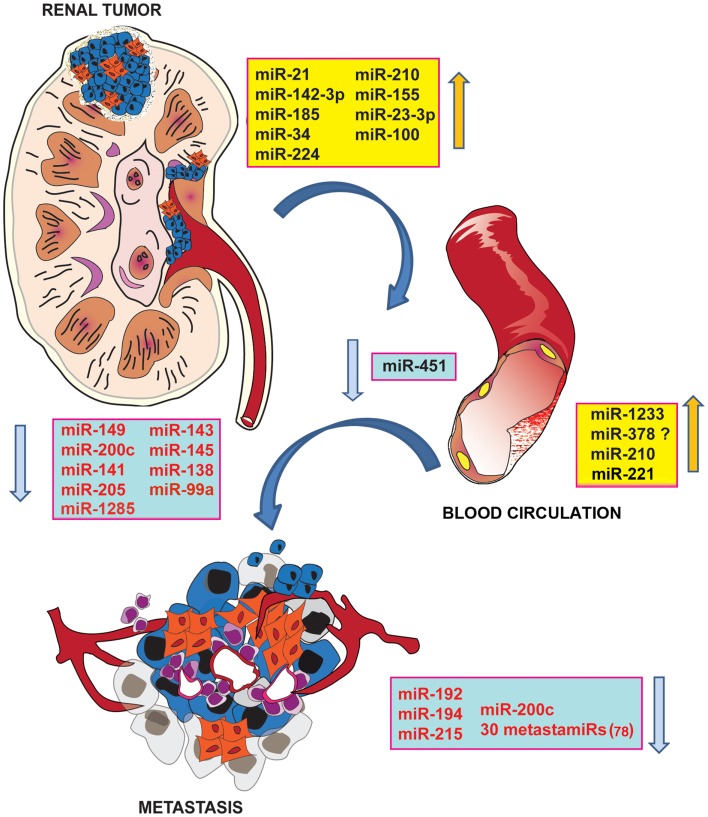
Tumor formation is a complex process that occurs in different steps and involves many cell types, including tumor cells, endothelial cells, and inflammatory cells, which interact to promote growth of the tumor mass and metastasization. Epigenetic alterations occurring in transformed cells result in de-regulation of miRNA expression (a class of small non-coding RNA that regulates multiple functions), which contributes to tumorigenesis. The specific miRNAs, which have an aberrant expression in tumors, are defined as oncomiRNAs, and may be either over- or under-expressed, but down-regulation is most commonly observed. Renal cell carcinoma (RCC) is a frequent form of urologic tumor, associated with an alteration of multiple signaling pathways. Many molecules involved in the progression of RCCs, such as HIF, VEGF, or mammalian target of rapamycin, are possible targets of de-regulated miRNAs. Within tumor mass, the cancer stem cell (CSC) population is a fundamental component that promotes tumor growth. The CSC hypothesis postulates that CSCs have the unique ability to self-renew and to maintain tumor growth and metastasis. CSCs present in RCC were shown to express the mesenchymal stem cell marker CD105 and to exhibit self-renewal and clonogenic properties, as well as the ability to generate serially transplantable tumors. The phenotype of CSC has been related to the potential to undergo the epithelial-mesenchymal transition, which has been linked to the expression pattern of tumorigenic miRNAs or down-regulation of anti-tumor miRNAs. In addition, the pattern of circulating miRNAs may allow discrimination between healthy and tumor patients. Therefore, a miRNA signature may be used as a tumor biomarker for cancer diagnosis, as well as to classify the risk of relapse and metastasis, and for a guide for therapy.
肿瘤形成是一个复杂的过程,它分不同步骤发生,涉及多种细胞类型,包括肿瘤细胞、内皮细胞和炎性细胞,这些细胞相互作用以促进肿瘤块的生长和转移。发生在转化细胞中的表观遗传改变导致miRNA表达失调(miRNA是一类调节多种功能的小非编码RNA),这有助于肿瘤发生。在肿瘤中异常表达的特定miRNA被定义为癌miRNA,其表达可能上调或下调,但最常观察到的是下调。肾细胞癌(RCC)是泌尿系统肿瘤的常见形式,与多种信号通路的改变有关。许多参与RCC进展的分子,如缺氧诱导因子(HIF)、血管内皮生长因子(VEGF)或雷帕霉素靶蛋白,可能是失调miRNA的作用靶点。在肿瘤块内,癌症干细胞(CSC)群体是促进肿瘤生长的基本组成部分。CSC假说假定CSC具有自我更新以及维持肿瘤生长和转移的独特能力。已证明RCC中存在的CSC表达间充质干细胞标志物CD105,并表现出自我更新和克隆形成特性,以及产生可连续移植肿瘤的能力。CSC的表型与上皮-间质转化的潜能有关,而上皮-间质转化与致癌miRNA的表达模式或抗肿瘤miRNA的下调有关。此外,循环miRNA的模式可能有助于区分健康人和肿瘤患者。因此,miRNA特征可作为肿瘤生物标志物用于癌症诊断,以及对复发和转移风险进行分类,并指导治疗。