Luo Yu, Liu Feng, Yan Chunhui, Qu Wei, Zhu Liang, Guo Zheng, Zhou Fan, Zhang Wei
Department of Urology, The 161st Hospital of the People's Liberation Army, Wuhan, Hubei 430010, People's Republic of China.
Cancer Manag Res. 2020 Mar 24;12:2195-2207. doi: 10.2147/CMAR.S242472. eCollection 2020.
The long non-coding RNA cancer susceptibility 19 () is recognized as an important regulator in gastric cancer, colorectal cancer, and non-small cell lung cancer. Nevertheless, to the best of our knowledge, the expression status and detailed roles of in clear cell renal cell carcinoma (ccRCC) have not been elucidated. Hence, we aimed to determine expression in ccRCC and investigate its roles in ccRCC oncogenicity. The molecular mechanisms underlying functions in ccRCC were also determined.
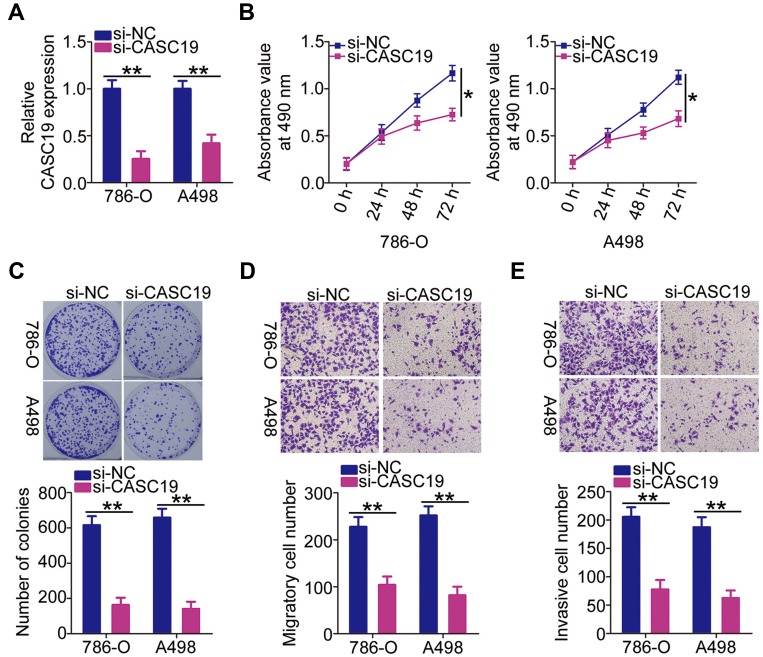
expression was measured by using reverse transcription-quantitative polymerase chain reaction. The effects of on ccRCC cell proliferation, colony formation, migration, and invasiveness in vitro, as well as on tumor growth in vivo, were examined by the MTT assay, colony formation assay, cell migration and invasiveness assays, and tumor xenograft in nude nice, respectively.
was overexpressed in ccRCC tissues and cell lines. High expression of was closely associated with unfavorable clinicopathological parameters and predicted negative clinical outcomes in patients with ccRCC. Knockdown of decreased ccRCC cell proliferation, colony formation, migration, and invasiveness, as well as attenuated tumor growth in vivo. Mechanistically, functioned as a competing endogenous RNA and upregulated the expression of ETS proto-oncogene 1 (ETS1) through sponging microRNA-532 (miR-532). Furthermore, rescue assays revealed that inhibiting miR-532 or restoring ETS1 expression partially abolished the impacts of knockdown on ccRCC cells.
The CASC19/miR-532/ETS1 regulatory pathway is crucial for the malignant manifestations of ccRCC, which makes it an attractive target for potential treatments of ccRCC.
长链非编码RNA癌症易感性19(CASC19)被认为是胃癌、结直肠癌和非小细胞肺癌中的重要调节因子。然而,据我们所知,CASC19在透明细胞肾细胞癌(ccRCC)中的表达状态及详细作用尚未阐明。因此,我们旨在确定CASC19在ccRCC中的表达,并研究其在ccRCC致癌性中的作用。还确定了CASC19在ccRCC中发挥功能的分子机制。
采用逆转录定量聚合酶链反应检测CASC19表达。分别通过MTT法、集落形成试验、细胞迁移和侵袭试验以及裸鼠肿瘤异种移植试验,检测CASC19对ccRCC细胞体外增殖、集落形成、迁移和侵袭能力以及体内肿瘤生长的影响。
CASC19在ccRCC组织和细胞系中过表达。CASC19的高表达与不良临床病理参数密切相关,并预测ccRCC患者的临床预后不良。敲低CASC19可降低ccRCC细胞的增殖、集落形成、迁移和侵袭能力,以及体内肿瘤生长。机制上,CASC19作为一种竞争性内源性RNA,通过结合微小RNA-532(miR-532)上调ETS原癌基因1(ETS1)的表达。此外,挽救试验表明,抑制miR-532或恢复ETS1表达可部分消除敲低CASC19对ccRCC细胞的影响。
CASC19/miR-532/ETS1调控通路对ccRCC的恶性表现至关重要,这使其成为ccRCC潜在治疗的有吸引力靶点。