Laboratory for Immunological and Molecular Cancer Research, Third Medical Department with Hematology, Medical Oncology, Hemostaseology, Rheumatology and Infectiology, Paracelsus Medical University, Salzburg, Austria.
Transfusion. 2014 Sep;54(9):2325-35. doi: 10.1111/trf.12632. Epub 2014 Mar 28.
Granulocyte-colony-stimulating factor (G-CSF) is routinely used for mobilization of hematopoietic stem and progenitor cells preceding autologous transplantation after high-dose chemotherapy in hematologic malignancies. However, due to high mobilization failure rates, alternative mobilization strategies are required.
Patients who poorly mobilized CD34+ hematopoietic cells (HCs) with G-CSF additionally received the CXCR4 antagonist plerixafor. The phenotype of CD34+ HCs collected after this plerixafor-induced "rescue" mobilization, in regard to adhesion molecule and CD133, CD34, and CD38 expression in comparison to CD34+ HCs collected after traditional G-CSF administration in good mobilizers, was analyzed flow cytometrically. To confirm previous studies in our patient cohort, the efficiency of mobilization and subsequent engraftment after this "on-demand" plerixafor mobilization were analyzed.
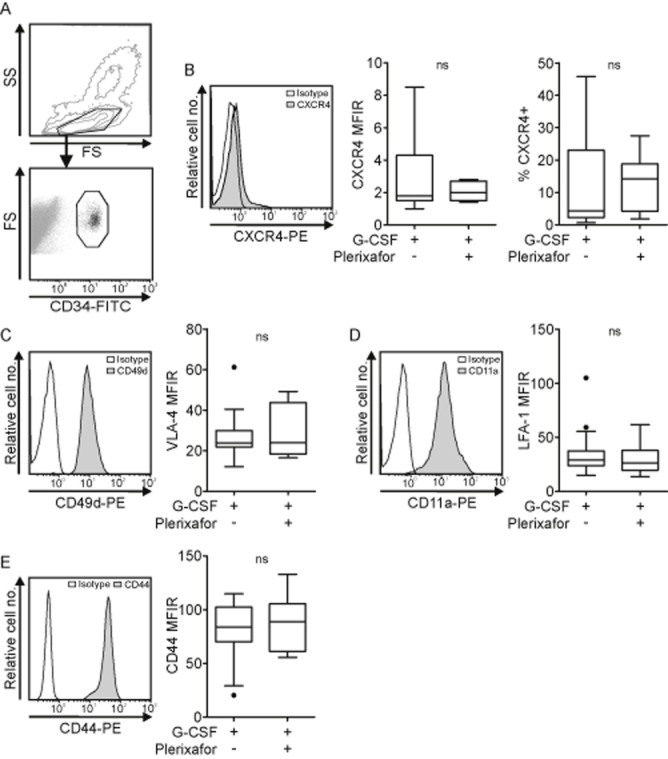
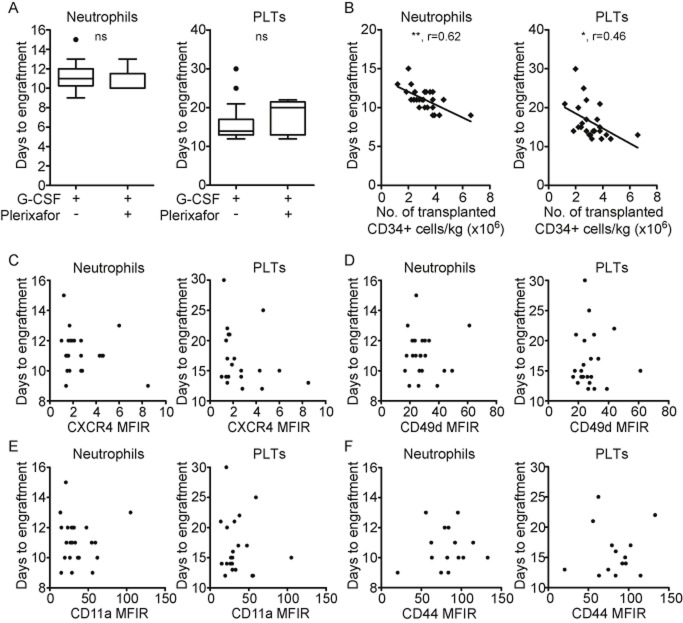
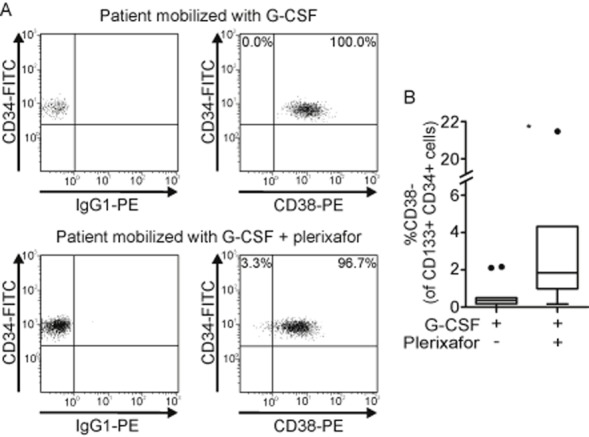
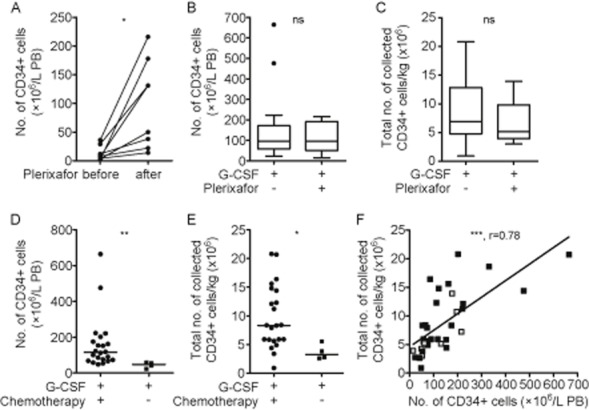
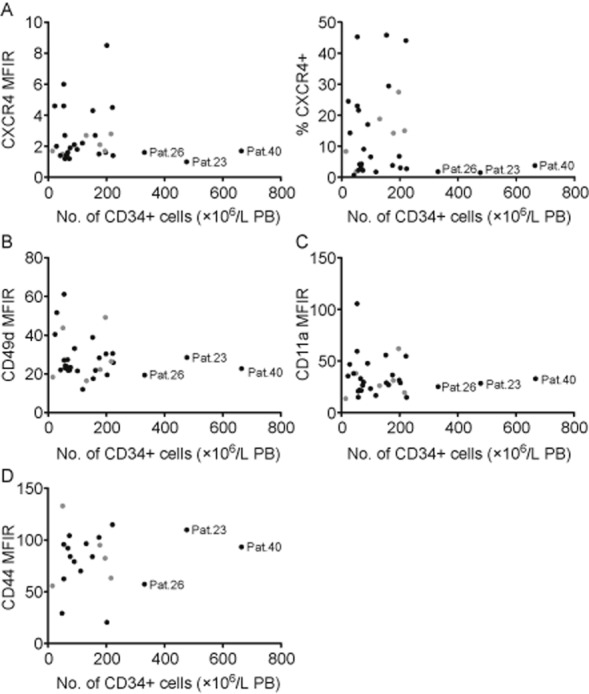
Pronounced mobilization occurred after plerixafor administration in poor mobilizers, resulting in similar CD34+ cell yields as obtained by G-CSF in good mobilizers, whereby plerixafor increased the content of primitive CD133+/CD34+/CD38- cells. The surface expression profiles of the marrow homing and retention receptors CXCR4, VLA-4, LFA-1, and CD44 on mobilized CD34+ cells and hematopoietic recovery after transplantation were similar in patients receiving G-CSF plus plerixafor or G-CSF. Unexpectedly, the expression levels of respective adhesion receptors were not related to mobilization efficiency or engraftment.
The results show that CD34+ HCs collected by plerixafor-induced rescue mobilization are qualitatively equivalent to CD34+ HCs collected after traditional G-CSF mobilization in good mobilizers, in regard to their adhesive phenotype and engraftment potential. Thereby, plerixafor facilitates the treatment of poor mobilizers with autologous HC transplantation after high-dose chemotherapy.
粒细胞集落刺激因子(G-CSF)常用于血液系统恶性肿瘤患者在接受大剂量化疗前进行自体移植的造血干细胞和祖细胞动员。然而,由于动员失败率较高,需要替代的动员策略。
对 G-CSF 动员效果差的 CD34+造血细胞(HC)患者,加用 CXCR4 拮抗剂培哚沙普。流式细胞术分析与传统 G-CSF 良好动员者相比,培哚沙普诱导的“挽救”动员后采集的 CD34+HC 的表型,包括黏附分子和 CD133、CD34 和 CD38 的表达。为了确认我们患者队列中的先前研究,分析了这种“按需”培哚沙普动员后的动员效率和随后的植入情况。
在动员效果差的患者中,培哚沙普给药后明显动员,导致 CD34+细胞产量与良好动员者的 G-CSF 相似,培哚沙普增加了原始 CD133+/CD34+/CD38-细胞的含量。接受 G-CSF 加培哚沙普或 G-CSF 的患者,动员后 CD34+细胞上的骨髓归巢和保留受体 CXCR4、VLA-4、LFA-1 和 CD44 的表面表达谱以及移植后的造血恢复相似。出乎意料的是,各自的黏附受体的表达水平与动员效率或植入无关。
结果表明,培哚沙普诱导的挽救动员采集的 CD34+HC 在黏附表型和植入潜能方面与传统 G-CSF 良好动员者采集的 CD34+HC 相当。因此,培哚沙普有助于治疗大剂量化疗后自体 HC 移植的动员效果差的患者。