Clinical and Experimental Pharmacology Group, Cancer Research UK Manchester Institute, University of Manchester, Manchester Cancer Research Centre, Manchester M20 4BX, UK.
BMC Cancer. 2014 Mar 28;14:226. doi: 10.1186/1471-2407-14-226.
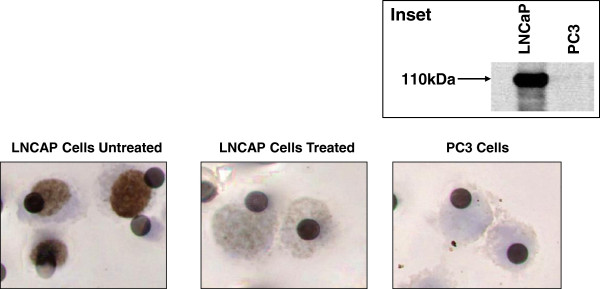
AZD3514 inhibits and down regulates the androgen receptor (AR) and has undergone clinical trials in prostate cancer. To provide proof-of-mechanism (POM) in patients, an immunohistochemistry (IHC) method for determination of AR in circulating tumour cells (CTC) was developed and validated.
After an assessment of specificity validation focused on intra- and inter-operator reproducibility utilising a novel modification of incurred sample reanalysis (ISR). β-Content γ-confidence tolerance intervals (BCTI) and Cohen's Kappa (κ) were employed in statistical analysis of results.
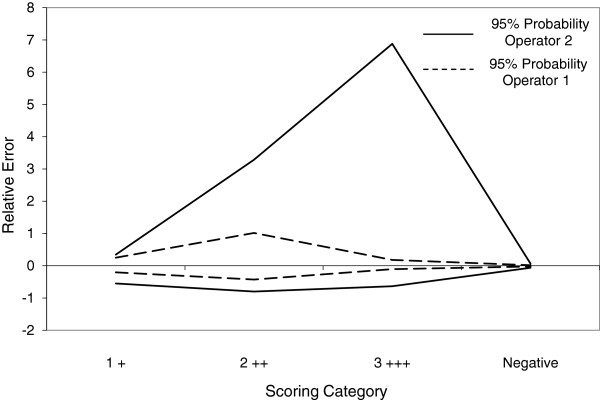
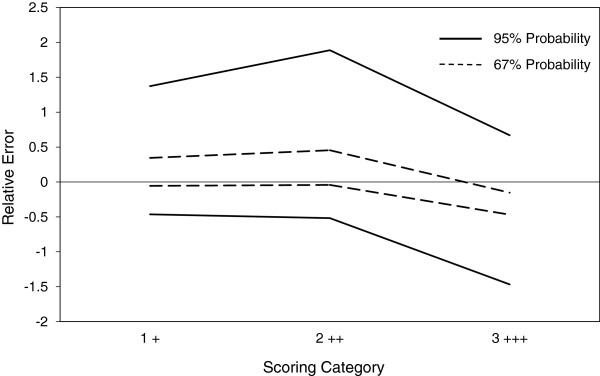
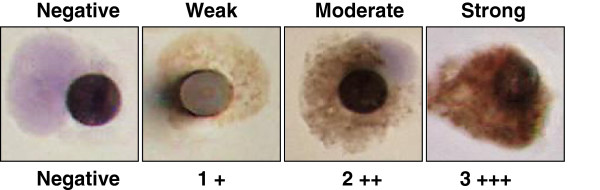
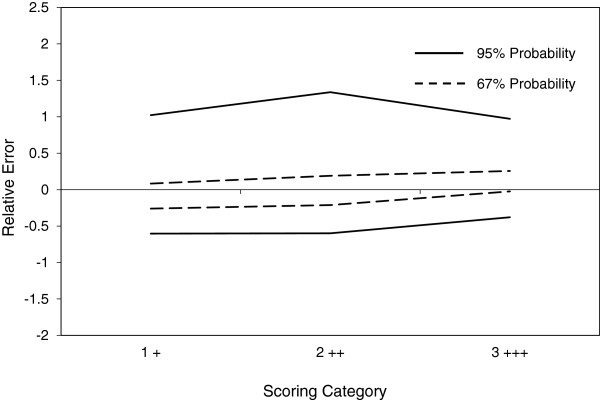
In a first set of IHC reproducibility experiments, almost perfect agreement was recorded (κ=0.94) when two different operators scored CTC as overall positive or negative for AR. However, BCTI analysis identified a specific bias in scoring staining intensity, where one operator favoured moderate over strong assignments, whereas the reverse was the case with the second operator. After a period of additional training involving deployment of a panel of standardised images, a second set of validation experiments were conducted. These showed correction of the inter-operator bias by BCTI with κ for scoring intensity increasing from 0.59 to 0.81, indicative of almost perfect agreement.
By application of BCTI to the validation of IHC, operator bias and therefore poor reproducibility can be identified, characterised and corrected to achieve a level of error normally associated with a quantitative biomarker assay, such as an ELISA. The methodological approach described herein can be applied to any generic IHC technique.
AZD3514 抑制和下调雄激素受体 (AR),并已在前列腺癌的临床试验中进行。为了在患者中提供机制证明 (POM),开发并验证了一种用于检测循环肿瘤细胞 (CTC) 中 AR 的免疫组织化学 (IHC) 方法。
在利用新的受损样本再分析 (ISR) 方法评估针对内和间操作员重现性的特异性验证之后。β-含量 γ-置信区间 (BCTI) 和 Cohen's Kappa (κ) 用于统计分析结果。
在第一组 IHC 重现性实验中,当两名不同的操作员将 CTC 整体上标记为 AR 阳性或阴性时,记录到几乎完美的一致性 (κ=0.94)。然而,BCTI 分析确定了评分染色强度存在特定的偏差,其中一名操作员倾向于中度而非强分配,而第二名操作员则相反。在涉及部署标准化图像面板的额外培训期之后,进行了第二组验证实验。这些实验通过 BCTI 校正了操作员之间的偏差,强度评分的 κ 值从 0.59 增加到 0.81,表明几乎完全一致。
通过将 BCTI 应用于 IHC 的验证,可以识别、描述和校正操作员偏差,从而实现通常与定量生物标志物测定(如 ELISA)相关的误差水平。本文所述的方法学方法可应用于任何通用的 IHC 技术。