Direnzo Graziella V, Langhammer Penny F, Zamudio Kelly R, Lips Karen R
Department of Biology, University of Maryland, College Park, Maryland, United States of America.
School of Life Sciences, Arizona State University, Tempe, Arizona, United States of America.
PLoS One. 2014 Mar 27;9(3):e93356. doi: 10.1371/journal.pone.0093356. eCollection 2014.
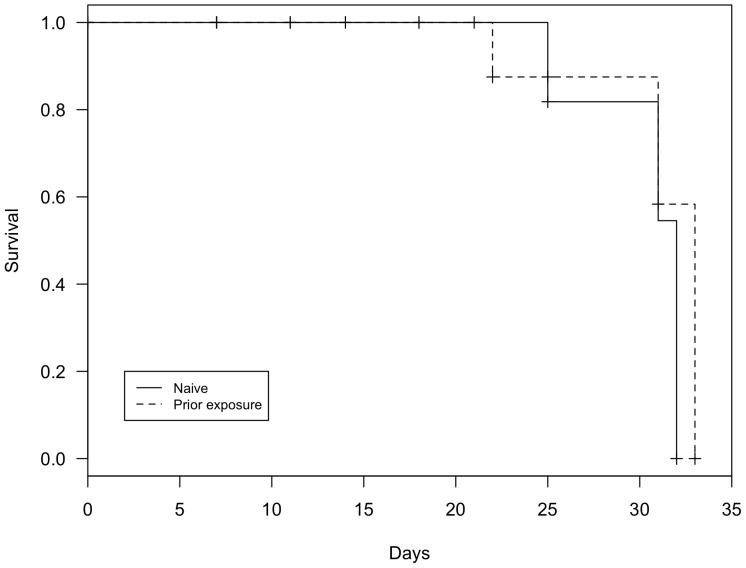
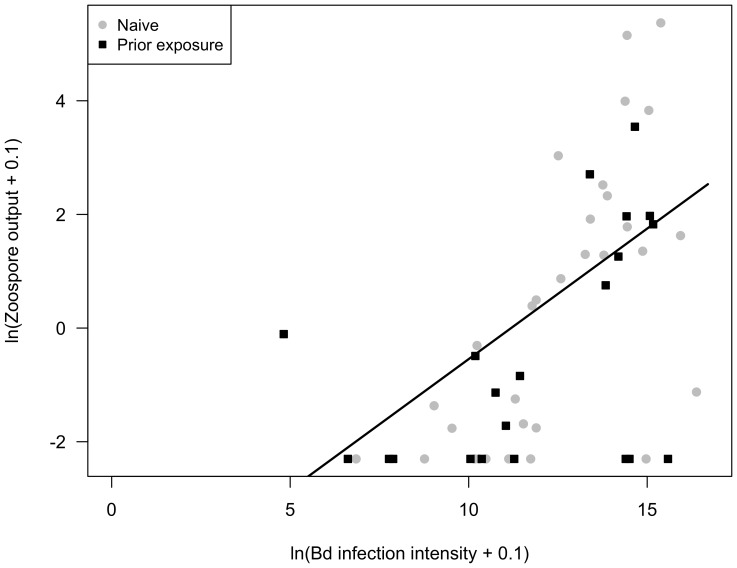
Amphibians vary in their response to infection by the amphibian-killing chytrid fungus, Batrachochytrium dendrobatidis (Bd). Highly susceptible species are the first to decline and/or disappear once Bd arrives at a site. These competent hosts likely facilitate Bd proliferation because of ineffective innate and/or acquired immune defenses. We show that Atelopus zeteki, a highly susceptible species that has undergone substantial population declines throughout its range, rapidly and exponentially increases skin Bd infection intensity, achieving intensities that are several orders of magnitude greater than most other species reported. We experimentally infected individuals that were never exposed to Bd (n = 5) or previously exposed to an attenuated Bd strain (JEL427-P39; n = 3). Within seven days post-inoculation, the average Bd infection intensity was 18,213 zoospores (SE: 9,010; range: 0 to 66,928). Both average Bd infection intensity and zoospore output (i.e., the number of zoospores released per minute by an infected individual) increased exponentially until time of death (t50 = 7.018, p<0.001, t46 = 3.164, p = 0.001, respectively). Mean Bd infection intensity and zoospore output at death were 4,334,422 zoospores (SE: 1,236,431) and 23.55 zoospores per minute (SE: 22.78), respectively, with as many as 9,584,158 zoospores on a single individual. The daily percent increases in Bd infection intensity and zoospore output were 35.4% (SE: 0.05) and 13.1% (SE: 0.04), respectively. We also found that Bd infection intensity and zoospore output were positively correlated (t43 = 3.926, p<0.001). All animals died between 22 and 33 days post-inoculation (mean: 28.88; SE: 1.58). Prior Bd infection had no effect on survival, Bd infection intensity, or zoospore output. We conclude that A. zeteki, a highly susceptible amphibian species, may be an acute supershedder. Our results can inform epidemiological models to estimate Bd outbreak probability, especially as they relate to reintroduction programs.
两栖动物对致死性蛙壶菌(Batrachochytrium dendrobatidis,简称Bd)感染的反应各不相同。一旦Bd到达某个地点,高度易感物种会率先数量下降和/或消失。由于先天和/或后天免疫防御无效,这些易感宿主可能会促进Bd的增殖。我们发现,巴拿马金蛙(Atelopus zeteki)是一种高度易感物种,其种群数量在整个分布范围内都大幅下降,它的皮肤Bd感染强度会迅速呈指数级增加,达到的强度比其他大多数已报道物种高出几个数量级。我们对从未接触过Bd的个体(n = 5)或之前接触过减毒Bd菌株(JEL427 - P39;n = 3)进行了实验性感染。接种后七天内,平均Bd感染强度为18,213个游动孢子(标准误:9,010;范围:0至66,928)。平均Bd感染强度和游动孢子产量(即受感染个体每分钟释放的游动孢子数量)在死亡前均呈指数级增加(分别为t50 = 7.018,p<0.001;t46 = 3.164,p = 0.001)。死亡时的平均Bd感染强度和游动孢子产量分别为4,334,422个游动孢子(标准误:1,236,431)和每分钟23.55个游动孢子(标准误:22.78),单个个体上的游动孢子数量多达9,584,158个。Bd感染强度和游动孢子产量的每日增加百分比分别为35.4%(标准误:0.05)和13.1%(标准误:0.04)。我们还发现Bd感染强度和游动孢子产量呈正相关(t = 3.926,p<0.001)。所有动物在接种后22至33天内死亡(平均:28.88;标准误:1.58)。先前的Bd感染对存活、Bd感染强度或游动孢子产量没有影响。我们得出结论,巴拿马金蛙这种高度易感的两栖动物物种可能是急性超级传播者。我们的结果可为流行病学模型提供信息,以估计Bd爆发的概率,特别是与重新引入计划相关的概率。