Swiss Tropical and Public Health Institute, Basel, Switzerland; University of Basel, Basel, Switzerland.
Swiss Tropical and Public Health Institute, Basel, Switzerland; FAIRMED Africa Regional Office, Yaoundé, Cameroon.
PLoS Negl Trop Dis. 2014 Mar 27;8(3):e2756. doi: 10.1371/journal.pntd.0002756. eCollection 2014 Mar.
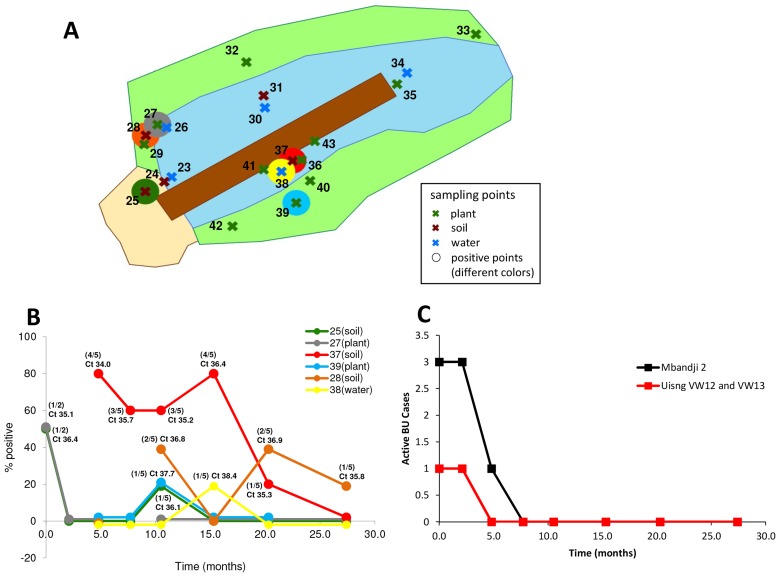
Buruli ulcer (BU), a neglected tropical disease of the skin and subcutaneous tissue, is caused by Mycobacterium ulcerans and is the third most common mycobacterial disease after tuberculosis and leprosy. While there is a strong association of the occurrence of the disease with stagnant or slow flowing water bodies, the exact mode of transmission of BU is not clear. M. ulcerans has emerged from the environmental fish pathogen M. marinum by acquisition of a virulence plasmid encoding the enzymes required for the production of the cytotoxic macrolide toxin mycolactone, which is a key factor in the pathogenesis of BU. Comparative genomic studies have further shown extensive pseudogene formation and downsizing of the M. ulcerans genome, indicative for an adaptation to a more stable ecological niche. This has raised the question whether this pathogen is still present in water-associated environmental reservoirs. Here we show persistence of M. ulcerans specific DNA sequences over a period of more than two years at a water contact location of BU patients in an endemic village of Cameroon. At defined positions in a shallow water hole used by the villagers for washing and bathing, detritus remained consistently positive for M. ulcerans DNA. The observed mean real-time PCR Ct difference of 1.45 between the insertion sequences IS2606 and IS2404 indicated that lineage 3 M. ulcerans, which cause human disease, persisted in this environment after successful treatment of all local patients. Underwater decaying organic matter may therefore represent a reservoir of M. ulcerans for direct infection of skin lesions or vector-associated transmission.
布鲁里溃疡(BU)是一种皮肤和皮下组织的被忽视的热带病,由溃疡分枝杆菌引起,是继结核和麻风之后的第三大常见分枝杆菌病。尽管该疾病的发生与停滞或缓慢流动的水体有很强的关联,但 BU 的具体传播方式尚不清楚。溃疡分枝杆菌从环境中的鱼类病原体海分枝杆菌中通过获得编码产生细胞毒性大环内酯毒素(mycolactone)所需酶的毒力质粒而出现,mycolactone 是 BU 发病机制中的一个关键因素。比较基因组研究进一步表明,溃疡分枝杆菌基因组广泛出现假基因形成和缩小,表明其适应了更稳定的生态位。这就提出了一个问题,即这种病原体是否仍然存在于与水相关的环境储层中。在这里,我们在喀麦隆一个流行村的 BU 患者的一个水接触点,显示了在两年多的时间里,M. ulcerans 特定 DNA 序列的持续存在。在村民用于洗涤和沐浴的浅水坑的定义位置,污垢中始终存在 M. ulcerans DNA 的阳性检测结果。插入序列 IS2606 和 IS2404 之间观察到的平均实时 PCR Ct 差异为 1.45,这表明引起人类疾病的 3 型 M. ulcerans 在所有当地患者成功治疗后,在这种环境中持续存在。因此,水下腐烂的有机物质可能是 M. ulcerans 的一个储层,可直接感染皮肤损伤或通过媒介物相关传播。