University of Tennessee, Knoxville, Tennessee, USA.
PLoS Negl Trop Dis. 2012 Jan;6(1):e1506. doi: 10.1371/journal.pntd.0001506. Epub 2012 Jan 31.
Mycobacterium ulcerans is the causative agent of Buruli ulcer (BU). In West Africa there is an association between BU and residence in low-lying rural villages where aquatic sources are plentiful. Infection occurs through unknown environmental exposure; human-to-human infection is rare. Molecular evidence for M. ulcerans in environmental samples is well documented, but the association of M. ulcerans in the environment with Buruli ulcer has not been studied in West Africa in an area with accurate case data.
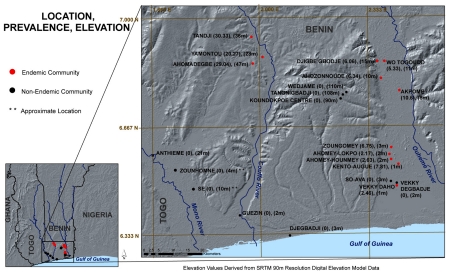
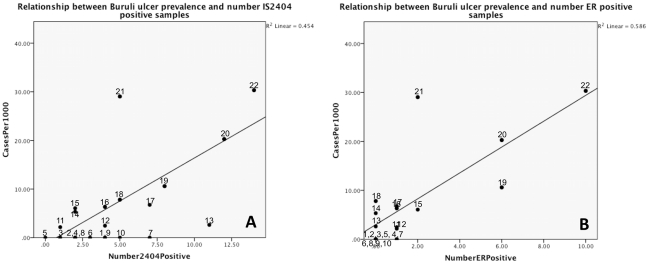
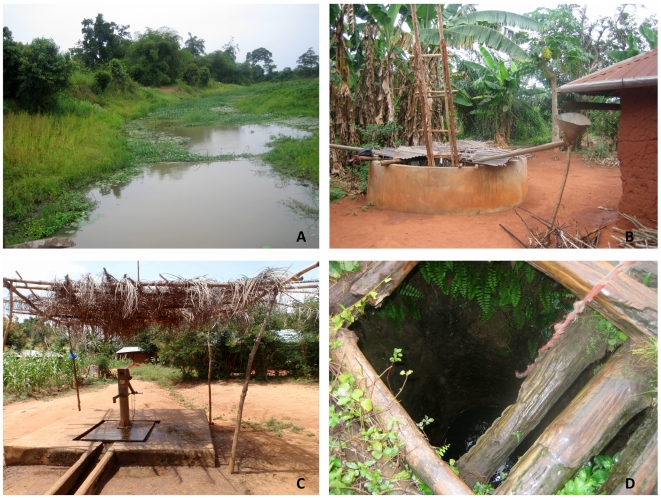
METHODOLOGY/PRINCIPAL FINDING: Environmental samples were collected from twenty-five villages in three communes of Benin. Sites sampled included 12 BU endemic villages within the Ouheme and Couffo River drainages and 13 villages near the Mono River and along the coast or ridge where BU has never been identified. Triplicate water filtrand samples from major water sources and samples from three dominant aquatic plant species were collected. Detection of M. ulcerans was based on quantitative polymerase chain reaction. Results show a significant association between M. ulcerans in environmental samples and Buruli ulcer cases in a village (p = 0.0001). A "dose response" was observed in that increasing numbers of M. ulceran- positive environmental samples were associated with increasing prevalence of BU cases (R(2) = 0.586).
CONCLUSIONS/SIGNIFICANCE: This study provides the first spatial data on the overlap of M. ulcerans in the environment and BU cases in Benin where case data are based on active surveillance. The study also provides the first evidence on M. ulcerans in well-defined non-endemic sites. Most environmental pathogens are more broadly distributed in the environment than in human populations. The congruence of M. ulcerans in the environment and human infection raises the possibility that humans play a role in the ecology of M. ulcerans. Methods developed could be useful for identifying new areas where humans may be at high risk for BU.
溃疡分枝杆菌是造成伯利兹溃疡(BU)的病原体。在西非,伯利兹溃疡与居住在水生资源丰富的低洼农村村庄有关。感染是通过未知的环境暴露引起的;人与人之间的感染很少见。环境样本中分枝杆菌溃疡的分子证据已有充分记录,但在具有准确病例数据的西非地区,环境中分枝杆菌溃疡与伯利兹溃疡之间的关联尚未得到研究。
方法/主要发现:从贝宁的三个公社的 25 个村庄采集了环境样本。采样地点包括乌赫梅和库福河流域的 12 个伯利兹溃疡流行村庄,以及莫诺河附近以及从未发现伯利兹溃疡的沿海或山脊上的 13 个村庄。从主要水源采集了三倍水滤膜样本,并采集了三种主要水生植物的样本。分枝杆菌溃疡的检测基于定量聚合酶链反应。结果表明,环境样本中的分枝杆菌溃疡与村庄中的伯利兹溃疡病例之间存在显著关联(p=0.0001)。观察到“剂量反应”,即越来越多的分枝杆菌溃疡阳性环境样本与伯利兹溃疡病例的患病率增加有关(R²=0.586)。
结论/意义:本研究提供了贝宁环境中分枝杆菌溃疡与伯利兹溃疡病例重叠的第一个空间数据,其中病例数据基于主动监测。该研究还提供了第一个关于明确非流行地区分枝杆菌溃疡的证据。大多数环境病原体在环境中的分布比在人类群体中更为广泛。环境中分枝杆菌溃疡与人类感染的一致性提出了人类可能在分枝杆菌溃疡的生态中发挥作用的可能性。开发的方法可能有助于确定人类可能处于伯利兹溃疡高风险的新地区。