Department of Clinical Biochemistry, Immunology and Genetics, Statens Serum Institut, Artillerivej 5, DK-2300 Copenhagen S, Denmark.
Clin Proteomics. 2014 Mar 29;11(1):12. doi: 10.1186/1559-0275-11-12.
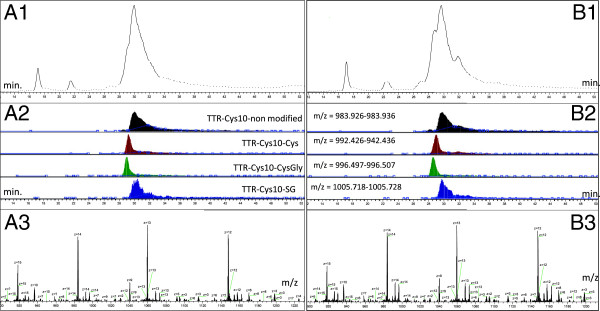
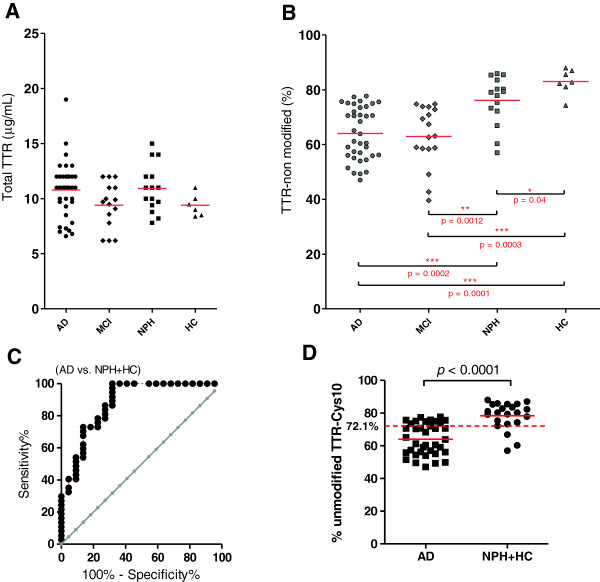
Transthyretin (TTR), an abundant protein in cerebrospinal fluid (CSF), contains a free, oxidation-prone cysteine residue that gives rise to TTR isoforms. These isoforms may reflect conditions in vivo. Since increased oxidative stress has been linked to neurodegenerative disorders such as Alzheimer's disease (AD) it is of interest to characterize CSF-TTR isoform distribution in AD patients and controls. Here, TTR isoforms are profiled directly from CSF by an optimized immunoaffinity-mass spectrometry method in 76 samples from patients with AD (n = 37), mild cognitive impairment (MCI, n = 17)), and normal pressure hydrocephalus (NPH, n = 15), as well as healthy controls (HC, n = 7). Fractions of three specific oxidative modifications (S-cysteinylation, S-cysteinylglycinylation, and S-glutathionylation) were quantitated relative to the total TTR protein. Results were correlated with diagnostic information and with levels of CSF AD biomarkers tau, phosphorylated tau, and amyloid β1-42 peptide.
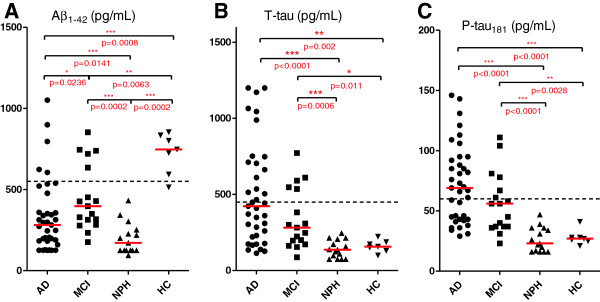
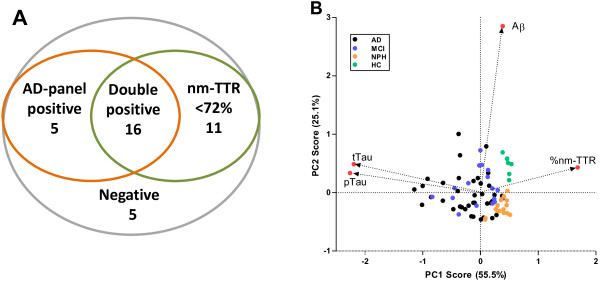
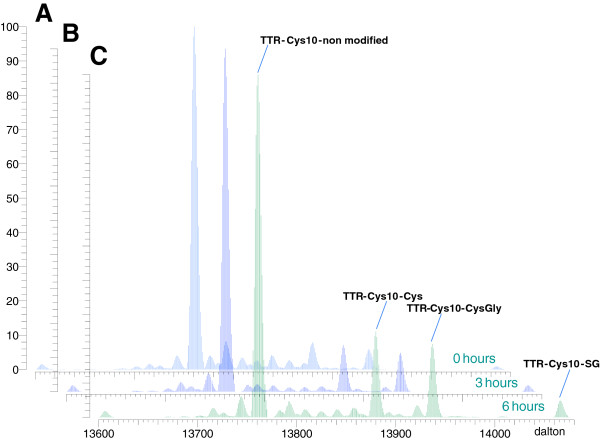
Preliminary data highlighted the high risk of artifactual TTR modification due to ex vivo oxidation and thus the samples for this study were all collected using strict and uniform guidelines. The results show that TTR is significantly more modified on Cys(10) in the AD and MCI groups than in controls (NPH and HC) (p ≤ 0.0012). Furthermore, the NPH group, while having normal TTR isoform distribution, had significantly decreased amyloid β peptide but normal tau values. No obvious correlations between levels of routine CSF biomarkers for AD and the degree of TTR modification were found.
AD and MCI patients display a significantly higher fraction of oxidatively modified TTR in CSF than the control groups of NPH patients and HC. Quantitation of CSF-TTR isoforms thus may provide diagnostic information in patients with dementia symptoms but this should be explored in larger studies including prospective studies of MCI patients. The development of methods for simple, robust, and reproducible inhibition of in vitro oxidation during CSF sampling and sample handling is highly warranted. In addition to the diagnostic information the possibility of using TTR as a CSF oxymeter is of potential value in studies monitoring disease activity and developing new drugs for neurodegenerative diseases.
转甲状腺素蛋白(TTR)是脑脊液(CSF)中丰富的蛋白质,含有一个易氧化的游离半胱氨酸残基,由此产生 TTR 同工型。这些同工型可能反映了体内的情况。由于氧化应激的增加与阿尔茨海默病(AD)等神经退行性疾病有关,因此研究 AD 患者和对照组 CSF-TTR 同工型分布情况很有意义。在这里,通过优化的免疫亲和质谱法,在 76 例 AD 患者(n = 37)、轻度认知障碍(MCI,n = 17)、正常压力脑积水(NPH,n = 15)和健康对照组(HC,n = 7)的 CSF 中直接对 TTR 同工型进行了分析。相对于总 TTR 蛋白,定量了三种特定氧化修饰(S-半胱氨酸化、S-半胱氨酰甘氨酸化和 S-谷胱甘肽化)的分数。结果与诊断信息以及 CSF AD 生物标志物 tau、磷酸化 tau 和淀粉样β1-42 肽的水平相关联。
初步数据突出表明,由于体外氧化,TTR 修饰存在很高的人为风险,因此本研究的所有样品均采用严格和统一的指南进行收集。结果表明,与对照组(NPH 和 HC)相比,AD 和 MCI 组的 TTR 在 Cys10 上的修饰显著增加(p ≤ 0.0012)。此外,虽然 NPH 组的 TTR 同工型分布正常,但淀粉样β肽明显减少,而 tau 值正常。未发现 CSF AD 常规生物标志物水平与 TTR 修饰程度之间存在明显相关性。
AD 和 MCI 患者的 CSF 中氧化修饰的 TTR 比例明显高于 NPH 患者和 HC 对照组。定量 CSF-TTR 同工型可能为有痴呆症状的患者提供诊断信息,但这应在包括 MCI 患者前瞻性研究在内的更大研究中进行探索。非常需要开发用于简单、稳健和可重复抑制 CSF 采样和样品处理过程中体外氧化的方法。除了诊断信息外,TTR 作为 CSF 血氧计的可能性在监测疾病活动和开发神经退行性疾病新药物的研究中具有潜在价值。