Endocrine Surgery Research Laboratories, Department of Surgery, University of Wisconsin School of Medicine and Public Health, Madison, Wisconsin.
Department of Biological Sciences, University of Wisconsin-Milwaukee, Milwaukee, Wisconsin.
J Surg Res. 2014 Jul;190(1):191-7. doi: 10.1016/j.jss.2014.02.042. Epub 2014 Feb 28.
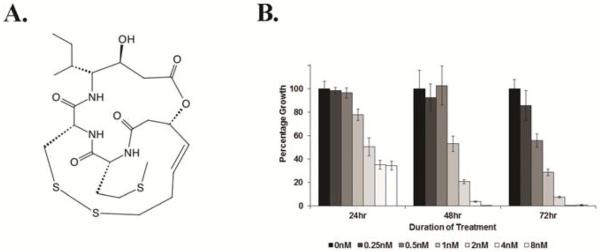
Anaplastic thyroid cancer (ATC) remains refractory to available surgical and medical interventions. Histone deacetylase (HDAC) inhibitors are an emerging targeted therapy with antiproliferative activity in a variety of thyroid cancer cell lines. Thailandepsin A (TDP-A) is a novel class I HDAC inhibitor whose efficacy remains largely unknown in ATC. Therefore, we aimed to characterize the effect of TDP-A on ATC.
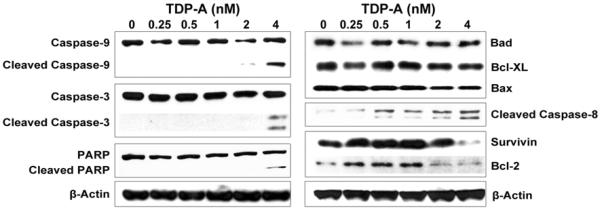
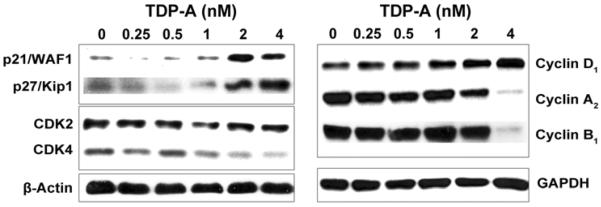
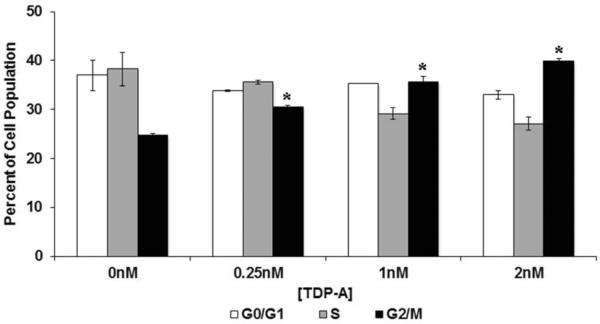
Human-derived ATC cells were treated with TDP-A. IC50 was determined by a 3-(4,5-dimethylthiazol-2-yl)-2,5-diphenyltetrazolium bromide (MTT) rapid colorimetric assay, and cell proliferation was measured by viable cell count. Molecular mechanisms of cell growth inhibition were investigated by Western blot analysis of canonical apoptosis markers, intrinsic and extrinsic apoptosis regulators, and cell cycle regulatory proteins. Cell cycle staging was determined with propidium iodide flow cytometry.
TDP-A dose- and time-dependently reduced cell proliferation. Increased cleavage of the apoptosis markers Caspase-9, Caspase-3, and poly adenosine diphosphate ribose polymerase were observed with TDP-A treatment. Levels of the intrinsic apoptosis pathway proteins BAD, Bcl-XL, and BAX remained unchanged. Importantly, the extrinsic apoptosis activator cleaved Caspase-8 increased dose-dependently, and the antiapoptotic proteins Survivin and Bcl-2 decreased. Among the cell cycle regulatory proteins, levels of CDK inhibitors p21/WAF1 and p27/KIP increased. Flow cytometry showed that ATC cells were arrested in G2/M phase with diminished S phase after TDP-A treatment.
TDP-A induces a notable dose- and time-dependent antiproliferative effect on ATC, which is mainly attributed to extrinsic apoptosis with concomitant cell cycle arrest. TDP-A therefore warrants further preclinical and clinical investigations.
间变性甲状腺癌(ATC)仍然对现有手术和医学干预措施具有抗性。组蛋白去乙酰化酶(HDAC)抑制剂是一种新兴的靶向治疗药物,在多种甲状腺癌细胞系中具有抗增殖活性。泰国春砂素 A(TDP-A)是一种新型的 I 类 HDAC 抑制剂,其在 ATC 中的疗效仍知之甚少。因此,我们旨在研究 TDP-A 对 ATC 的作用。
用人源性 ATC 细胞进行 TDP-A 处理。通过 3-(4,5-二甲基噻唑-2-基)-2,5-二苯基四氮唑溴盐(MTT)快速比色法测定 IC50,通过活细胞计数测定细胞增殖。通过 Western blot 分析典型凋亡标志物、内在和外在凋亡调节剂以及细胞周期调节蛋白来研究细胞生长抑制的分子机制。通过碘化丙啶流式细胞术确定细胞周期分期。
TDP-A 呈剂量和时间依赖性地降低细胞增殖。用 TDP-A 处理后观察到凋亡标志物 Caspase-9、Caspase-3 和多聚腺苷二磷酸核糖聚合酶的裂解增加。内在凋亡途径蛋白 BAD、Bcl-XL 和 BAX 的水平保持不变。重要的是,外在凋亡激活剂裂解 Caspase-8 呈剂量依赖性增加,抗凋亡蛋白 Survivin 和 Bcl-2 减少。在细胞周期调节蛋白中,CDK 抑制剂 p21/WAF1 和 p27/KIP 的水平增加。流式细胞术显示 ATC 细胞在用 TDP-A 处理后被阻滞在 G2/M 期,S 期减少。
TDP-A 对 ATC 产生明显的剂量和时间依赖性的抗增殖作用,主要归因于外在凋亡和细胞周期阻滞。因此,TDP-A 值得进一步进行临床前和临床研究。