1] Department of Psychology, University of California, Berkeley, California, USA. [2] Department of Brain and Cognitive Sciences, Massachusetts Institute of Technology, Cambridge, Massachusetts, USA. [3] McGovern Institute for Brain Research, Massachusetts Institute of Technology, Cambridge, Massachusetts, USA.
1] Department of Psychology, University of California, Berkeley, California, USA. [2] Helen Wills Neuroscience Institute, University of California, Berkeley, California, USA. [3] Vision Science Group, University of California, Berkeley, California, USA.
Nat Neurosci. 2014 May;17(5):738-43. doi: 10.1038/nn.3689. Epub 2014 Mar 30.
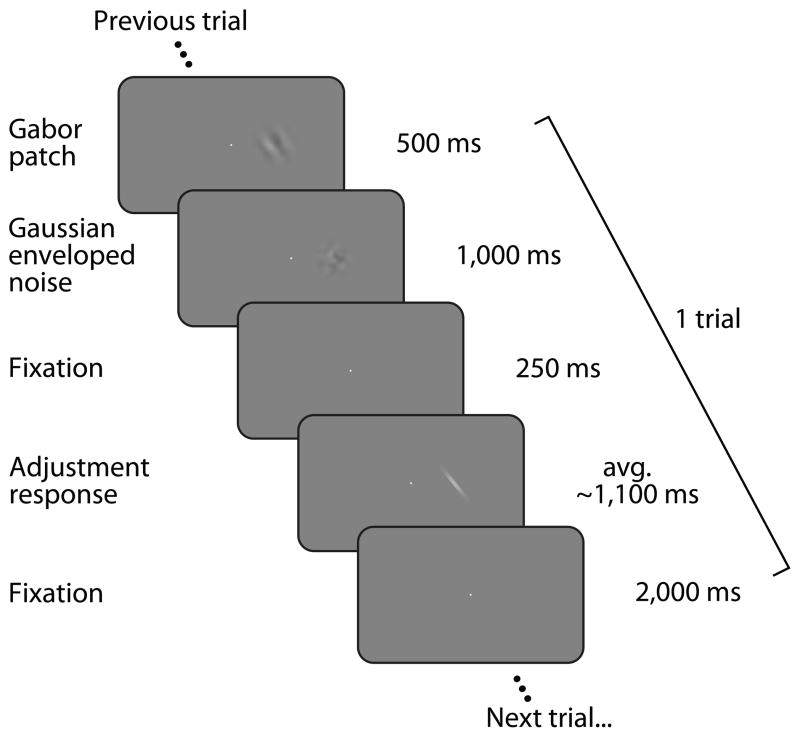
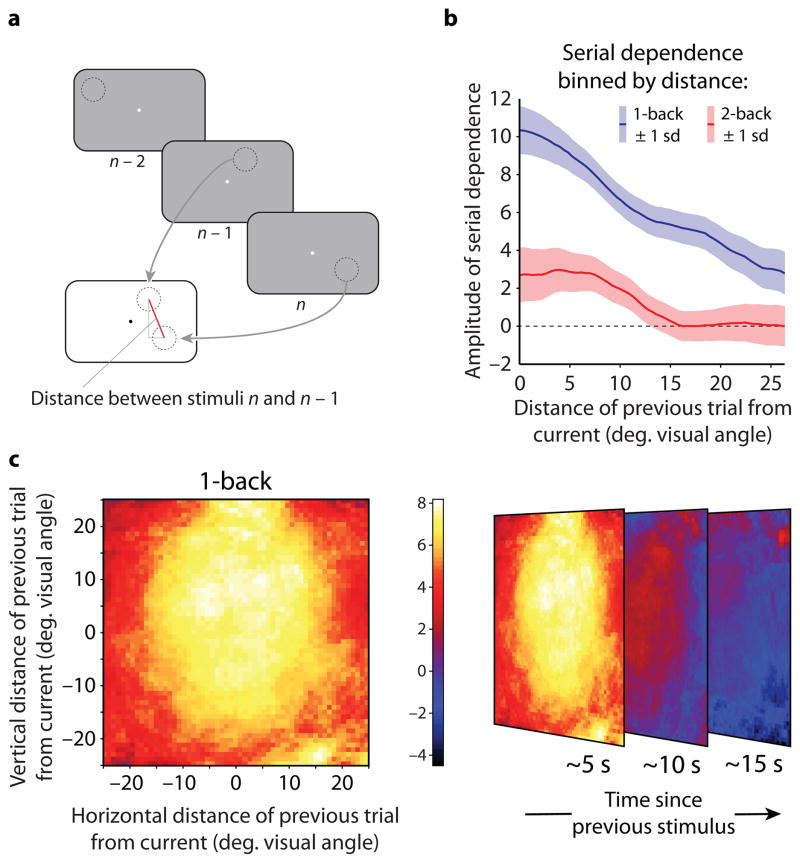
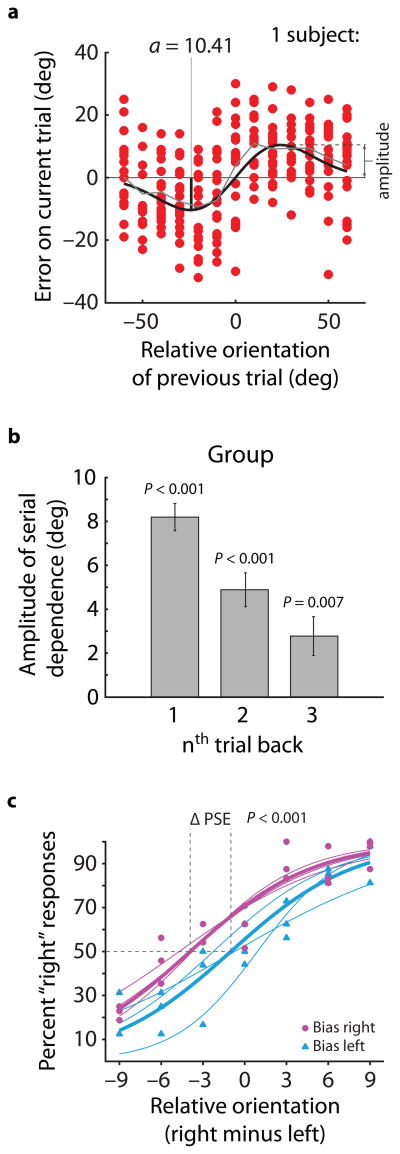
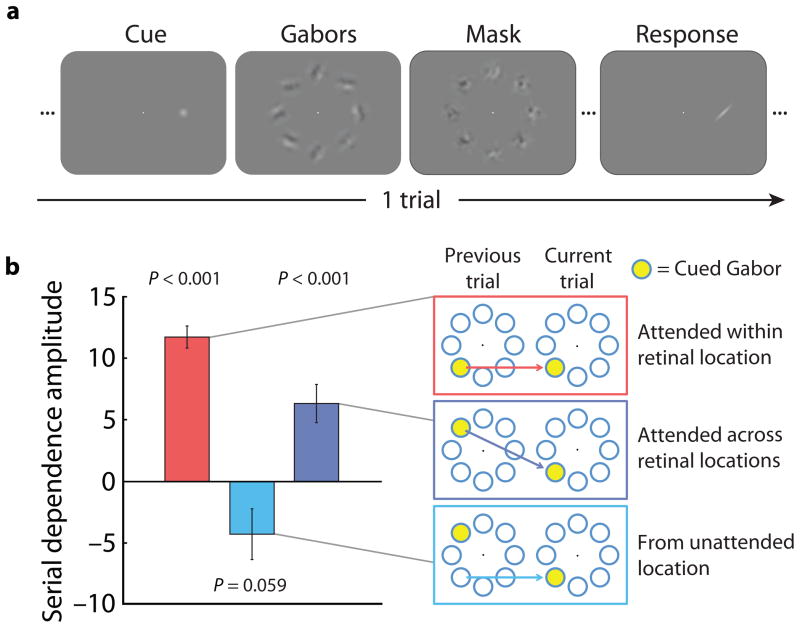
Visual input often arrives in a noisy and discontinuous stream, owing to head and eye movements, occlusion, lighting changes, and many other factors. Yet the physical world is generally stable; objects and physical characteristics rarely change spontaneously. How then does the human visual system capitalize on continuity in the physical environment over time? We found that visual perception in humans is serially dependent, using both prior and present input to inform perception at the present moment. Using an orientation judgment task, we found that, even when visual input changed randomly over time, perceived orientation was strongly and systematically biased toward recently seen stimuli. Furthermore, the strength of this bias was modulated by attention and tuned to the spatial and temporal proximity of successive stimuli. These results reveal a serial dependence in perception characterized by a spatiotemporally tuned, orientation-selective operator-which we call a continuity field-that may promote visual stability over time.
视觉输入通常是嘈杂和不连续的,这归因于头部和眼睛的运动、遮挡、光照变化以及许多其他因素。然而,物理世界通常是稳定的;物体和物理特征很少自发地变化。那么,人类视觉系统如何利用时间上的物理环境连续性呢?我们发现,人类的视觉感知是序列依赖的,既利用过去的输入,也利用当前的输入来告知当前的感知。使用方向判断任务,我们发现,即使视觉输入随时间随机变化,感知的方向也会强烈且系统地偏向于最近看到的刺激。此外,这种偏差的强度受注意力调节,并与连续刺激的空间和时间接近度相匹配。这些结果揭示了一种以时空调谐、方向选择性算子为特征的感知序列依赖性——我们称之为连续性场——它可能会促进视觉随时间的稳定性。