Hashemi Hassan, Pourzamani Hamidreza, Rahmani Samani Bahareh
Department of Environmental Health Engineering, Faculty of Health, Shahrekord University of Medical Sciences, Shahrekord 88157-13471, Iran.
Environment Research Center, Isfahan University of Medical Sciences, Isfahan 81676-36954, Iran.
J Environ Public Health. 2014;2014:230163. doi: 10.1155/2014/230163. Epub 2014 Feb 13.
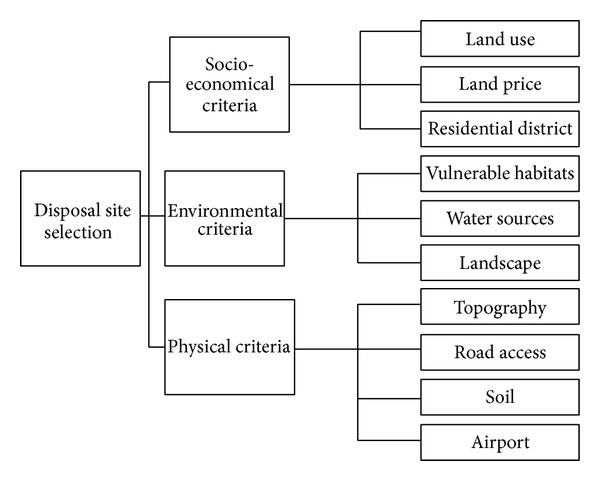
The aim of this study is the comprehensive planning for integrated management of solid waste at the industrial parks. The share of each industrial group including food, metal, chemical, non-metallic minerals, textile, electrical and electronical, and cellulose industries were 48.2, 14.9, 6.7, 22, 0.9, 0.6, and 6.5 percent, respectively. The results showed that nearly half of total industrial waste produced from the range of biological materials are biodegradable and discharging them without observing environmental regulations leads to short-term pollution and nuisance in the acceptor environment. Also some parts of case study waste were recyclable which is considerable from viewpoint of economical and environmental pollution. Long-term impacts will appear due to improper site selection of disposal from the spatial standpoint. In this way, an approach for site selection using several socioeconomic, physical, and environmental criteria based on multicriteria decision making model (MCDM) is introduced. Health risks and environment pollution such as soil and surface water may be done. It is essential to revise the studied industries layout, particularly those units which produce special waste which should be more cautious. Also stricter enforcement is required as an effective step in reducing the harmful impacts of it.
本研究的目的是对工业园区固体废物综合管理进行全面规划。食品、金属、化工、非金属矿物、纺织、电气和电子以及纤维素等各工业集团的占比分别为48.2%、14.9%、6.7%、22%、0.9%、0.6%和6.5%。结果表明,生物材料范围内产生的工业废物总量中近一半是可生物降解的,在不遵守环境法规的情况下排放这些废物会导致受体环境出现短期污染和滋扰。此外,案例研究废物的一些部分是可回收的,从经济和环境污染的角度来看这相当可观。从空间角度看,由于处置场地选择不当会产生长期影响。通过这种方式,引入了一种基于多准则决策模型(MCDM),使用若干社会经济、物理和环境标准进行场地选择的方法。可能会造成健康风险以及土壤和地表水等环境污染。必须修订所研究的产业布局,特别是那些产生特殊废物的单位,对此应更加谨慎。此外,需要更严格地执行规定,作为减少其有害影响的有效措施。