Ream Geoffrey L, Elliott Luther C, Dunlap Eloise
School of Social Work, Adelphi University, Garden City, NY, USA.
Institute for Special Populations Research, National Development and Research Institutes, New York, USA.
J Addict Res Ther. 2013 May 21;6:8.
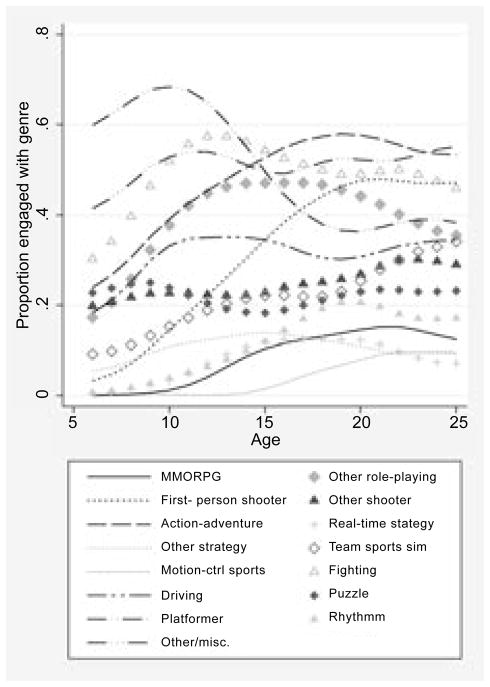
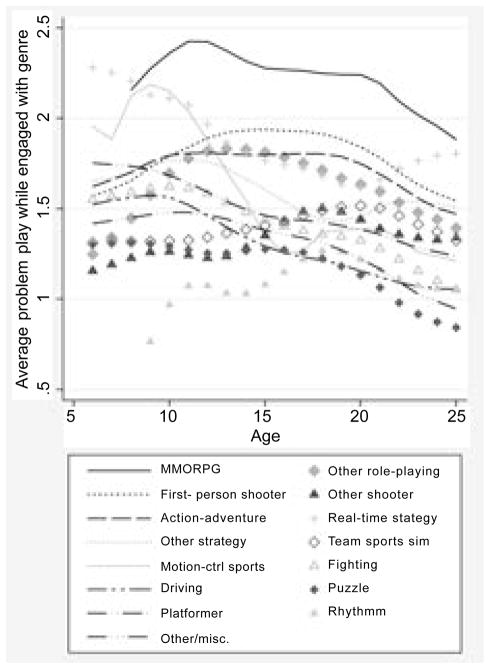
This study explored predictors of engagement with specific video game genres, and degree of problem play experienced by players of specific genres, during the early life course. Video game players ages 18-29 (n = 692) were recruited in and around video game retail outlets, arcades, conventions, and other video game related contexts in New York City. Participants completed a Computer-Assisted Personal Interview (CAPI) of contemporaneous demographic and personality measures and a Life-History Calendar (LHC) measuring video gaming, school/work engagement, and caffeine and sugar consumption for each year of life ages 6 - present. Findings were that likelihood of engagement with most genres rose during childhood, peaked at some point during the second decade of life, and declined through emerging adulthood. Cohorts effects on engagement also emerged which were probably attributable to changes in the availability and popularity of various genres over the 12-year age range of our participants. The relationship between age and problem play of most genres was either negative or non-significant. Sensation-seeking was the only consistent positive predictor of problem play. Relationships between other variables and engagement with and problem play of specific genres are discussed in detail.
本研究探讨了在生命早期阶段,参与特定电子游戏类型的预测因素,以及特定类型游戏玩家所经历的问题游戏程度。年龄在18至29岁之间的电子游戏玩家(n = 692)是在纽约市的电子游戏零售店、游乐场、展会及其他与电子游戏相关的场所及其周边招募的。参与者完成了一项计算机辅助个人访谈(CAPI),内容包括同期的人口统计学和性格测量,以及一份生活史日历(LHC),该日历测量了6岁至今每年的电子游戏、学校/工作参与情况以及咖啡因和糖分摄入量。研究结果表明,参与大多数游戏类型的可能性在童年时期上升,在生命的第二个十年中的某个时间点达到峰值,并在成年初期下降。同时也出现了队列效应,这可能归因于在我们参与者12年的年龄范围内,各种游戏类型的可获得性和受欢迎程度的变化。大多数游戏类型的年龄与问题游戏之间的关系要么是负相关,要么不显著。寻求刺激是问题游戏唯一一致的正向预测因素。文中详细讨论了其他变量与参与特定游戏类型以及问题游戏之间的关系。